chem 2125 final exam study guide
 Call Kai
 Learn
 Practice Test
 Spaced Repetition
 Match
 Flashcards
 Knowt Play
1/38

Earn XP
Description and Tags
god save us all. labs covered so far: 25, 23, 18-B, 18, 17, 26
39 Terms
provide the mechanism for the acid-catalyzed hydrolysis of methyl benzoate into benzoic acid

provide the reaction for the esterification of salicylic acid to form salicylate

what is the formula for finding percent yield?
actual yield/theoretical yield * 100%
what aroma could be smelled when a smell test was performed on the esterification product of salicylic acid?
wintergreen/mint.
a student is performing the esterification of salicylic acid and their product ended up clumpy and somewhat solid like. what error most likely transpired? what should the product ideally look like?
unreacted salicylic acid remained as a result of rushed precipitation/insufficient alcohol (which should have been in excess)/insufficient heating
the product should look like a foggy liquid/oil
while running a TLC sheet during the esterification of salicylic acid experiment, a student spotted salicylic acid and noticed some streaking when the plate was analyzed.
the student proposed redoing the experiment to their TA, but the TA said this is not necessary. why?
streaking for acids like salicylic acid is normal/expected, as salicylic acid is strongly polar and therefore drags on the polar silica gel to create streaking
what is the purpose of washing the organic layer with sodium bicarbonate during the esterification of salicylic acid experiment?
the sodium bicarbonate reacts with remaining acids to form a water-soluble compound, getting rid of any unwanted impurities.
what is the purpose of washing the organic layer with sodium chloride during the esterification of salicylic acid experiment?
it helps separate the aqueous layer from the organic layer due to its salt nature
what is the purpose of washing the organic layer with anhydrous calcium chloride during the esterification of salicylic acid experiment?
it helps dry the compound and remove any excess water
carbons that give very small peaks on C13 nmr most likely have what quality in common?
they are not bonded to any neighboring hydrogens, only carbons.
what is the advantage of performing witting synthesis over dehydrohalogenation reaction? explain
wittig synthesis has a high level of regioselectivity, preventing a mix of structural isomers seen with dehydrohalogenation
what was the limiting reagent in the witting synthesis of trans-9-(2-phenylethenyl)anthracene?
benzyltriphenyl
provide the reaction for the witting synthesis of trans-9-(2-phenylethenyl)anthracene

KNOW HOW TO NORMALIZE AN NMR, ADD RXN MECHANISMS
what precautions should be taken when working with phenacetin?
phenacetin is a suspected carcinogen, so proper PPE should be worn to avoid contact/ingestion
what is the function of the sodium acetate in the amide synthesis of phenacetin?
it provides a buffer for the solution, helping maintain pH and stopping the amide functional group into becoming a salt
draw the reaction for the amide synthesis of phenacetin. include starting material, reagents, temperature, time, and product
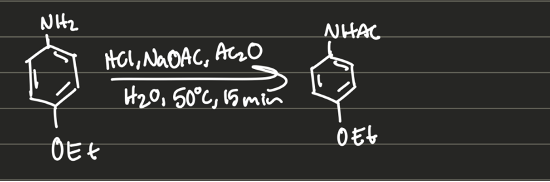
how is finding mixture melting point helpful for identity of the product?
it helps confirm whether products made are identical. if identical, the mixture melting point should closely match the literature one, if not, there will be a sliceable difference
regardless of the amide or Williamson ether synthesis of phenacetin, the properties of phenacetin still remained the same. how can this be explained?
it does not matter the synthesis pathway taken, but a product’s characteristics should always still be identical.
why is using the right amount of methoxide in the Williamson ether synthesis of phenacetin important? explain
if insufficient amount is used, not all of the p-acetamidophenol is converted into its conjugate base and reacts with bromoethane, leading to lower yield.
if too much is used, excess methoxide ions will compete with p-acetamidophenoxide as a nucleophile and reduce phenacetin yield
a student is performing phenacetin synthesis and their product begins to “oil out.” how can this be corrected?
oiling out can be corrected by adding more ethanol and heat to redissolve, then cooling the solution again
GET RXN FOR EXP 18
what could potentially be the cause of each of these IR peaks?
3300
1653
1244
837
In order:
N-H
C=O
C-O-C (ether/ester) bonds
Para-disubstituted benzene
what safety precautions must be observed when using ethyl acetate?
ethyl acetate eis flammable and irritating, so it shoudln’t be used near flames or heat sources and you need to wear PPE
what safety precautions should be observed with dichloromethane?
dichloromethane is toxic and irritating. wear ppe, don’t inhale
what IR range is associated with ortho substituted? meta? para?
735-770 for ortho, 680-725 and 750-810 for meta, 800-840 for para
why is a phase transfer catalyst needed in the oxidation of methoxybenzyl alcohol using NaOCl?
the starting alcohol is only soluble in organic solvents but not in water, while NaOCl is only soluble in water and not organic solvents. this phase transfer catalyst acts as a shuttle and moves back and forth between the aqueous and organic layer to oxidize the alcohol
what major peak is present in methoxybenzyl alcohol but absent in aldehyde?
characteristic alcohol peak found at 3400 on IR.
what hazards are associated with ethyl ether?
ethyl ether is flammable,t toxic, and must be kept away from any heat source. wear proper PPE
what hazards are associated with sodium methoxide?
sodium methoxide is flammable, toxic, and corrosive, and must be kept from other heat sources. wear proper PPE
provide the reaction for aldol and michael


what were some differences found between the IR of the aldol and Michael products? similarities? use the image to help
the aldol and Michael product differ, as Michael has para-isomer reading, aromatic C=C readings, and sp2-hybridized readings slightly higher than 3000, while the aldol does not
similarities include: sp3-hybridized carbon reading, C=O 1650-1750 reading, multiple 1000-1300 peaks (C-O reading) indicating ester/ether
provide the name and melting point of the aldol and Michael products
aldol = dianisalacetone, mp = 130. Michael = dimethyl 2,6-bis(p-methoxyphenyl)-4-oxocyclohexane-1,1-dicarboxylate, mp = 194
draw an equation for the reaction of butylamine and hydrochloric acid

draw a reaction between benzodiazonium chloride and potassium iodide
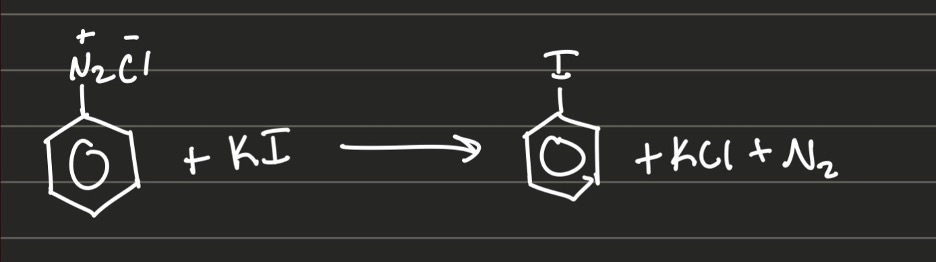
which is the stronger base: butylamine or aniline?
butylamine is stronger because of the electron density provided by the alkyl group to the nitrogen atom. it is less resonance stabilized than aniline
give the equation for the reactions used in the properties of amines experiment

what is the melting point of p-iodonitrobenzene?
171-174 degrees celsius
have an unshared pair of electrons on their nitrogen and act as bases, nucleophiles, etc. form salts with acids and coordination complexes with metal cations.