Patho Exam 4

0.0(0)
Studied by 0 people
call kaiCall Kai
learnLearn
examPractice Test
spaced repetitionSpaced Repetition
heart puzzleMatch
flashcardsFlashcards
GameKnowt Play
Card Sorting

1/13

encourage image

There's no tags or description

Looks like no tags are added yet.

14 Terms

1
New cards

Renal/kidney system

Nephrons: the functional units of the kidneys.

Receive a large amount of blood flow (perfusion)

Outside the peritoneal space (protection)

Functions:

  1. Regulate osmolarity

  2. Long-term acid–base balance

  3. Secrete erythropoietin for RBC production.

  4. Protein-free urine containing water, electrolytes, and waste.


<p>Nephrons: the functional units of the kidneys.</p><p>Receive a large amount of blood flow (perfusion)</p><p>Outside the peritoneal space (protection)</p><p>Functions:</p><ol><li><p>Regulate osmolarity</p></li><li><p>Long-term acid–base balance</p></li><li><p>Secrete erythropoietin for RBC production.</p></li><li><p>Protein-free urine containing water, electrolytes, and waste.</p></li></ol><p></p>
2
New cards

Renal Blood Supply

Afferent Ateriole: blood → Nephrons in each kidney; enters the glomerulus and has a larger diameter (bigger); controls blood flow and pressure in the glomerulus

Efferent Arteriole: Exits, smaller; contains all the blood, solutes, and water that were not filtered and return to the circulation; it’s an arteriole; ability to constrict or dilate, allowing for continuous glomerular capillary pressure

Glomerulus: hydrostatic pressure, by the difference in diameters

Blood plasma in the afferent arterioles that ends up as glomerular filtrate is known as filtration fraction: 16-20%

<p><strong>Afferent Ateriole</strong>: blood → Nephrons in each kidney; enters the glomerulus and has a <strong>larger diameter (bigger)</strong>; controls blood flow and pressure in the glomerulus</p><p><strong>Efferent Arteriole</strong>: Exits, smaller; contains all the blood, solutes, and water that were not filtered and return to the circulation; it’s an arteriole; ability to constrict or dilate, allowing for continuous glomerular capillary <u>pressure</u></p><p>Glomerulus: <u>hydrostatic pressure</u>, by the difference in diameters</p><p>Blood plasma in the afferent arterioles that ends up as glomerular filtrate is known as <strong>filtration fraction</strong>: 16-20%</p>
3
New cards

Nephrons

Functional unit of the kidney: cleanse blood, filtrate → urine through filtration, reabsorption, and secretion (make and release), and excretion (release) FRSE

Can’t regenerate; adults lose 10% of their nephrons for each decade after 40 years

Cortical nephrons - short, thick loops of Henle, excretory/secretion/reabsoprtion

Juxtamedullary - larger and longer, thinner loops of Henle, primary site of urine concentration or dilution

<p><u>Functional unit of the kidney</u>: cleanse blood, filtrate → urine through <strong>filtration, reabsorption, and secretion (make and release), and excretion (release) FRSE</strong></p><p>Can’t regenerate; adults lose 10% of their nephrons for each decade after 40 years</p><p><strong>Cortical nephrons</strong> - short, thick loops of Henle,<u> excretory/secretion/reabsoprtion </u></p><p><strong>Juxtamedullary</strong> - larger and longer, thinner loops of Henle, primary site of urine <u>concentration or dilution</u></p>
4
New cards

Glomerulus

First step in filtration → Capillary membrane (Highest filtration rate)

Fenestrated capillary endothelium - 50% more permeable to water and solutes than other capillary beds; pores in the endothelial cells allow small molecules to pass through quickly/easily, but larger particles are prevented

Basement membrane → Epithelial foot processes

Allows substances to diffuse based on size: water, glucose, urea, ions like sodium and potassium <4 nanometers) cross.

The kidneys hold on to blood, proteins, albumin (large particles)

If urine contains RBCs or proteins: There is a problem with the kidney; dilation - bigger cells now get through to urine

<p>First step in filtration → Capillary membrane (Highest filtration rate)</p><p><strong>Fenestrated capillary endothelium</strong> - 5<u>0% more permeable to water and solutes than other capillary beds; pores</u> in the <u>endothelial cells</u> allow small molecules to pass through quickly/easily, but larger particles are prevented </p><p>Basement membrane → Epithelial foot processes</p><p>Allows substances to diffuse based on size: water, glucose, urea, ions like sodium and potassium &lt;4 nanometers) cross.</p><p>The kidneys hold on to blood, proteins, albumin (large particles)</p><p>If urine contains RBCs or proteins: There is a problem with the kidney; dilation - bigger cells now get through to urine</p>
5
New cards

Glomerular Filtration Rate + Bowmans Capsule

Glomerular Filtration Rate (GFR): 90-125 mL/min, finely controlled

men = 180 L/day

women = 150 L/day

GFR too high? Needed substances would rush through the renal tubules, lost in the urine, not reabsorbed.

Bowman's capsule - surrounds the glomerulus and is a double-walled space, inner visceral and outer parietal layers; Bowman’s space is the space inside Bowman’s capsule

<p><strong>Glomerular Filtration Rate (GFR)</strong>: <strong>90-125 mL/min</strong>, finely controlled</p><p><strong>men = 180 L/day</strong></p><p><strong>women = 150 L/day</strong></p><p>GFR too high? Needed substances would rush through the renal tubules, lost in the urine, not reabsorbed.</p><p><strong>Bowman's capsule</strong> - surrounds the glomerulus and is a double-walled space, inner visceral and outer parietal layers; <strong>Bowman’s space</strong> is the space inside Bowman’s capsule</p>
6
New cards

Proximal tubule → Loop of Henle → Distal Tubule → Collecting Duct

Reabsorption begins as soon as filtrate enters the proximal tubule; reabsorption returns 99% of all filtrate back to the bloodstream

  • Water, sodium, glucose, amino acids, K, HCO3, calcium, and phosphorus vary; most foreign substances are excreted

  • Thin descending limb: highly permeable to water, impermeable to ions; large amount of water is reabsorbed back into circulation; becomes increasingly concentrated; isotonic

  • Thick Ascending limb: impermeable to water, highly permeable to ions; returns to circulation the remaining solutes; mitochondria powerhouse of the Loop of Henle (Less osmotic, more dilute); pumps NaCl out but not water, becomes increasingly dilute; hypertonic

Fluid is not more dilute than when it came to the loop of Henle: Hypotonic

Ischemic state, no oxygen, Loop of Henle: no sodium/chlorid pump, lower BP, no sodium to hold onto water

Distal tubule: water reabsorption by ADH, sodium by aldosterone.

Collecting duct: reabsorbs solutes and water; ADH from filtrate

<p>Reabsorption begins as soon as filtrate enters the <strong>proximal tubule</strong>; reabsorption returns <u>99%</u> of all filtrate back to the bloodstream</p><ul><li><p>Water, sodium, glucose, amino acids, K, HCO3, calcium, and phosphorus vary; most foreign substances are excreted</p></li></ul><ul><li><p><strong>Thin descending limb</strong>: highly permeable to water, impermeable to ions; large amount of water is reabsorbed back into circulation; becomes increasingly concentrated<span style="background-color: transparent; font-size: 1.6rem;">;&nbsp;</span><strong>isotonic</strong></p></li><li><p><strong>Thick Ascending limb</strong>: impermeable to water, highly permeable to ions; returns to circulation the remaining solutes;<strong> mitochondria powerhouse</strong> of the Loop of Henle (Less osmotic, more dilute); pumps NaCl out but not water, becomes increasingly dilute; <strong>hypertonic</strong></p></li></ul><p>Fluid is not more dilute than when it came to the loop of Henle: <strong>Hypotonic</strong></p><p>Ischemic state, no oxygen, Loop of Henle: no sodium/chlorid pump, lower BP, no sodium to hold onto water</p><p>Distal tubule: water reabsorption by ADH, sodium by aldosterone.</p><p>Collecting duct: reabsorbs solutes and water; ADH from filtrate</p>
7
New cards

Inherited Polycystic Kidney Disorders

Polycystic kidney disease: fluid-filled sacs or segments that arise from the tubules

Autosomal Dominant Polycystic Kidney Disease (One parent gene)

Adult polycystic kidney disease - large bilateral fluid-filled cysts in the kidneys; kidney function slowly declines, diagnosed based on:

1) Family History

2) Total Kidney volume

3) Ultrasound (30 years)

Physical Assessment findings: HTN, activates renin (thinks there is less blood flow), holds onto water and sodium, pain, hematuria, cerebral aneurysm (headaches)

Management: Drink water, low-sodium diet, control HTN, aneurysm screening

<p><strong>Polycystic kidney disease</strong>: fluid-filled sacs or segments that arise from the tubules</p><p><strong>Autosomal Dominant Polycystic Kidney Disease</strong> (One parent gene)</p><p><strong>Adult polycystic kidney disease</strong> - large bilateral fluid-filled cysts in the kidneys; kidney function slowly declines, diagnosed based on:</p><p>1) Family History</p><p>2) Total Kidney volume</p><p>3) Ultrasound  (30 years)</p><p>Physical Assessment findings: HTN, activates renin (thinks there is less blood flow), holds onto water and sodium, pain, hematuria, <u>cerebral aneurysm</u> (headaches)</p><p>Management: Drink water, low-sodium diet, control HTN, aneurysm screening</p>
8
New cards

Autosomal Recessive Polycystic Kidney Disease (Both parents)

Infant PKD is diagnosed so early in life that the lungs never mature

Mortality is 30% within the first week of life → if the child survives the first few weeks of life → good chance of surviving into adulthood (No cure, respiratory therapy, salt restriction, diuretics for edema, dialysis)

9
New cards

Renal Calculi

Stones can form anywhere in the urinary tract; they are the most common cause of upper urinary tract obstruction.

Urine crystallizes to form stones; inadequate hydration and low urine volume; CT scan or non-high molecular weight

  1. Calcium Oxalate: most common, higher calcium, lower citrate (stone inhibitor & magnesium). Oxalate foods → in plants and animals, beets, black tea, chocolate, nuts, potatoes, and spinach; immobility; bone disease, urinary pH <7.2 acidic environment); treatment: diuretic and citrate

  2. Calcium phosphate stones: urinary pH is alkaline

  3. Struvite Stones/Infection stones “Coffin-lid” result from UTI bacteria, very alkaline urine; magnesium ammonium phosphate, pH >7.2, get rid of infection; untreated → larger stones that fill the entire collecting system → Staghorn stones

  4. Uric Acid Stones - very low urine pH <5; from purine foods meat, fish, legumes, increased BMI obesity, more common in men who don’t drink enough water, diets high in meat, gout, kidney stones, chemo (family history)

  5. Cystine Stones - amino acid important in nails, collagen, and hair = Cystine; cystine build-up, acidic pH, genetic, men are affected about twice as often, first cystine stone formation is 22 years, lower quality of life, more surgeries, high risk for chronic kidney disease (forms anywhere)

1) Renal colic: severe pain - stretching of the ureter, obstructs flow; acute, intermittent, excruciating pain in the flank; cool skin; N/V

2) Non-colicky renal pain: Produced by stones; dull, deep ache in the flank, mild to severe, made worse by drinking large amounts of water (inside kidney, not obstructing)

< 5 mm can pass

Percutaneous nephrolithotomy (renal or proximal ureteral) or lithotripsy (shock wave non-surgical removal)

<p>Stones can form anywhere in the urinary tract; they are the most common cause of upper urinary tract obstruction.</p><p>Urine crystallizes to form stones;<strong> inadequate hydration and low urine volume</strong>; <u>CT scan</u> or n<u>on-high molecular weight</u></p><ol><li><p><strong>Calcium Oxalate</strong>: <em>most common</em>, higher calcium, lower citrate (stone inhibitor &amp; magnesium). <strong>Oxalate foods</strong> → in plants and animals, beets, black tea, chocolate, nuts, potatoes, and spinach; immobility; bone disease, urinary pH &lt;7.2 acidic environment); <strong>treatment: diuretic and citrate</strong></p></li><li><p><strong>Calcium phosphate stones</strong>: urinary pH is alkaline </p></li><li><p><strong>Struvite Stones/Infection stones </strong>“Coffin-lid” <strong>result from UTI</strong> bacteria, very alkaline urine; magnesium ammonium phosphate, pH &gt;7.2, get rid of infection; untreated → larger stones that fill the entire collecting system → <strong>Staghorn stones</strong></p></li><li><p><strong>Uric Acid Stones</strong> - very low urine pH &lt;5; from <strong>purine</strong> foods meat, fish, legumes, increased BMI obesity, more common in men who don’t drink enough water, diets high in meat, gout, kidney stones, chemo (family history)</p></li><li><p><strong>Cystine Stones</strong> - amino acid important in nails, collagen, and hair = <strong>Cystine</strong>; cystine build-up, acidic pH, genetic, men are affected about twice as often, first cystine stone formation is 22 years, lower quality of life, more surgeries, high risk for chronic kidney disease (forms anywhere)</p></li></ol><p>1) <strong>Renal colic: severe pain</strong> - stretching of the ureter, obstructs flow; acute, intermittent, excruciating pain in the flank; cool skin; N/V</p><p>2) <strong>Non-colicky renal pain</strong>: Produced by stones; dull, deep ache in the flank, mild to severe, made worse by drinking large amounts of water (inside kidney, not obstructing)</p><p>&lt; 5 mm can pass</p><p><strong>Percutaneous nephrolithotomy (renal or proximal ureteral) or</strong> lithotripsy (shock wave non-surgical removal)</p>
10
New cards

UTI

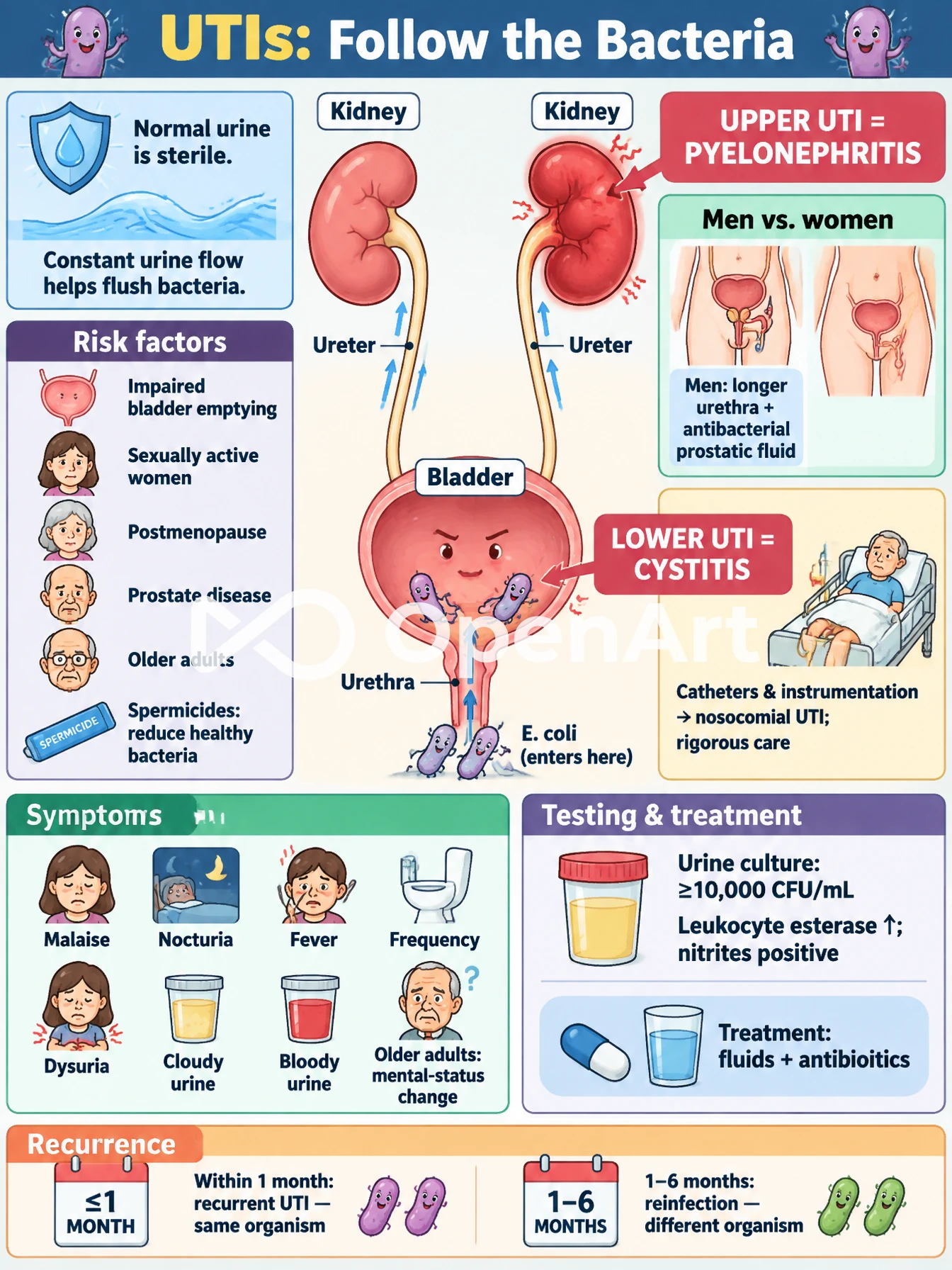
E.coli bacterial enters through urethra in the lower or upper parts of the renal system.

Lower UTIs: cystitis | upper UTIs: pyelonephritis.

Urine in the bladder = sterile; constant urine production helps flush out bacteria.

Risk factors: impaired bladder emptying, sexually active women, postmenopausal women, men with prostate disease, older adults, spermicides (kills healthy bacteria)

Men have longer urethras & the prostate has antibacterial

Catheterization and instrumentation are causes of nosocomial UTIs; rigorous care & advocate

Clinical Manifestations: Malaise, nocturia, fever, frequency, dysuria, cloudy, bloody. Older clients: change in mental status.

Diagnosis: CFUs of 10,000 bacteria/mL

Signs: elevated leukocyte (WBC) esterase, reduced nitrate levels

Treatment: fluids & antibiotics

Repeated UTI in one month, same organism

UTI in 1-6 months: a different organism, reinfection
<p>E.coli bacterial enters through urethra in the lower or upper parts of the renal system.</p><p>Lower UTIs: cystitis | upper UTIs: pyelonephritis.</p><p>Urine in the bladder = sterile; constant urine production helps flush out bacteria.</p><p>Risk factors: impaired bladder emptying, sexually active women, postmenopausal women, men with prostate disease, older adults, spermicides (kills healthy bacteria)</p><p>Men have longer urethras &amp; <u>the prostate has antibacterial </u></p><p>Catheterization and instrumentation are causes of <strong>nosocomial UTIs</strong>; <strong>rigorous care &amp; advocate </strong></p><p>Clinical Manifestations: Malaise, nocturia, fever, frequency, dysuria, cloudy, bloody. Older clients: change in mental status.</p><p>Diagnosis: <strong>CFUs of 10,000 bacteria/mL</strong></p><p>Signs: elevated leukocyte (WBC) esterase, reduced nitrate levels</p><p>Treatment: fluids &amp; antibiotics</p><p>Repeated UTI in one month, same organism</p><p>UTI in 1-6 months: a different organism, reinfection</p>
11
New cards

Acute Pyelonephritis (Kidney Infection)

Gram-negative bacteria: chills, fever, N/V, CVA

Hospitalization → IV antibiotics & hydration 10-14 days

12
New cards

Malignant Tumors of Kidney (high survival rate)

1) Wilms Tumor (Nephroblastoma) - pediatric (3-5) renal cancer; abdominal mass, pain, hematuria

Treatment: nephrectomy, systemic chemotherapy, radiation, breast cancer risk

2) Renal Cell Cancer (Ultrasound, CT, MRI) - most common, smoking, obesity, HTN, epithelial cells of the nephron; flank pain, hematuria, swelling in testicle/engorged varicose vein

Treatment: surgical resection

<p>1) Wilms Tumor (Nephroblastoma) - pediatric (3-5) renal cancer; abdominal mass, pain, hematuria</p><p>Treatment: nephrectomy, systemic chemotherapy, radiation, breast cancer risk</p><p>2) Renal Cell Cancer (Ultrasound, CT, MRI) - most common, smoking, obesity, HTN, epithelial cells of the nephron; flank pain, hematuria, swelling in testicle/engorged varicose vein</p><p>Treatment: surgical resection</p>
13
New cards

Acute Kidney Injury (Previous: Acute renal failure)

Sudden reduction in kidney function

NPR: 0.3-1.5 mg/dL (Neutrophil-to-Platelet Ratio)

Creatinine is a chemical waste product of creatine

Creatinine level 1 = 100% kidney function

AKI: creatinine increases and UO drops (usually creatinine is released in urine)

Defined by at least one of these criteria:

1) Increased serum creatinine by 0.3 or more in 48 hours

2) Increase in serum creatinine to 1.5 times+ of baseline within 7 days

3) Urine volume less than 0.5 mL/kg /hr for at least 6 hours

Pre-renal AKI - reduces blood flow to the kidneys, hypoperfusion; avoid medications: Spironolactone, bumetanide; NSAIDs (not Tylenol)

Intrarenal AKI: Glomerulus or tubule; NSAIDs or prolonged prerenal injury. Renal ischemia occurs when blood flow is reduced: HTN emergency, sepsis, rhabdomyolysis, head injury. Medications to avoid: Aminoglycosides (“-mycin”/“-micin”), vancomycin, amphotericin B, and IV high-molecular-weight contrast given in radiology or cath lab

Post-renal AKI: urine can’t leave body, calculi, tumor, blood clot, urethral obstruction, neurogenic bladder, BPH

ICU hospitalized patients, huge contributor to extended hospital stays and pateint morbidity, vancomycin

1) Onset phase - event until tubular injury occurs

2) Oliguric/anuric phase - lowest urine output, water intoxication, HTN

3) Diuretic phase: Urine volume will increase, but waste products such as BUN and creatinine, potassium, and phosphate levels are still elevated.

4) Recovery phase: Renal function begins to improve, with fluid, electrolyte, BUN, and creatinine balance returning to normal.

Monitor urine output, serum BUN, and creatinine

Hemodialysis: continuous renal replacement therapy for electrolyte + fluid balance.

Fluid test → urine output increases → the client likely has prerenal AKI

<p><strong>NPR: 0.3-1.5 mg/dL (</strong>Neutrophil-to-Platelet Ratio)</p><p><strong>Creatinine is a chemical waste product of creatine</strong></p><p><strong>Creatinine level 1 = 100% kidney function</strong></p><p>AKI: <u>creatinine increases and UO drops</u> (usually creatinine is released in urine)</p><p>Defined by at least one of these criteria:</p><p>1) Increased serum creatinine by 0.3 or more in  48 hours</p><p>2) Increase in serum creatinine to 1.5 times+ of baseline within 7 days</p><p>3) Urine volume less than 0.5 mL/kg /hr for at least 6 hours</p><p><strong>Pre-renal AKI</strong> - <strong>reduces blood flow to the kidneys,</strong> hypoperfusion; avoid medications: Spironolactone, bumetanide; NSAIDs (not Tylenol)</p><p><strong>Intrarenal AKI:</strong> Glomerulus or tubule; NSAIDs or prolonged prerenal injury. Renal ischemia occurs when blood flow is reduced: HTN emergency, sepsis, rhabdomyolysis, head injury. Medications to avoid: Aminoglycosides (“-mycin”/“-micin”), vancomycin, amphotericin B, and <strong>IV high-molecular-weight contrast given in radiology or cath lab</strong></p><p><strong>Post-renal AKI</strong>: urine can’t leave body, calculi, tumor, blood clot, urethral obstruction, neurogenic bladder, BPH</p><p>ICU hospitalized patients, huge contributor to extended hospital stays and pateint morbidity, <strong>vancomycin</strong></p><p>1) Onset phase - event until tubular injury occurs</p><p>2) Oliguric/anuric phase - lowest urine output, water intoxication, HTN</p><p>3) Diuretic phase: Urine volume will increase, but waste products such as BUN and creatinine, potassium, and phosphate levels are still elevated.</p><p>4) Recovery phase: Renal function begins to improve, with fluid, electrolyte, BUN, and creatinine balance returning to normal.</p><p>Monitor urine output, serum BUN, and creatinine</p><p><strong>Hemodialysis: </strong>continuous renal replacement therapy for electrolyte + fluid balance.</p><p><strong>Fluid test</strong> → urine output increases → the client likely has prerenal AKI</p>
14
New cards

Chronic Kidney Disease

Glomerular filtration rate <60 for 3+ months; declines until dialysis or transplantation is needed (GFR <15: end-stage renal disease). Normal GFR is 90-125

GFR <90: mild kidney damage

Signs: High BUN, electrolyte imbalances, acid-base balance, anemia, coagulation, HTN, skin integrity issues

Treatment: treat infection fast, Control BP, BG, stop smoking, decrease protein, increase CHO; avoid phosphate & potassium

2+ colas/day (phosphoric acid) → increased risk of CKD

<p>Glomerular filtration rate &lt;60 for 3+ months; declines until dialysis or transplantation is needed (GFR &lt;15: end-stage renal disease). Normal GFR is 90-125</p><p>GFR &lt;90: mild kidney damage</p><p>Signs: High BUN, electrolyte imbalances, acid-base balance, anemia, coagulation, HTN, skin integrity issues</p><p>Treatment: treat infection fast, Control BP, BG, stop smoking, decrease protein, increase CHO; avoid phosphate &amp; potassium</p><p>2+ colas/day (phosphoric acid) → increased risk of CKD </p>



