food micro exam 3
 Call Kai
 Learn
 Practice Test
 Spaced Repetition
 Match
 Flashcards
 Knowt Play
1/53

There's no tags or description
Looks like no tags are added yet.
54 Terms
name origin of clostridum perfringens
small spindles, per (through) frango (shatter or break into pieces)
characteristics of c. perfringens
• Gram-positive, rods
• Encapsulated, non-motile
• Aerotolerant anaerobic
(Compare with C. botulinum)
• Blood hemolysis
• Spore-former
i. Oval sub-terminal spores
ii. Sporulation: Sporadic, sometimes unpredictable
iii.Germination: Importance of heat-shock for spore germination
growth temp of c. perfringens
• Optimum: 40°C to 45°C
• Minimum: 20°C
mesophilic/thermophilic
generation time and prevalence of c. perfringens
Generation time
• Under optimum conditions: 8-10 min!!!
Prevalence
• Soil
• Intestine of humans and animals; healthy or otherwise
nutritional requirements
amylase and lactase positive
• Complex needs = Rich foods
• CHO: Glucose, lactose, and starch
- Lactose → CO2 + H2 + Acid
- Stormy fermentation of milk
(only 4-6 hours!)
symptoms, onset and other diseases of clostridium perfringens gastroenteritis
caused by clostridium perfringens enterotoxin
Symptoms
- Abdominal cramps
- abdominal distention (gas liberation)
- Profuse watery diarrhea
Onset/Incubation
6-24 hr. (short for infection mode!)
Subsides in 12-24 hrs
Other diseases of Clostridium perfringens
- Necrotic enteritis (Pig-Bel)
- Wound infections (e.g., during surgery!)
- Gas gangrene
Sequence of events leading to Clostridium perfringens gastroenteritis w picture
survival- oil (or rich foods) will protect spores from stomach

summary of Sequence of events leading toClostridium perfringens gastroenteritis
• Incidence of the spore-former in food
- Contaminated food (e.g., poultry, or meat)
- Ingredients (e.g., spices)
• Survival of the spores during food preparation/processing
- Sub-sporicidal heating (e.g., < 100°C)
• Growth in food to a large population (106-107 cells/g food)
- Slow cooling
- Other forms of temperature abuse (bar food)
• Ingestion of contaminated food by susceptible individuals
• Survival in the stomach
- Rise of stomach pH during consumption of a large meal
- Physical protection (e.g., food particle coated with lipids)
• Growth in the intestine, reaching stationary phase
• Sporulation in the large intestine and simultaneous release
of CPE toxin
what is the death of body tissue
necrotizingt
toxin types of clostridum perfringens
• Toxin types: More than 20 toxins produced
alpha, beta, gamma, epsilon, iota, etc.
• Species typing: Based on toxin(s) produced
(Type A, type B, type C, etc.)
• Clostridium perfringens enterotoxin (CPE)
- Produced mainly by Clostridium perfringens type A
- Causes C. perfringens gastroenteritis
- Unusual toxin production stage (Sporulation)
Laboratory diagnostics of
Clostridium perfringens gastroentiritis
• Detection of the microorganism and/or the toxin in food!
• Detection of the microorganism vs. toxin in feces!
control for clostridium perfringens
Dangerous Temperature range for holding food
• The “danger zone:” 40°F (4.4°C) to 140°F (60°C)
• Applies to many foods and most pathogens.
• “Hot food” should stay hot (> 60°C) and
• “cold food” should stay cold (< 4.4)
• Food reheating: 70°C to 100°C (not just warming it)
• Avoid slow-heating, cooling and defrosting
(Note: chicken carcass chiller and cooling rates)
Seasonality of C. perfringens gastroenteritis
• Almost 1 million people get the disease every year in the US.
• Many of the cases/outbreaks occur during the holidays (November and December)
Enterobacteriaceae Characteristics
• Gram-negative, rod-shaped
o 0.3-1.0 x 1.0-6.0 μm
• Motile by peritrichous flagella
• Mesophiles (optimum temp 22-35°C)
• Grow in the presence or absence of oxygen
(i.e., facultative anaerobes)
• Both respiratory and fermentative metabolism of carbohydrates
o Respiration (What is respiration?)
- Aerobic
- Anaerobic
o Fermentation
• Catalase-positive (most species)
• Oxidase negative (most species)
• Reduce nitrate to nitrite (most species)
Why?- can use nitrate instead of oxygen
Practical application in food safety?-fermented celery juice to still have nitrites
How?
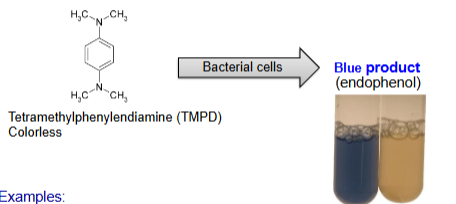
Oxidase Test
Determines whether a bacterium can oxidize certain aromatic amines(e.g., Tetramethylphenylendiamine; TMPD), which mimics a substrate for cell Cyt C oxidase, to form colored end products.
• This oxidation correlates with the “cytochrome c oxidase” activity of some bacteria. It is part of the respiratory electron transport chain
Ecology and host range of enterobacteriaceae
- Soil, water, and vegetation
- Human, animal and plant pathogens
- Common inhabitants of the intestinal tract
Latin origin of Salmonella
Daniel E. Salmon, an American veterinarian, who led the team that first isolated the bacterium from pigs in 1885
sources of salmonella
pork and poultry
biochemical characteristics of salmonella
Biochemical Characteristics
• Produce acid and gas from glucose
• Most strains do not ferment lactose (the genus could be considered- difference between this and pathogenic E. coli
lactose-negative)
• Reduce nitrates to nitrites
• Produce H2S on triple-sugar iron (TSI) agar
• Indole -, Methyl red +, Voges-Proskauer -, Citrate + (IMViC: -+-+).
Note that most Escherichia coli strains are (IMViC ++--)
• Catalase positive
• Oxidase negative
salmonella outbreak linked to fish vs backyard poultry name
Salmonella Litchfield
Salmonella infections with
serotypes Enteritidis, Hadar, Indiana, Infantis,Typhimurium, Mbandaka, and 1, 4,[5],12:i:-.
How many species and serovars does the genus Salmonella contain?
2 species (S. enterica and S. bongori) and about 2,500 serovars
What is a serovar?
A variant classified based on its antigenic characteristics (O, H, and Vi antigens).
What are the two Salmonella species?
Salmonella enterica and Salmonella bongori.
How many subspecies does Salmonella enterica have?
Six subspecies
What characteristics distinguish Salmonella subspecies?
Carbohydrate utilization, metabolic capabilities, phage susceptibility, and habitat
What are the three antigen types used in Salmonella classification?
O (somatic), H (flagellar), and Vi (capsular) antigens.
What does the O antigen represent?
What does the H antigen represent?
What does the Vi antigen represent?
The somatic (cell surface) antigen.
The flagellar antigen.
The capsular antigen
Which H antigen phases are used in serotyping?
Phase I and Phase II flagellar antigens.
What causes agglutination?
Antibody binding to a matching antigen.
Three major diseases caused by Salmonella?
Gastroenteritis (salmonellosis), enteric fever, septicemia
What serovar causes typhoid fever?
Salmonella enterica serovar Typhi
Key typhoid fever facts?
Human source, treated with antibiotics, lasts 1–8 weeks.
What is salmonellosis?
Non-typhoidal Salmonella gastroenteritis affecting the small intestine
Main symptoms of salmonellosis?
Diarrhea, fever, abdominal pain, vomiting, dehydration.
Major food sources of Salmonella?
Poultry, eggs, milk, produce, water, food handlers
Which serovar is multidrug-resistant?
Typhimurium DT104/DT204
Which serovar is heat-resistant?
Senftenberg.
biochemical characteristics of e. coli
can safely say indole and lactose positive
methyl red positive
vp negative- no acetoin from glucose
strains are IMViC ++ - -
Pathways for carbohydrate
metabolism by Enterobacteriaceae and what can e.coli do special
bio types of e. coli
classification based on biochemical characteristics)
Biotype 1: IMViC ++-- (95%). Biotype 2: IMViC -+-- (~5%)
serotypying of e. coli
• “O” antigen of lipopolysaccharide (LPS). ~170 known.
Defines serogroups
• “H” antigen of flagella. More than 50 known.
Defines serotypes
• Examples of serotypes (that happened to be pathogen):
“Escherichia coli O55:H6”, “E. coli O111:H8”, “E. coli O157:H7”
virotyping of e. coli
classification based on virulence; i.e., pathogenicity)
• Pathogenic
• Non-pathogenic (commensal)
diarrheagenic e. coli types
Enteropathogenic: EPEC
- Enterotoxigenic: ETEC
- Enteroinvasive: EIEC
- Enteroaggregative: EAEC
- Enterohemorrhagic EHEC
- Shiga toxin-producing
(Shigatoxigenic): STEC
Invade, cause tissue damage
Stack (like bricks) on intestine cells
Cause bloody diarrhea
Now combined
Attaching & effacing
Produce Shiga toxins
effacing- changing the landscape of the surfaces of microvilli
Naming that includes serotype and viroype
what are enterocytes
formation and attaching and effacing lesions in bacterial infection

ETEC interaction with the enterocytes e.coli
EIEC interaction with the enterocytes e.coli
EPEC interaction with the enterocytes e.coli
STEC interaction with the enterocytes e.coli
remove one nucleotide and whole ribosome is non working
famous serotypes of e. coli
- E. coli O104:H4
- E. coli O157:H7
Any biological relationship between serotype and Shiga toxin
production?
The "combo" matters:The worst food poisoning happens when a specific bacterial model (serotype) that is really good at sticking to your gut combines with the most dangerous version of the toxin weapon.
2 examples of STEC
In 1982, an E. coli (later found to be E. coli O157:H7) was initially identified as the cause of bloody diarrhea from eating undercooked or raw hamburger meat that was contaminated with the bacterium
In 2011, a Shigatoxin-producing Enteroaggregative E. coli O104:H4 strain (EAEC Stx2a+) caused a serious outbreak of acute gastroenteritis and hemolytic uremic syndrome (HUS) in Germany.*
—-Water, Sprouting for days, Fenugreek Seeds Sprouts
proposed scheme of new e. coli pathotype
AAF plasmid from EAEC and phage from eHEC combines to make that