8.3 Hexose Derivatives
 Call Kai
 Learn
 Practice Test
 Spaced Repetition
 Match
 Flashcards
 Knowt Play
1/7

There's no tags or description
Looks like no tags are added yet.
8 Terms
Types of Hexose Derivatives
Oxidized sugars:
aldonic acids
uronic acids
Reduced sugars
alditols = reduction of carbonyl to alcohol
Deoxy sugars = removal of OH from monosaccharides (H instead)
Amino sugars = replace OH with NH2/NH3+
often acetylated on the amino group
Oxidized Sugars
Aldonic acids = oxidation at c1
has COOH at C1 instead of the carbonyl
name: -onic acid”
ex. D-gluconic acid (derivative of glucose)
conjugate base form: D-gluconate

Uronic acids = oxidation of primary alcohol
converts OH → carboxylic acid (COOH)
name: -uronic acid
ex. D-glucuronic acid
conjugate base form: D-glucuronate

Reduced Sugars
Alditols = reduction of carbonyl to alcohol
converts carbonyl → CH2OH
often sugar substitutes (ex. xylitol in sugar free gum)
name: -itol

result: CANT form cyclic structures?
Q. What is the structure of D-threitol?
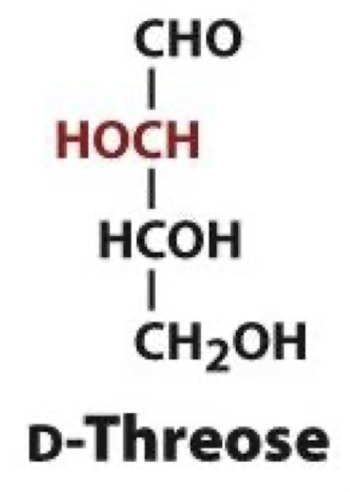
-itol, thus a reduced sugar
convert c1 from carbonyl to alcohol (CHO → CH2OH)

Q. which aldose can be reduced to generate “sorbitol”?

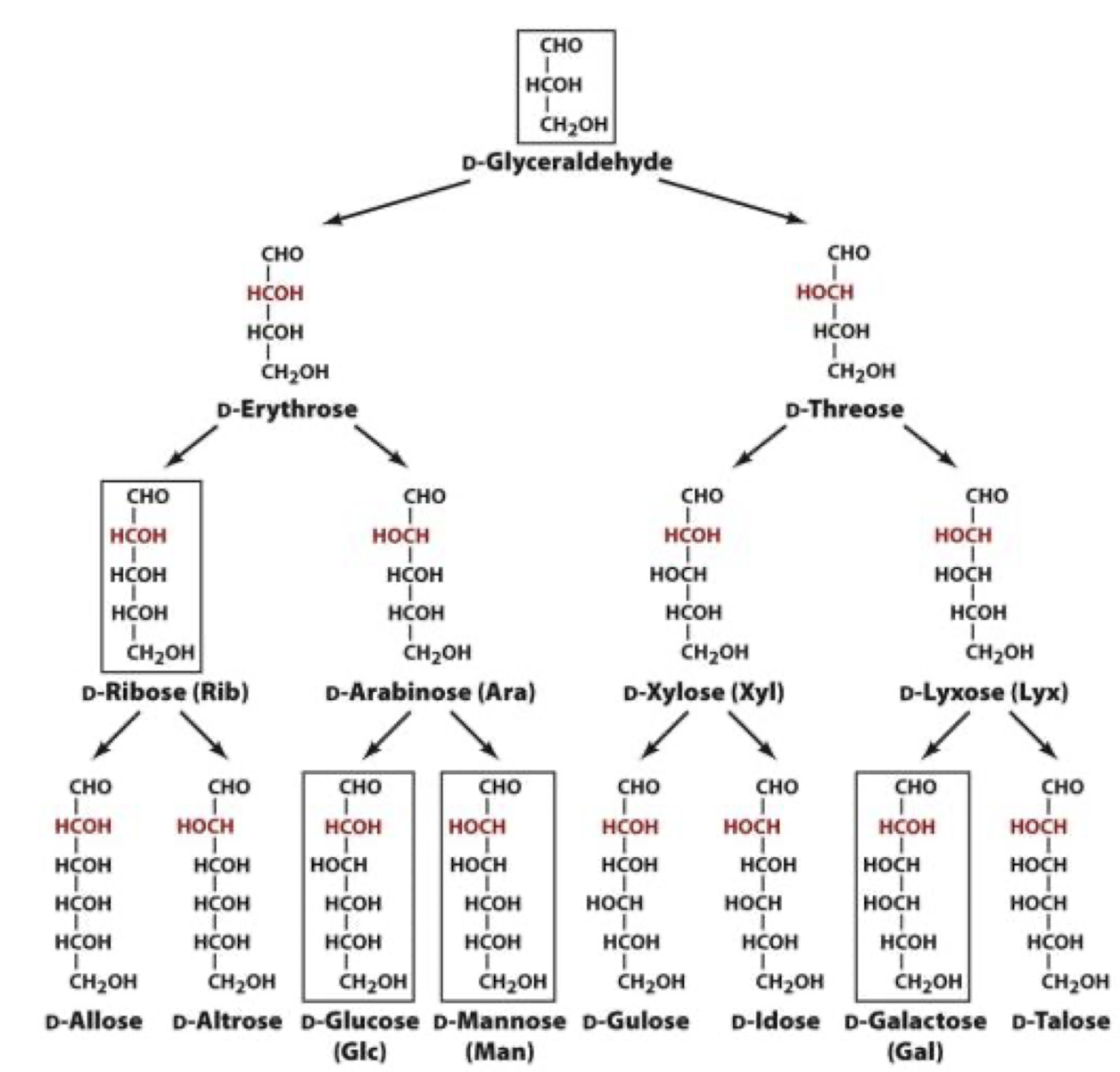
reduced, thus sorbitol has has its carbon reduced to an alcohol at c1
find an aldose with the only difference being an aldehyde at c1 (CHO)
answer: D-glucose
could also he described as “D-glucitol” for the reduced form

Deoxy Sugars
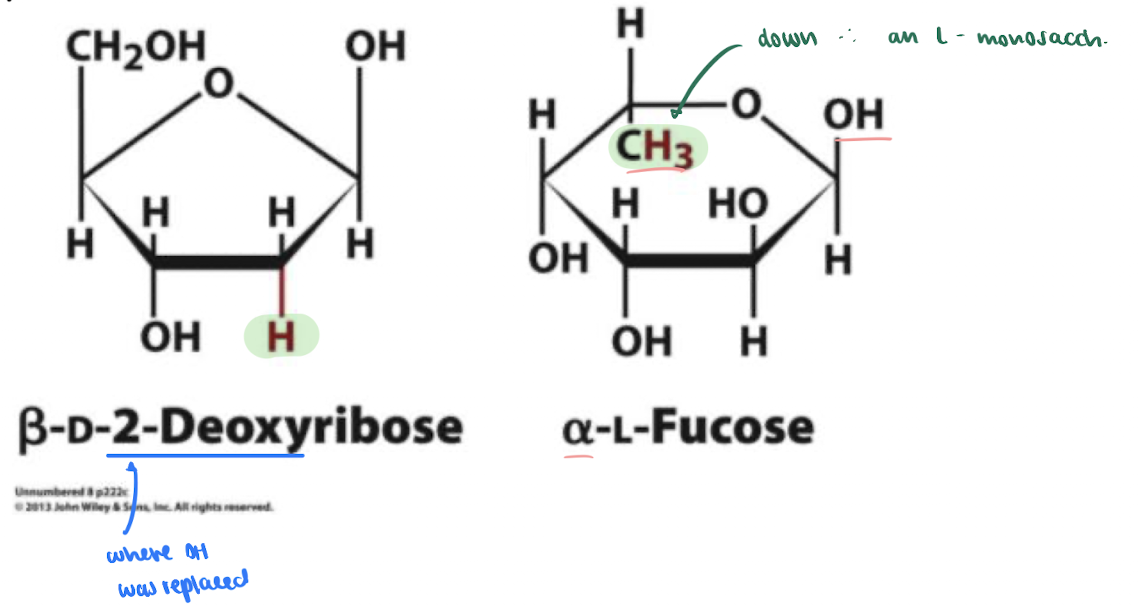
Deoxy sugars = removal of OH from monosaccharides
found in DNA
CAN still form cyclic structures
see an H instead of OH
name: #-Deoxy-
Amino Sugars
Amino sugars = replace OH (usually at C2) in monosaccharides with NH2/NH3+
often acetylated on the amino group
NH2 group can be protonated
if acetylated the amino group CANT carry a charge bc it becomes an amide
name: -amine


Sialic Acids
Sialic acids = derivatives of N-acetylneuraminic acid
can still undergo cyclization process to form cyclic form
usually carries a (-) charge → results in structures that contain sialic acids having a (-) charge
found in glycoproteins & glycolipids (ex. gangliosides, which carry a negative charge bc of sialic acids within them)
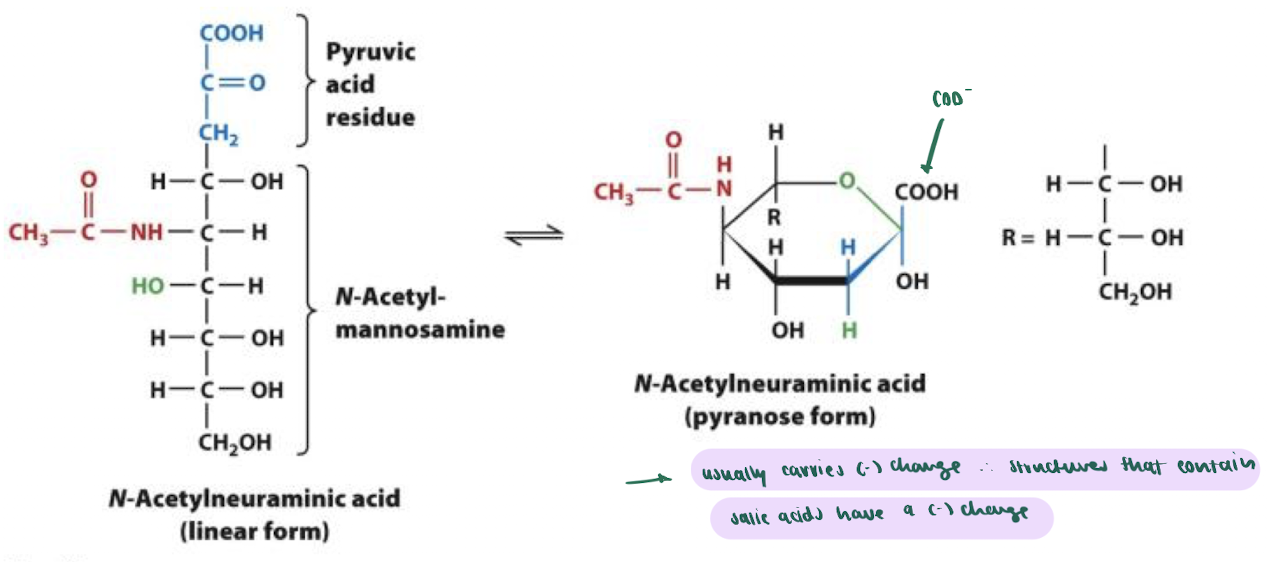
N-acetylneuraminic acid = 9C monosaccharide derived from N-acetylmannoseamine (amino sugar) & pyruvate