chem week 1 notes (light/waves/energy, quantum numbers, atomic spectra)
 Call Kai
 Learn
Learn Practice Test
 Spaced Repetition
 Match
Match Flashcards
 Knowt Play
1/8

There's no tags or description
Looks like no tags are added yet.
Name | Mastery | Learn | Test | Matching | Spaced | Call with Kai | Chat |
|---|
No analytics yet
Send a link to your students to track their progress
9 Terms
what are the 3 properties of waves (& the relationships)
wavelength, frequency, amplitude
wavelength: how long the wave is (distance btwt 2 peaks)
red: low energy, long λ
purple: high energy, shorter λ
Frequency: cycles per second 1/T
inc frequency, inc energy waves, short (dec) λ
Period: how much time ONE cycle takes 1/f
changing f or λ changes the colour
frequency and wavelength of the light defines the energy of each INDIVIDUAL photons
Amp: high or low wave. changes brightness.
inc amp = inc brightness
# of photons present
Light behaves as a….
wave and also a particle. The energy of each of these particles r dictated by the frequency of wavelength of the light (A PHOTON)
equation for energy of a photon

The photoelectric effect
1 photon transfers its energy to one electron & has leftover kinetic energy
Inc frequency = higher kinetic energy of ejected electrons
Inc intensity = sending MORE photons
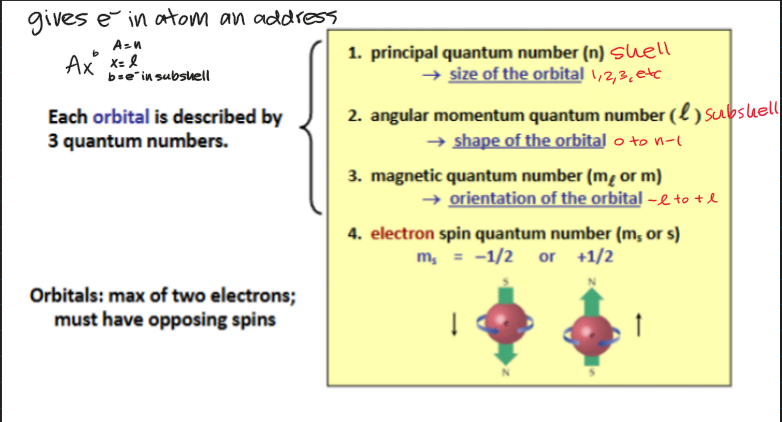
what are the 4 quantum numbers
s, p, d, f orbitals and their shapes + probability

what is penetration
how close an electron in a subshell can get to the nucleus
closer an e- gets to nucleus, less shielding, inc zeff
what is ground state n=? what is n=inf
n = 1, closest to nucleus
n = inf, electron is emitted from atom. energy is 0
absorption vs emission spectrum
absorption: electron absorbs a photon and moves to a higher energy lvl
emission: electron emits a photon and loses energy and moves to a lower energy lvl