Procedures ROM (UE)
 Call Kai
 Learn
 Practice Test
 Spaced Repetition
 Match
 Flashcards
 Knowt Play
1/51

There's no tags or description
Looks like no tags are added yet.
52 Terms
Capsular Pattern for Shoulder
ER > abduction > IR
Capsular Pattern for Elbow (humeroulnar/humeralradial)
flex > ext
Capsular Pattern for Forearm (sup/inf radioulnar)
equal pron/sup
Capsular Pattern for Wrist
flex = ext > RD/UD
Capsular Pattern for CMC - Digit 1
Abd > Ext
Capsular Pattern for MCP & IP
Flex = Ext
Atlano-Occipital Joint
Extension = Lateral Flexion
C2-C7
Equal Limitation of All except Flexion
Unilateral Facet Involvement
Lat Flex to Opp Side & Rot to Ipsi Side
Thoracic Spine
Ext, Lat Flex, Rot > Forward Flexion
Lumbar Spine
Marked & Equal Restriction of Lat Flexion, followed by Restriction of Flexion & Extension
Shoulder Flexion
Degrees:
180
End-feels:
Firm
Posterior jt capsule
post delt
teres minor
latissimus
sternocostal head of pec major
pec minor
Position/Alignment:
Standing (AROM)
Supine (PROM)
Keep elbow extended to take tricep out
Fulcrum:
lateral aspect of the greater tubercle
Proximal arm:
parallel to the midaxillary line of the thorax
Distal arm:
lateral midline of the humerus (using the lateral epicondyle or olecranon)
Keep knees flexed (Flex will cause PPT) (stops lumbar extension)
Lat length might limit ROM

Shoulder Extension
Degrees - 60
Make sure to flex elbow (take out biceps)
Lat gets taken out once shoulder goes into flexed position (lat extends from flexed position)
Position:
Prone
Fulcrum:
lateral aspect of the greater tubercle
Proximal arm:
parallel to the midaxillary line of the thorax
Distal arm:
lateral midline of the humerus (using the lateral epicondyle or olecranon)
End-feels:
Firm
Ant joint capsule, clavicular head of pec major, coracobrachialis, anterior delt
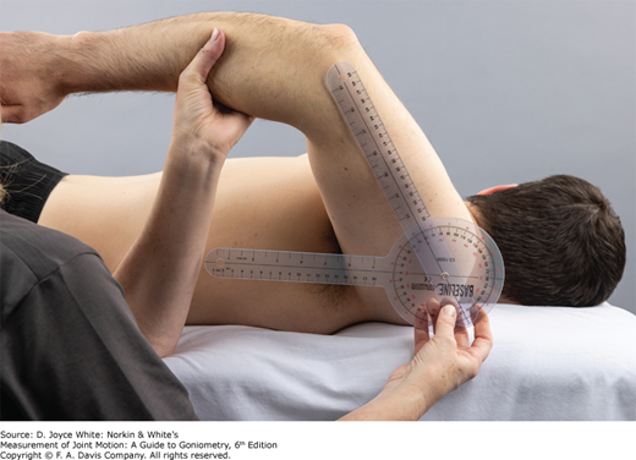
Shoulder Abduction
Degrees - 180
Position:
Standing (AROM)
Supine (PROM)
Have them tilt head to other side
Fulcrum: (will lose fulcrum)
anterior aspect of the acromion process
Proximal arm:
parallel to the midline of the anterior aspect of the sternum
Distal arm:
anterior midline of the humerus (medial epicondyle may be a helpful reference)
End-feels:
Firm
Inferior joint capsule
Lats
Teres major
Pec major
Coracobrachialis

Shoulder IR
Use towel under elbow
Degrees:
70 degrees
End-feels:
Firm
Posterior joint capsule
Infraspinatus
Teres minor
Posterior deltoid
Position/Alignment:
Supine
Knees flexed
Fulcrum:
Olecranon process
Proximal arm:
Perpendicular to the floor
Distal arm:
In line with the ulna using olecranon and styloid

Shoulder ER
Degrees - 90
End-feels:
Firm
Ant joint capsule
Subscapularis
Lats
Teres major
Ant deltoid
pec major
Position/Alignment:
Supine
Fulcrum:
Olecranon process
Proximal arm:
Perpendicular to the floor
Distal arm:
In line with the ulna using olecranon and styloid

Elbow Flexion
Degrees - 150
End-feels:
Soft
Compression of ant forearm and ant upper arm
Firm
Post jt capsule
Triceps med and lateral heads
anconeus
Hard
Contact b/t coronoid process of ulna and coronoid fossa of humerus OR b/t radial head and radial fossa of humerus
Position/Alignment:
Fulcrum
Lateral epicondyle of humerus
Proximal
Lateral midline of humerus using acromion for reference
Distal
Lateral midline of the radius using radial head for reference

Elbow Extension
Degrees - 0
End-feels:
Firm
Anterior joint capsule
Brachialis
Collateral ligaments
Hard
Contact b/t olecranon process of Ulna and olecranon fossa of humerus
Position/Alignment:
Fulcrum
Lateral epicondyle of humerus
Proximal
Lateral midline of humerus using acromion for reference
Distal
Lateral midline of the radius using radial head for reference

Pronation
Degrees - 80
End-feels:
Firm
Dorsal radioulnar ligament of the inferior radioulnar joint
Interosseous membrane
Supinator
Hard
Contact b/t radius and ulna
Position/Alignment:
Fulcrum:
Lateral and proximal to styloid process of radius.
Proximal arm:
Parallel to anterior midline of humerus
Distal arm:
Across the dorsal surface of forearm just proximal to radial and ulnar styloid (parallel to styloid processes)
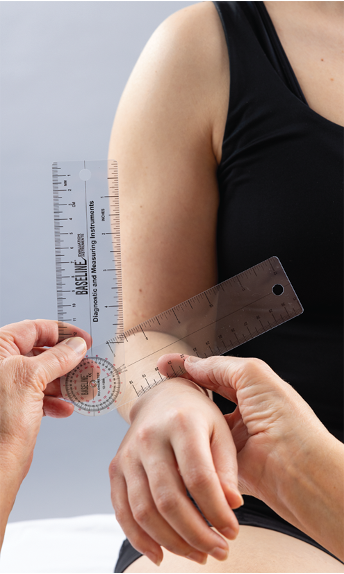
Supination
Degrees - 80
End-feels:
Firm
Interosseous membrane
Pronator teres
Pronator quadratus
Position/Alignment:
Fulcrum:
Medial and proximal to styloid process of radius.
Proximal arm:
Parallel to anterior midline of humerus
Distal arm:
Across the dorsal surface of forearm just proximal to radial and ulnar styloid (parallel to styloid processes)

Wrist Flexion
Degrees - 80
End-feels:
Firm
Dorsal joint capsule
ECRB
ECRL
ECU
Position/Alignment:
Fulcrum:
•Lateral aspect of wrist over the triquetrum.
Proximal arm:
•Lateral midline of ulna using olecranon and styloid process
Distal arm:
•Lateral midline of 5th met (not hypothenar eminence for reference)
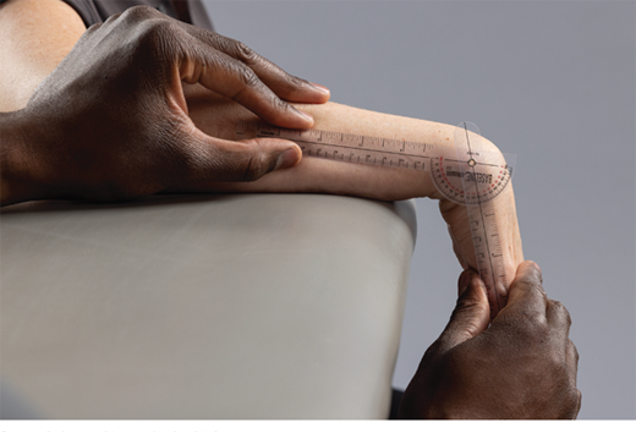
Wrist Extension
Degrees - 70
End-feels:
Firm
Palmar joint capsule
Palmaris longus
FCR
FCU
Hard
Contact b/t radius and carpals
Position/Alignment:
Fulcrum:
•Lateral aspect of wrist over the triquetrum.
Proximal arm:
•Lateral midline of ulna using olecranon and styloid process
Distal arm:
Lateral midline of 5th met (not hypothenar eminence for reference)

Radial Deviation
Degrees - 20
End-feels:
Firm
Ulnar joint capsule
ECU
FCU
Ulnar collateral ligament
Hard
Contact b/t radial styloid process & schapod or trapezium
Position/Alignment:
Fulcrum:
• Dorsal aspect of wrist over the capitate.
Proximal arm:
• Dorsal midline of forearm using lateral epicondyle for reference.
Distal arm:
• Dorsal midline of 3rd metacarpal (not 3rd phalanx)

Ulnar Deviation
Degrees - 30
End-feels:
Firm
Radial joint capsule
EPB
APL
Position/Alignment:
Fulcrum:
• Dorsal aspect of wrist over the capitate.
Proximal arm:
• Dorsal midline of forearm using lateral epicondyle for reference.
Distal arm:
• Dorsal midline of 3rd metacarpal (not 3rd phalanx)

Finger MCP Flexion
Degrees:
90
End-feels:
Firm
Dorsal joint capsule
Collateral ligs
Hard
Contact b/t palmar aspect of prox phalanx and metacarpal
Position/Alignment:
Proximal arm: dorsal midline of metacarpal
Fulcrum: dorsal aspect of the MCP
Distal arm: dorsal midline of proximal phalanx

Finger MCP Extension
Degrees:
45
End-feels:
Firm
Palmar joint capsule
Palmar plate
Position/Alignment:
Proximal arm: dorsal midline of metacarpal
Fulcrum: dorsal aspect of MCP
Distal arm: dorsal midline of proximal phalanx

Finger MCP Abduction
Position/Alignment
Proximal arm: dorsal midline of metacarpal
Fulcrum: dorsal aspect of MCP
Distal arm: dorsal midline of proximal phalanx

Finger PIP Flexion
Degrees
100
Position/Alignment
Proximal arm: dorsal midline of proximal phalanx
Fulcrum: dorsal aspect of the PIP joint
Distal arm: dorsal midline of middle phalanx
End feels
Firm
Palmar jt capsule
Collateral ligaments
Soft
Compression of soft tissue b/t dorsal aspect of middle and proximal phalanges
Hard
Contact b/t palmar aspect of middle phalanx and proximal phalanx

Finger PIP Extension
Degrees:
0
End-feels:
Firm
Palmar Jt Cap
Palmar Plate
Position/Alignment:
Proximal arm: dorsal midline of proximal phalanx
Fulcrum: dorsal aspect of the PIP joint
Distal arm: dorsal midline of middle phalanx

Finger DIP Flexion
Degrees:
90
End-feels:
Firm
Dorsal joint capsule
Collateral ligaments
Position/Alignment:
Proximal arm: dorsal midline of proximal phalanx
Fulcrum: dorsal aspect of the DIP joint
Distal arm: dorsal midline of middle phalanx
PIP joint flexed 70-90°
*Full MCP/PIP flex = ED, EI, EDM limit
*Full PIP ext = oblique retinacular lig

Finger DIP Extension
Degrees:
0
End-feels:
Firm
Dorsal joint capsule
Collateral ligaments
Position/Alignment:
Proximal arm: dorsal midline of proximal phalanx
Fulcrum: dorsal aspect of the DIP joint
Distal arm: dorsal midline of middle phalanx

Composite Flex
Alignment
Measure perpendicular distance between distal palmar crease and tip of finger or distal corner of nail bed

Thumb CMC Flexion
Degrees:
15
End-feels:
Soft
Contact b/t MM Bulk of Thenar Eminence & Palm of Hand
Firm
Dorsal Jt Cap, EPB, APB
Position/Alignment:
Proximal arm: vertical midline of radius using radial head and styloid
Fulcrum: palmar aspect of 1st CMC joint
Distal arm: ventral midline of 1st metacarpal
*Math is involved since we do not begin at 0
*For flex: push met toward ulnar side

Thumb CMC Extension
Degrees:
20
End-feels:
Firm
Ant Jt Cap, FPB, Add Pollicis, Opp. Pollicis, 1st DI
Position/Alignment:
Proximal arm: vertical midline of radius using radial head and styloid
Fulcrum: palmar aspect of 1st CMC joint
Distal arm: ventral midline of 1st metacarpal
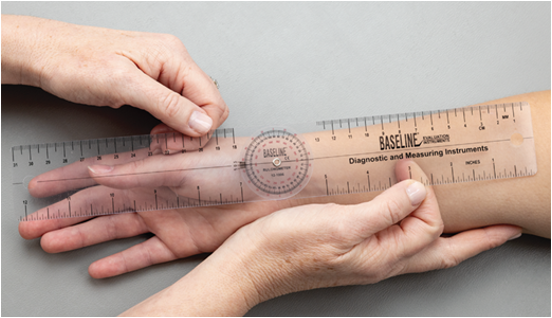
Thumb CMC Abduction
Degrees:
70
End-feels:
Firm
Fascia & Skin of Web Space, Add Pollicis, 1st DI
Position/Alignment:
Proximal arm: lateral midline of the 2nd metacarpal using the center of the second MCP for reference
Fulcrum: lateral aspect of the scaphoid or radial styloid; proximal and distal arms “shoot out” of the hand
Distal arm: dorsal midline of the 1st metacarpal using the center of the 1st MCP joint for reference
“Sparks shooting out of the fingertips”

Thumb CMC Opposition
Alignment
Distance from tip of thumb to proximal digital crease of little finger
*Thumb metacarpal moves into abd, flex, add, and med rotation and thumb IPs flex, while 5th met is stabilized

Thumb MCP Flexion
Degrees:
50
End-feels:
Firm
Dorsal Jt Cap, Collateral Ligs, EPB
Hard
Contact b/t Palmar Aspect of Prox Phalanx & 1st MC
Position/Alignment:
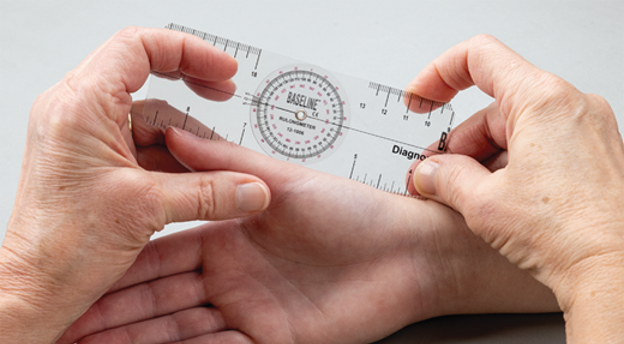
Proximal arm: dorsal midline of metacarpal
Fulcrum: dorsal aspect of the MCP joint
Distal arm: dorsal midline of proximal phalanx
*For flexion: if the wrist and IP joint of the thumb were in full flexion, tension in the EPL would restrict motion
*use the index finger and the thumb to stabilize and use other hand to move into flexion
Thumb MCP Extension
Degrees:
0
End-feels:
Firm
Palmar Jt Cap, Palmar Plate, Cruciate Ligs, FPB
Position/Alignment:
Proximal arm: dorsal midline of metacarpal
Fulcrum: dorsal aspect of the MCP joint
Distal arm: dorsal midline of proximal phalanx

Thumb IP Flexion
Degrees:
80
End-feels:
Firm
Dorsal Jt Cap, Collateral Ligs
Hard
Contact b/t Palmar Aspect of Distal Phalanx, Palmar Plate, Prox Phalanx
Position/Alignment:
Proximal arm: dorsal midline of proximal phalanx
Fulcrum: dorsal surface of the IP joint
Distal arm: dorsal midline of the distal phalanx
*if the wrist and MCP are flexed, tension in the EPL would limit motion, if they were fully extended, tension in the APB, and oblique fibers of the adductor pollicis may restrict the motion through their insertion into the extensor mechanism.

Thumb IP Extension
Degrees:
20
End-feels:
Firm
Palmar joint capsule
Palmar plate
Position/Alignment:
Proximal arm: dorsal midline of proximal phalanx
Fulcrum: dorsal surface of the IP joint
Distal arm: dorsal midline of the distal phalanx
*if the wrist and MCP are flexed, tension in the EPL would limit motion, if they were fully extended, tension in the APB, and oblique fibers of the adductor pollicis may restrict the motion through their insertion into the extensor mechanism.

Cervical Spine Flexion
Degrees:
45 (50)
End-feels:
Firm
Supraspinous, Interspinous, Ligamentum Flavum, Ligamentum Nuchae, Post Fibers of Annulus Fibrosus in IVDs, Post Facet Jt Cap, PLL, Erector Spinae, UT, Levator Scapulae
Position/Alignment:
Proximal arm: perp or parallel to ground.
Fulcrum: ext auditory meatus (ear canal)
Distal arm: base of the nares (nostril)
Muscles:
Nerves:

Cervical Spine Extension
Degrees:
45 (60)
End-feels:
FIrm
ALL, Ant Fibers of Annulus Fibrosus, Facet Jt Cap, SCM, Longus Capitis, Longus Colli, Rectus Capitis Anterior, Ant Scalene
Hard
Extreme Extension → Contact b/t SPs
Position/Alignment:
Proximal arm: perp or parallel to ground.
Fulcrum: ext auditory meatus (ear canal)
Distal arm: base of the nares (nostril)
Muscles:
Nerves:

Cervical Spine Lateral Flexion
Degrees:
45 (45)
End-feels:
Position/Alignment:
Proximal arm: spinous processes of thoracic vertebrae
Fulcrum: C7 SP
Distal arm: dorsal midline of head, using occipital protuberance for reference.
Muscles:
Firm
Intertransverse Ligs, Lat Annulus Fibrosus Fibers, Lat Facet Jt Ant Scalene, SCM, Levator Scapulae, UT
Nerves:

Cervical Spine Rotation
Degrees:
60 (80)
End-feels:
Firm
Fibers of Facet Jt Cap Contra: SCM, UT, Ant Scalene Ipsi: Levator Scapulae
Position/Alignment:
Proximal arm: parallel to an imaginary line between acromial processes.
Fulcrum: center of cranial aspect of head
Distal arm: tip of nose
Muscles:
Nerves:

Thoracolumbar Flexion Method 1
Degrees:
80° or 4 inches from T1 to S2
End-feels:
Firm
PLL, Ligamentum Flavum, Suprapsinous & Interspinious Ligs, Post Fibers of Annulus Pulposus of IVD, Facet Jt Cap, Thoracolumbar Fascia, Erector Spinae, QL, Multifidus
Position/Alignment:
Flexion Method 1: Tape Measure
•Mark spinous processes T1 and S2
•Record distance
•Hold tape measure in place as pt performs flexion
•Record distance and calculate difference
Flexion Method 2: Fingertip-to-floor•
•Have pt perform trunk flexion with knees extended, feet together
•Measure perpendicular distance from floor to tip of 3rd digit
Muscles:
Nerves:

Thoracolumbar Flexion Method 2
Degrees:
80° or 4 inches from T1 to S2
End-feels:
Firm
PLL, Ligamentum Flavum, Suprapsinous & Interspinious Ligs, Post Fibers of Annulus Pulposus of IVD, Facet Jt Cap, Thoracolumbar Fascia, Erector Spinae, QL, Multifidus
Position/Alignment:
Flexion Method 2: Fingertip-to-floor•
•Have pt perform trunk flexion with knees extended, feet together
•Measure perpendicular distance from floor to tip of 3rd digit
Muscles:
Nerves:

Thoracolumbar Extension
Degrees:
25
End-feels:
Firm
Facet Jt Cap, Ant Fibers of Annulus Fibrosus, ALL, Rec Ab, External Oblique, Internal Oblique
Hard
Contact b/t SPs & Facets
Position/Alignment:
•Mark the spinous processes of the T1 and S2 TP
•Position one inclinometer over the SP of T1 and the second inclinometer over S2.
•Read and record the values on both inclinometers. The difference between the two inclinometers indicates thoracolumbar extension ROM.
Muscles:
Nerves:

Thoracolumbar Lateral Flexion (Method 1)
Degrees:
35
End-feels:
Firm
Contra Fibers of the Annulus Fibrosus, Facet Jt Cap, Intertransverse Ligs, Thoracolumbar Fascia, External & Internal Oblique Abdominals, Erector Spinae, QL, Multifidus
Hard
Impact of Ipsi Facets & Restrictions imposed by Ribs & Costal Jts in Upper Tspine, Ribs (Potentially 10th) & Iliac Crests
Position/Alignment:
Proximal arm: perpendicular to ground
Fulcrum: Posterior aspect of S2 SP
Distal arm: Posterior aspect of T1 SP.
Muscles:
Nerves:

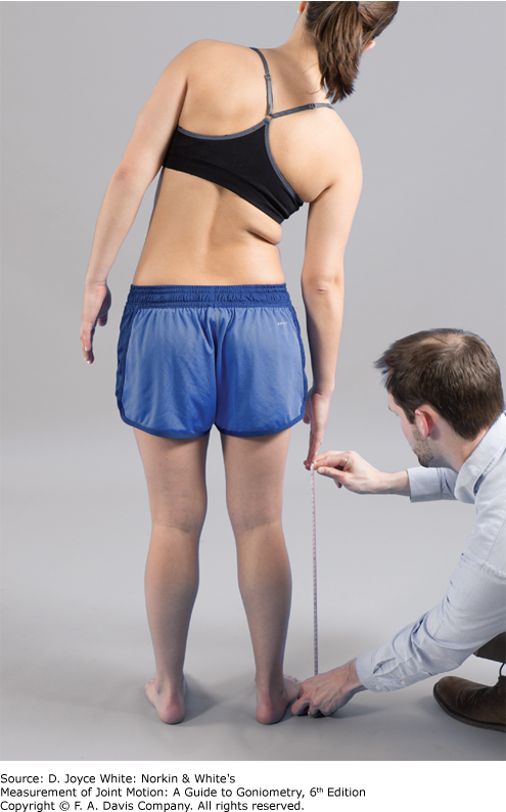
Thoracolumbar Lateral Flexion (Method 2)
•Feet shoulder width apart, knees extended
•Subject bends to side
•Measure distance from floor to tip of 3rd digit
*Beware of forward flexion
Thoracolumbar Rotation
Degrees:
45
End-feels:
Firm
Contra Annulus Fibrosus, Facet Jt Cap, Rec Ab, External & Internal Obliques, Multifidus
Hard
Contact b/t Facet Joints
Position/Alignment:
Proximal arm: parallel to an imaginary line b/w two prominent tubercles on the iliac crests.
Fulcrum: center of the cranial aspect of the head
Distal arm: imaginary line between the two acromial processes.
Muscles:
Nerves:

Lumbar Flexion/Extension
•Double inclinometer:
–Mark and place on T12 and S2 SP
–Subtract two readings
•Single inclinometer:
–Just repeat the test twice with one goni (first at T12 then S2)

Degrees:
End-feels:
Position/Alignment:
Muscles:
Nerves: