L4 - Agents and Environments
 Call Kai
 Learn
 Practice Test
 Spaced Repetition
 Match
 Flashcards
 Knowt Play
1/86

There's no tags or description
Looks like no tags are added yet.
87 Terms
True or False. Agent = Architecture + Program
True
Fill in the gap. Agents should be….
Rational
What does the behaviour of the agent depend on?
Environment and the defined goals
What can agents include?
Humans, robots, softbots, thermostats, etc.
True or False. The agent function maps from percept histories to actions
True
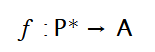
True or False. The agent program runs on physical architecture to produce the agent function
True
What does an agent use to perceive it’s environment?
Sensors and actuators
Diagram of classical agent

Diagram of a modern LLM agent

What are the characteristics of an intelligent agent?
Autonomy
Reactivity
Proactivity
Social ability
What are some examples of an intelligent agent?
Robots, software agents, virtual assistants
What would be the percepts of a robot vacuum-cleaner?
Locations and contents
E.g., [A, Dirty, B, Clean]
What would be the actions of a vacuum-cleaner agent?
Left, Right, Inhale
Diagram of an example of percept sequences and actions for a vacuum-cleaner agent
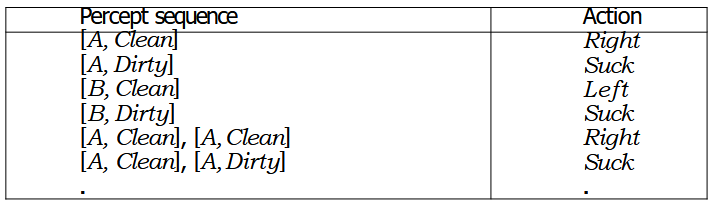
Diagram of an example of a function for a vacuum-cleaner agent

What is the first dependent of rationality for an agent?
The performance measure defines the criteria of success
What is the second dependent of rationality for an agent?
The agent’s prior knowledge of the environment
What is the third dependent of rationality for an agent?
The actions the agent can perform
What is the fourth dependent of rationality for an agent?
The agent’s percept subsequence to date
True or False. A rational agent chooses whichever action maximises the expected value of the performance measure given the percept sequence to date.
True
Diagram of discussion of the attributes of rationality for an agent

What four factors are used to specify the task environment to design a rational agent?
Performance measure
Environment
Actuators
Sensors
What is meant by performance measure?
How the agent’s success is measured
What is meant by environment?
The surroundings in which the agent operates
What is meant by actuators?
Tools agent uses to take action
What is meant by sensors?
Tools agent uses to perceive its environment
Diagram of a specified task environment for an automated taxi

Diagram of a specified task environment for a internet shopping agent
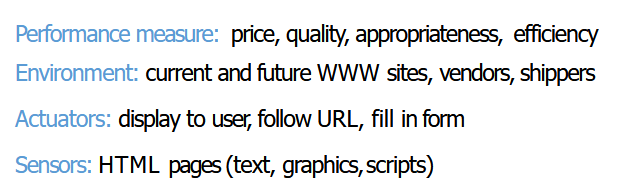
Diagram of a specified task environment for ChatGPT assistant agent

Diagram of the profound shift from chatbots to copilots to agents

True or False. The LLM is the agent.
False. The LLM is only the brain, it needs a harness to be useful
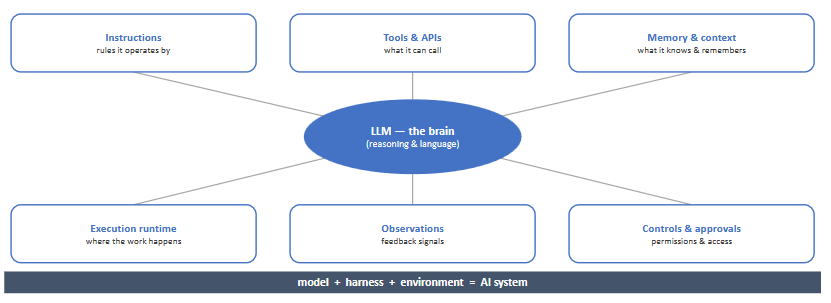
What is meant by a harness in modern AI agents?
A system that supports and controls an AI agent, so it can perform tasks
True or False. There are six factors included in a harness.
True.
Instructions
Tools & APIs
Memory & context
Execution runtime
Observations
Controls & approvals
What are instructions to an LLM?
The rules the AI operates by
What are tools & APIs to an LLM?
What the AI can call
What is memory & context to an LLM?
What the AI knows & remembers
What is execution runtime to an LLM?
Where the AI’s work is performed
What are observations to an LLM?
Feedback the AI receives about its actions
What are controls & approvals to an LLM?
Permissions determining what the AI is allowed to do
Which three factors make up an AI system?
Model, harness and environment
Diagram of all components in an AI system
What does observability describe in an environment?
Whether the agent can see all relevant aspects
What is an example of a fully observable environment?
Chess. Whole board is visible
What is an example of a partially observable environment?
Poker
What is the difference between a deterministic and stochastic environment?
Deterministic - Current state and action determines next state
Stochastic - Next state is not completely predictable
What is the difference between a episodic and sequential environment?
Episodic - Agent experience divided into independent episodes
Sequential - Decisions depend on each other
What is an example of a episodic environment?
A quiz game
What is an example of a sequential environment?
Football
What is the difference between a static and dynamic environment?
Static - Environment doesn’t change, while agent deliberates
Dynamic - Environment can change even, if agent does nothing
What is an example of a static environment?
Chess
What is an example of a dynamic environment?
Self-driving cars
What is the difference between a discrete and continuous environment?
Discrete - Finite number of actions and states
Continuous - Range of possible states and actions is infinite
What is an example of a discrete environment?
Tic-tac-toe
What is an example of a continuous environment?
Steering a car
What is the difference between a single-agent and multi-agent environment?
Single-agent - Only one agent acts in the environment
Multi-agent - Multiple agents interact
What is an example of a single-agent environment?
A sudoku solver
What is an example of a multi-agent environment?
A stock trading system
Diagram of games and their environment types

True or False. The real world is fully observable, deterministic, episodic, static, discrete and single-agent.
False. The real world is the complete opposite of all those types.
Table of a modern agentic coding assistant’s environment types

How does a simple-reflex agent work?
Uses sensors to observe the current environment
Follows condition-action rules to choose an action
True or False. A simple-reflex agent remembers past situations
False. Its actions are based off sensing the current environment
Diagram of a simple reflex agent
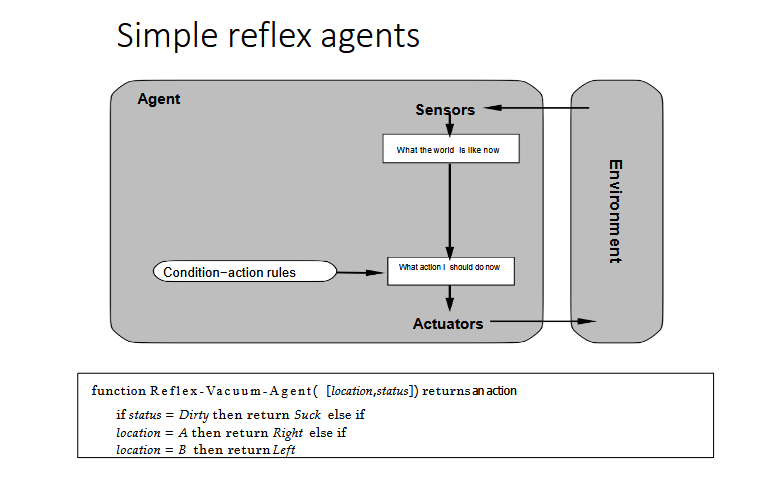
True or False. A goal-based agent uses only its initial environment to decide which action to take, not considering its goals.
False. Uses the current environment and its goals to decide which action will help achieve the desired result
Diagram of a goal-based agent

Which four factors is a problem defined by?
Initial state
Successor function
Goal test
Path cost
True or False. A solution is a sequence of actions from the initial to a goal state
True
Example of a goal-based agent travelling to Romania

Example problem formulation for travelling to Romania

What is the first step a utility-based agent follows?
Perceives the environment
What is the second step a utility-based agent follows?
Predicts outcomes of possible actions
What is the third step a utility-based agent follows?
Evaluates outcomes using a utility function
What is the fourth step a utility-based agent follows?
Chooses best outcome
Diagram of a utility-based agent
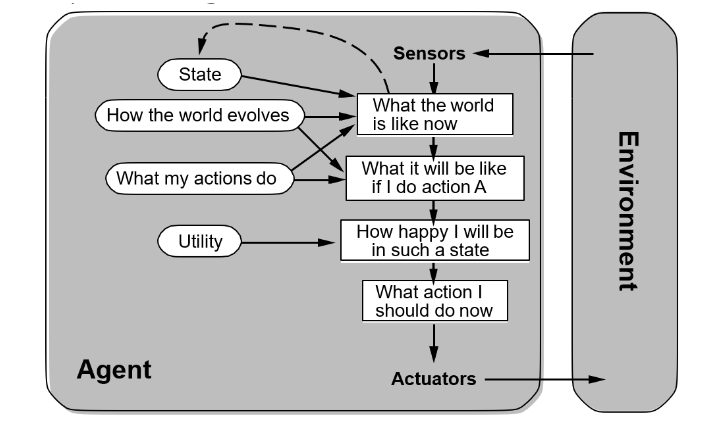
What are some examples of utility-based agents?
Autonomous vehicles
Financial trading systems
Recommendation systems
Healthcare management
What is the first step a learning agent follows?
Takes feedback from a critic to learn from its performance
What is the second step a learning agent follows?
Updates its knowledge to improve its performance
What is the third step a learning agent follows?
Uses a problem generator to explore new actions and improve future decisions
What are some examples of learning agents?
Game Playing AI (AlphaGo, Chess AI)
Recommendation Systems (Amazon)
How does a deterministic, fully observable (single-state) problem work?
Agent knows which state it will be in
Solution is a sequence
How does a non-observable (sensor-less) problem work?
Agent may have no idea where it is
If solution, it’s a sequence
How does a non-deterministic and/or partially observable (contingency) problem work?
Percepts provide new info about current state
Solution is contingent plan or policy
How does a unknown state space (exploration) problem work?
Agent must explore environment to discover the states and how they connect
Current research and future directions

What are some examples of multi-agent systems?
Traffic management
Smart grids
Robotics
Gaming
What are some challenges in developing multi-agent systems?
Communication and coordination
Decision-making
Learning
What are some ethical and social implications?
Algorithm bias and fairness
Transpareny
Privacy and security
Legal and accountability
Workplace displacement