Era 1
 Call Kai
 Learn
Learn Practice Test
 Spaced Repetition
 Match
Match Flashcards
 Knowt Play
1/27

There's no tags or description
Looks like no tags are added yet.
Name | Mastery | Learn | Test | Matching | Spaced | Call with Kai | Chat |
|---|
No analytics yet
Send a link to your students to track their progress
28 Terms
It supported economic development, settlement, and the growth of large-scale, organized societies like the Aztecs and Pueblos.
Maize cultivation
The growing of corn, a staple crop that spread from Mexico northward.
Maize cultivation
Native American groups in the central part of North America who developed largely mobile, hunter-gatherer lifestyles in response to the region's arid grasslands.
Great Plains societies
A Spanish labor system that granted conquerors the right to the labor of specific groups of Native Americans. It was a form of coercive labor disguised as a system for protection and Christianization.
Encomienda system
A social hierarchy established by the Spanish in the Americas that organized society based on racial ancestry. It placed Europeans at the top and Africans and Native Americans at the bottom.
Caste system
Dry, permanent, maize
Southwest
Hunter-gatherers, coastal/fishing
Northwest
Hunter-gatherers, boar/grassland
Plains
Rich soil, permenant
Mississippi valley
Agricultural and hunter-gatherer economies, trees, fertile, Iroquois, permenant
Northeast
Europeans and Native Americans disagreed deeply on religion, gender roles, family structures, and land ownership
Social and cultural change
Spain created a strict caste system (castas) in its colonies to define the social status of Europeans, Native Americans, and enslaved Africans
Social and cultural changes
The Spanish used the encomienda system to force Native Americans to mine and farm, and they partnered with West African traders to start the transatlantic slave trade
Social and cultural changes
Finding wealth in the Americas sparked fierce political, religious, and economic rivalry among European nations like Spain, Portugal, France, and England
Political and economic changes
Influxes of gold and silver from the Americas helped shift Europe's economy away from feudalism and toward early capitalism
Political and economic changes
Gold, god and glory
Reasons for European expansion
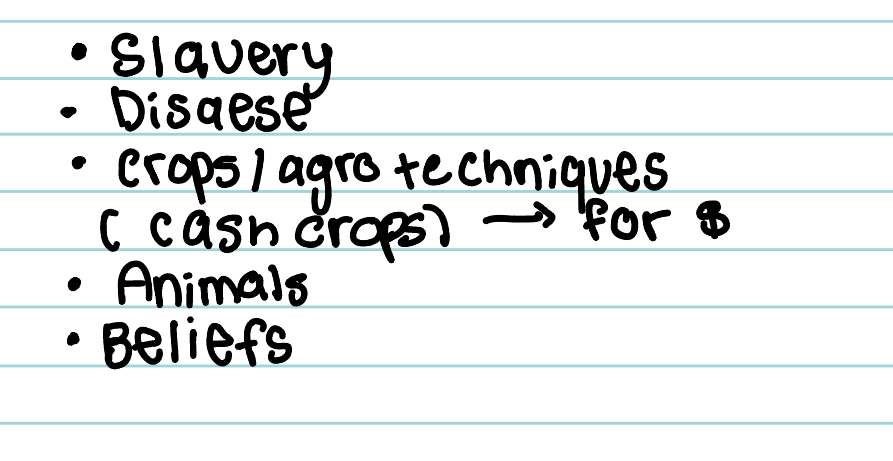
Effects of Colombian exchange on Europe
vast geographic reach, aggressive extraction of wealth, and deep religious mission.
Characteristics of Spanish empire
leading to the collapse of indigenous empires, massive demographic shifts, and the creation of an entirely new colonial society.
Effects of Colombian exchange and Spanish power on the americas
Artificial systems built by native groups (like the Pueblo) to divert water to crops. This allowed societies to farm and build permanent villages in dry climates.
Irrigation
A vast, arid region in the western US (present-day Nevada/Utah). Lacking water and resources, the native groups here lived highly mobile, nomadic lifestyles.
Great Basin
A fertile region where advanced, sedentary native societies (like the Cahokia) built massive earthen mounds and large permanent settlements based on agriculture.
Mississippi River valley
The East Coast of North America. Societies here (like the Powhatan) combined hunting, fishing, and agriculture in permanent villages.
Atlantic seaboard
The initial meeting, interaction, and clash between Europeans, Native Americans, and Africans beginning in 1492.
Contact
The massive transatlantic transfer of plants, animals, culture, human populations, technology, and diseases between the Eastern and Western Hemispheres.
Colombian exchange
: A business where multiple investors pool their money to fund voyages and share profits/losses. This was a critical financial tool used by the British to fund colonies (like Jamestown) without relying on the king's money.
Joint-stock company
The act of bringing a group of people under complete control or enslavement through force.
Subjugation
A widespread outbreak of an infectious disease (like smallpox) that spreads rapidly through a population with no immunity.
Epidemic