FC 2-3 Water in foods
 Call Kai
 Learn
 Practice Test
 Spaced Repetition
 Match
 Flashcards
 Knowt Play
1/17

There's no tags or description
Looks like no tags are added yet.
18 Terms
What are three things that water controls in foods?
Shelf life
Texture
Freezing behaviour
Why is water important for shelf life?
Microbes, enzymes and chemical reactions depend on it
Why is water important for structure and texture?
Juiciness and crispiness
Water binding capacity: how well meat products, thickeners and instant-products hold water → water adds weight, more weight more money. Water can also stabilize instant-products
Why is water important for freezing (ice-crystals)?
Lower reaction rates
Osmotic effects
Volume increase
Lower water activty
Why does bread have a high water content although it feels dry?
Because water is very tightly bound

How are water molecules bound together?
Through hydrogen bonding
Hydrogen bonding of water molecules in a — configuration.
Tetrahedral
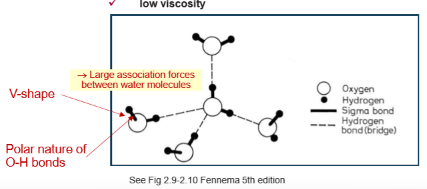
How is the water molecule shaped? What is water’s structure?
The molecule is V-shaped and its O–H bonds are polar, so each molecule forms hydrogen bonds with neighbours in a tetrahedral arrangement (large association forces between water molecules).
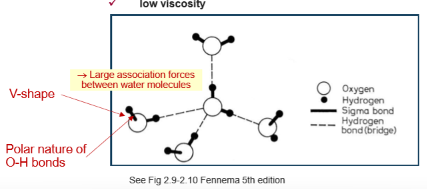
What are the characteristics of water structure?
Ordered structure: dynamic three dimensional network
“Effective MW” higher than it is: this is why its heat capacity, melting point, boiling point, surfave tension and enthalpies of phase transitions are high
Low viscosity → IA: because the bonds break and re-form constantly
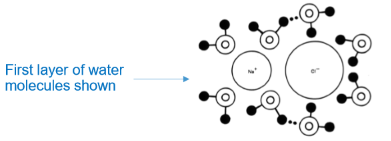
What are the interactions of water with ions?
Net structure formers: small and/or multivalent ions (i.e. strong electric fields) → e.g. Li+. Na+, Ca2+, Mg2+, Mg2+, OH-
Net structure breakers: large and/or monovalent ions (i.e weaker electric fields) → e.g. K+, NH4+, Cl-, NO3-
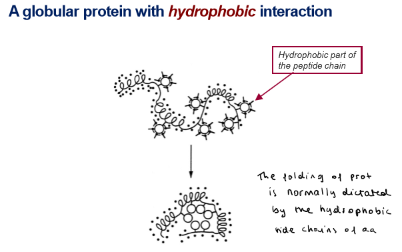
What are the interactions of water with non-polar substances?
Hydrophophic hydration: water can’t hydrogen-bond to a hydrophobic group, so it builds an ordered cage (clatharate hydrate) around it. → a result of water’s attempt to miniize contact with hydrophobic groups
Does hydrophobic hydration cost energy? What is the hydrophobic interaction?
It does. As the cage costs entropy (it is ordered, which is unfavourable), water prefers to put hydrophobic groups together. It can be depicted thermodinamically (hydrophobic interaction):
ΔG = ΔH − TΔS
When hydrophobic groups cluster, the caged water is released and ΔS rises a lot. So ΔG < 0 (spontaneous reaction, exergonic) and aggregation happens on its own
The hydrophobic interaction is driven by entropy
Example by IA:
Imagine 10 small oil droplets scattered through water. Each one has its own cage, so a lot of water is locked up. Now let them merge into 1 big droplet: the total surface area touching water is much smaller, so far fewer water molecules are needed for the cage. The rest are released back into the free liquid and get their freedom back.
So entropy increases when the hydrophobic groups cluster. The oil didn't pull itself together. The water "pushed" it together, because that frees up the most water.

The folding of a protein is normally dictated by the — aa side-chains. That is why globular proteins fold with (hydrophobic/polar) residues on the inside and (hydrophobic/polar) ones on the outside.
Hydrophobic
Hydrophobic
Polar
Food stability is strongly correlated to the —.
Water activity
Define water activity:
Water activity (aw) is a measure of the energy status of the water in a system i.e. the intensity with which water associates with othe compounds.
Define water activity mathematically:
aₐ = p/p₀ = ERH/100 → it ranges from 0 (completely dry) to 1 (pure water)
relative water pressure:
p: vapour pressure of water above the food
po: the vapour pressure of pure water at the same time
equilibrum relative humidity above the food: ERH
How can you measure water activity?
With hygrometer (e.g. resistive electrolytic hygrometers, capacitance hygrometers, Dew point hygometers)
Water active