(7): 34: Anticoagulant drugs II: non-coumarins and 35: Fibrinolytic drugs
 Call Kai
 Learn
 Practice Test
 Spaced Repetition
 Match
 Flashcards
 Knowt Play
1/23

There's no tags or description
Looks like no tags are added yet.
24 Terms
Anticoagulant drugs II: non-coumarins
Types of anticoagulants
Indirect anticoagulants
Heparins
MOA
Drugs/Reversal
Caution
Adverse effect
Direct anticoagulants
Direct Factor Xa Inhibitors
MOA
Drugs/Reversal
Caution
Advantage
Fun Facts
Uses
Interaction
Direct Thrombin (IIa) Inhibitors
Drugs
Heparins
MOA
All enhance antithrombin III (ATIII) → inhibit clotting factors.
Heparins
Drug
Drug | MOA | Monitoring |
|---|---|---|
UFH | Inhibits IIa + Xa | aPTT
|
LMWH | Mainly inhibits Xa | Usually none |
Fondaparinux (Arixtra) | Inhibits Xa only | Usually none |
UFH: Long chain; IV/SC; immediate anticoagulation.
LMWH: Short chain; SC; more predictable.
Fondaparinux: Synthetic; SC;
LMWH/fondaparinux → monitoring may be needed in renal dysfunction, obesity, pregnancy.
Heparin
Caution
Never administer heparin IM → hematoma.
Avoid heparin with active bleeding or a history of HIT.
Heparin Reversal
Protamine
UFH → Full reversal.
LMWH → Partial reversal.
MOA: Protamine (+) binds heparin (−) → neutralizes anticoagulant effect.
Heparin
Adverse Effect
Heparin-Induced Thrombocytopenia (HIT)
Other heparin adverse effects:
bleeding
long-term use → osteoporosis, alopecia, hypersensitivity.
Heparin-Induced Thrombocytopenia (HIT)
What is it? ↓ Platelets BUT ↑ thrombosis (clot formation).
How it happens? Heparin + platelet factor 4 → immune reaction.
Treatment - Alternative anticoagulant → Argatroban.
Direct Factor Xa Inhibitors
MOA: Directly inhibit factor Xa → block coagulation.
Drugs: Rivaroxaban (Xarelto) + Apixaban (Eliquis)
Reversal → Andexanet alfa (Andexxa).
Caution - Dose adjustments may be needed with renal dysfunction or low body weight.
Advantages:
Oral
rapid onset
no routine INR
predictable, fixed dosing
Fun Facts
Uses: AF stroke prevention, DVT/PE, postoperative clot prevention.
Interactions: CYP3A4 + P-glycoprotein.
Direct Factor Xa Inhibitors
drugs
Rivaroxaban | Apixaban |
|---|---|
Once daily in professor's comparison | Twice daily |
Higher GI bleeding risk | Lower GI bleeding risk |
Direct Thrombin (IIa) Inhibitors
Drug | MUST KNOW |
|---|---|
Argatroban (Acova) |
|
Dabigatran (Pradaxa) |
|
Both inhibit thrombin directly, without ATIII.
Dabigatran
⭐ Dabigatran reversal → Idarucizumab (Praxbind).
Warfarin Comparison to DIRECT anticoagulants!
Warfarin (Coumadin)
Inhibits vitamin K recycling → decreases clotting factor production.
Delayed onset, requires INR monitoring.
Many food and drug interactions.
Direct Xa/IIa inhibitors
faster, more predictable effects.
Clinical Scenarios
UFH - Acute DVT/PE needing immediate anticoagulation
LMWH - Pregnancy
Argatroban - HIT
UFH / Argatroban - Severe renal dysfunction
Oral direct anticoagulants - Long-term AF stroke prevention
Fibrinolytic Drug
Fibrinolytic Drugs - topics
Mechanism
Meds
Cautions
Adverse Effects
Clinical Uses
Anticoagulants =
Prevent clot formation/extension.
Fibrinolysis
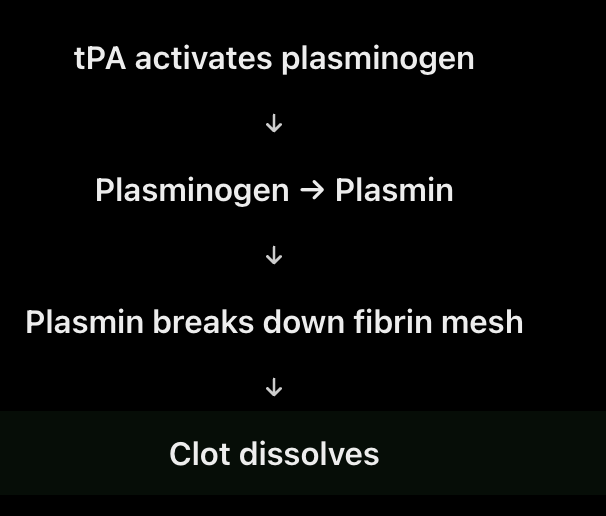
Mechanism
Fibrinolytics = DISSOLVE an existing clot.
Fibrinolytic Drugs
Drug | MUST KNOW |
|---|---|
Streptokinase |
|
Alteplase |
|
Tenecteplase |
|
All administered IV.
Fibrinolytic
Clinical Uses
Used for serious clot-related vessel obstruction:
Acute ischemic stroke
STEMI (heart attack)
Pulmonary embolism
Severe DVT / other life-threatening obstructions.
⭐ STEMI:
PCI preferred when promptly available.
If PCI unavailable/delayed → fibrinolytic therapy may be used during transfer.
TIME IS MUSCLE → treatment delays increase heart damage.
Fibrinolytic
Adverse Effects
Streptokinase → allergic reactions.
Bleeding → most important.
Intracranial hemorrhage → bleeding inside skull.
Reperfusion injury → Blood returns → damaged vessel may BLEED.
Fibrinolytic
Contraindications
Absolute — Do NOT use | Relative — Weigh risks |
|---|---|
History of intracranial hemorrhage | Anticoagulation with high INR |
Certain recent ischemic strokes | Recent major surgery |
Serious recent trauma | Pregnancy |
Suspected aortic dissection | Peptic ulcer |
Fibrinolytics increase the risk of severe bleeding.
Antifibrinolytic / Reversal
Tranexamic acid
🧠 TRANEXAMIC = Tells clot to STAY.
Tranexamic acid
MOA: Blocks plasminogen/plasmin binding → prevents fibrin breakdown.
Effect:
Stabilizes clot → helps control bleeding.
to counter excessive fibrinolysis.
Cauton: Professor mentioned avoiding in DIC and genitourinary bleeding.
Risk: Increased thrombosis.
MEMORIZE: DRUG → REVERSAL
Anticoagulant / Drug class | Reversal |
|---|---|
UFH | Protamine — full |
LMWH | Protamine — partial |
Rivaroxaban / Apixaban | Andexanet alfa |
Dabigatran | Idarucizumab |
Fibrinolytics | Tranexamic acid |