Chapter 15.1 : Regulation of Gene Expression - Bacteria often respond to environmental change by regulating transcription
 Call Kai
 Learn
 Practice Test
 Spaced Repetition
 Match
 Flashcards
 Knowt Play
1/29

There's no tags or description
Looks like no tags are added yet.
30 Terms
How is gene expression in bacteria controlled?
It’s controlled by a mechanism described as the operon model
TRUE OR FALSE: Natural selection has favored bacteria that produce only the gene products needed by the cell.
TRUE
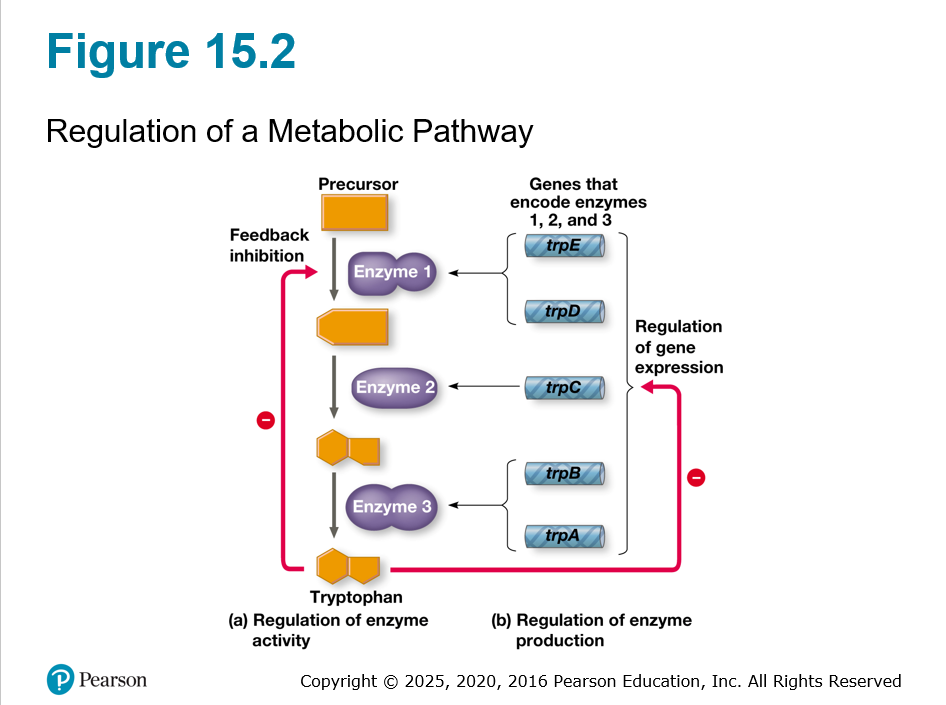
List two ways a cell can regulate enzyme production.
feedback inhibition
gene regulation
What is inside an operon?
In an operon, a single promoter serves a set of functionally related genes.
These genes can then be coordinately controlled by a single “on-off switch”
What is an operator?
The operator is a segment of DNA that acts as our “switch” and it is usually positioned within the promoter.
What is an operon
An operon is the entire stretch of DNA that includes the operator, the promoter, and the genes that they control.
How can an operon be switched off?
By a protein repressor.
How do protein repressors switch operons off
The repressor binds to the operator and blocks the attachment of RNA polymerase
What is the repressor a product of
The repressor is a product of a separate regulatory gene, which is not part of the operon.
TRUE OR FALSE: an operator alternates between two states. If true, which two states?
TRUE: One state with the repressor bound and one without.
TRUE OR FALSE: The repressor is always in an active form.
FALSE: A repressor can be in an active or inactive form. depending on the presence of other molecules.
What is a corepressor
A corepressor is a molecule that cooperates with a repressor protein to switch an operon off.
Give an example of a repressible operon
trp (tryptophan) operon is an example of a repressible operon where tryptophan functions as the corepressor.
Explain in three steps how corepressors work?
ex: trp operon
By default, the trp operon is on and the genes for tryptophan synthesis are transcribed
when tryptophan is present, it binds to the trp repressor protein, which then turns the operon off
The repressor is active ONLY in the presence of its corepressor tryptophan; thus, the trp operon is turned off (repressed) if tryptophan levels are high.

Define a repressible operon
A repressible operon is an operon that is usually on. However, when the repressor binds to the operator, transcription shuts off.
Define an inducible operon.
An inducible operon is usually off; a molecule called an inducer inactivates the repressor and turns transcription on.
EX: lac operon
Give an example of an inducible operon
One example of an inducible operon is lac operon and contains genes that code for enzymes that function in the use of the sugar, lactose.
What are inducers?
Molecules that bind to active repressors, turning them inactive and thus turning transcription on.
What is the inducer for lac operon called?
Allolactose, formed from the lactose that enters the cell.
TRUE OR FALSE: Enzymes of the lactose pathway are called inducible enzymes and enzymes of the tryptophan synthesis are called repressible enzymes.
TRUE
Repressible enzymes usually function in which type of pathway?
Anabolic pathways; their synthesis is repressed by high levels of the end product.
Inducible enzymes usually function in which type of pathways?
Catabolic pathways. Their synthesis is induced by a chemical signal.
Regulation of the trp and lac operons involve what type of control of genes?
Negative, because operons are switched off by the active form of the repressor.
TRUE OR FALSE: E. COLI will preferentially use glucose when it is present in the environment
TRUE
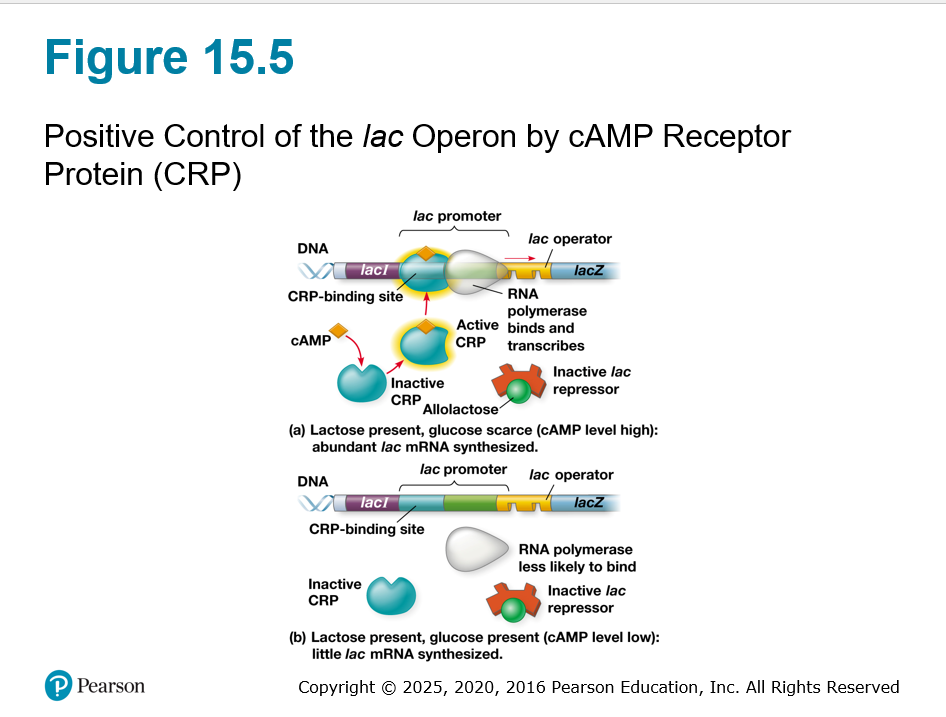
When glucose is scarce, what does CRP (cAMP receptor protein) do?
It acts as an activator of transcription.
How is CRP activated?
By binding with cyclic AMP (cAMP)
Activated CRP attaches to the promoter of the lac operon and increases the affinity of RNA polymerase in order to…..
accelerate transcription.
What does cAMP do when glucose levels increase?
cAMP levels fall, CRP detaches from the lac operon, and transcription proceeds at a very low rate, even if lactose is present.
TRUE OR FALSE: CRP helps regulate only the glucose operon
FALSE: CRP helps regulate other operons that encode enzymes used in catabolic pathways.
It may affect the expression of more than 100 genes in E. Coli