Physics Exam SCINT DETECTORS ONLY!
 Call Kai
 Learn
 Practice Test
 Spaced Repetition
 Match
 Flashcards
 Knowt Play
1/48

There's no tags or description
Looks like no tags are added yet.
49 Terms
What is the scintillation detector system, starting at the detector?
Detector, linear amplifier, pulse height analyzer (where we get our analog pulses in btwn), Counter scaler (where we get our digital pulses in btwn). During the PHA, we have a Multi-Channel Analyzer that sorts counts into bins of accepted counts.
What makes Sodium Iodide scintillation detector so desirable?
Large crystals are available at a reasonable cost and they have geometric efficiencies. High atomic number combined with dense crystals results in high intrinsic detection efficiencies.
Photoelectric absorption and Compton scatter both create ...
Ion pairs (free electron and an atom minus one electron)
What does the excited electron create?
Light emission
What happens to produce light in a scintillator?
Excited electron creates light emission
Moves from valence to conduction band. Fall to energy state created by impurity. Fall to valence band with emission of light.
What interactions occur in scintillation processes?
Photoelectric absorption
Compton Scattering
Be familiar with this image

After photon interaction in crystal, light flashes proportional to ?
Energy deposited
What component of the scintillation detector collects the emitted light?
Photocathode
What component of a scintillator emits electrons after the light?
Photocathode
Which component of a scintillator amplifies the electrons?
Dynodes
Which component of a scintillator collects the electrons?
After electrons are collected at the anode, what happens?
Charge integration (the process of collecting an electrical current pulse over a set period of time and measuring the total accumulated electric charge.)
What is the pulse shaped by in the scintillator?
Pre-amplifier
What is the pulse amplified by?
Linear amplifier
What is the pulse analyzed by?
The pulse heigh analyzer
Refresher: What is the diagnostic energy range and what interactions are possible in this range?
30-511 keV
Photoelectric Absorption and Compton Scatter
There are certain interactions that can occur for X-rays and gamma rays within a NaI detector. What are these?
A, B, and C are all results of photoelectric absorption in the lead shield, with a lead x-ray absorbed. B and C are different types of A that can occur.
A. Total Absorption (either B or C)
B. Compton Scatter with Absorption
C. Compton Scatter with Escape
D. Photoelectric Absorption/X-ray Escapes
E. Compton Scatter in Shield. Scattered photon absorbed.
and scattering of the photon in the source.

Explain what happens in photoelectric absorption on the first interaction.
The gamma photon disappears and ejects an electron. When the atom fills the vacancy, it can emit a characteristic x-ray. If the electron and the X-ray both deposit their energy inside the crystal, the detector records the full gamma energy.
Explain what happens in photoelectric absorption followed by compton scatter.
At each Compton scatter, the photon gives some energy to an electron and continues with less energy. The final photoelectric interaction absorbs the remaining photon. If all the energy stays in the crystal, the detector adds those deposits into one full-energy pulse.
Image as a reminder of Photoelectric Absorption

Explain Iodine Escape
Occurs when an X-ray produced inside the NaI detector crystal escapes, carrying away some of the original gamma photon's energy. The photon undergoes photoelectric absorption in an iodine atom, ejecting an inner shell electron. This leaves a vacancy that is then filled, releasing a characteristic iodine X-ray.
Characteristic Iodine X-rays are always how much less than the photopeak?
28 keV
Compton Scatter Image Refresher
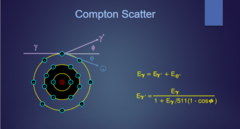
How do we calculate the ejected electron after compton scatter? For example, what if the angle of a 140 kev photon is 90 degrees?
You would take 180-90 to get the energy of the gamma photon, with the rest of the energy going to (140 keV) the electron energy (140-110) would be 30.
Explain partial absorption and what it is called on the graph.
Occurs when a gamma photon undergoes Compton scatter inside the detector crystal and the scattered photon escapes. The detector reads only the energy deposited by the electron. This produces a range of energies called the Compton Scatter in Detector.
What is the multiple compton scatter in detector portion of the graph ?
Explains how much energy a detector records from a Tc-99m point source in air.


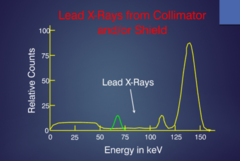
Where is the lead x-rays from collimator and/or shield on the graph?
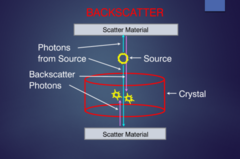
What is backscatter and where is it on the graph?
Backscatter happens when a gamma photon undergoes Compton scatter in material outside the detector and turns back toward the crystal.
Top path: A photon travels upward from the source, hits the scatter material above it, and scatters downward into the crystal.
Bottom path: A photon passes through the crystal, hits the material below it, and scatters upward back into the crystal.
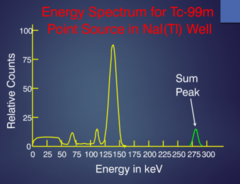
Where does the sum peak, which is where the simultaneous interactions are expressed, live on the graph?
Everything summed up, so supperrrrr far to the right
What is Compton Scatter in a volume source and how does it appear on the graph?
A volume source is radioactive material spread throughout a figure, like the body or an organ. It can either go straight to the detector without scattering, scatter but still reach the detector with less energy, or scatter out and not hit the detector.

Practice this Energy Spectrum Graph

What is a liquid scintillation detector typically used for?
For beta and low energy gamma counting
What are solid state detectors also known as? Also, separate from that, what are they similar in operation to?
Semiconductors, similar in operation to an ionization chamber.
What happens in a solid state detector?
Voltage is applied across the semiconductor (a solid material whose electrical conductivity falls between that of a conductor and an insulator), Ions created in the material migrate to circuits, and charge collected represents energy absorbed.

What are common examples of solid state detectors?
Cadmium zinc telluride (CZT) and High Purity Germanium (HPGe).
Are scintillation or solid state detectors more expensive? Which has higher energy resolution?
Solid state for both questions
What is one key advantage of solid state detectors?
Form for design of imaging equipment (smaller, more compact, easier to use for that reason)
Properties of solid state detectors: Atomic number, density, energy resolution, and room temp operation of NaI and CZT.
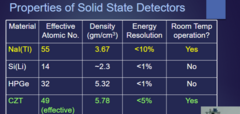
Define energy resolution
Accuracy of energy determination
How do we record energy resolution?
Using FWHM of photopeak as a percent. Full width half maximum (measures the full width at half max of the photopeak L O L)
width/peak max times 100
How do we determine detector performance efficiency for both extrinsic/geometric and intrinsic purposes? Give the equations.
Extrinsic: photons incident upon the detector/photons emitted
Intrinsic: photons detected/photons incident upon the detector
Total efficiency: multiply the two (photons detected/photons emitted)
What is dead time when considering detector performance?
Dead time is the small amount of time required to process each detection event. Another count cannot be accepted during this time. (Paralyzable and non-paralyzable)

What is dead time specifically an issue for? *What kinds of detectors?
Issue for scintillators and Geiger counters
Is a dose calibrator a scintillation?
NO
Is a well counter an ion chamber?
NO
Well counters can determine the .....
ENERGY

What kind of detector is an uptake (thyroid) probe?
Scintillation

What is the automatic counter that we use for GFR's an example of?
A scintillation detector