10.6 Neurodevelopmental disorders
 Call Kai
 Learn
 Practice Test
 Spaced Repetition
 Match
 Flashcards
 Knowt Play
1/37

Earn XP
Description and Tags
Neurodevelopmental disorders
38 Terms
Child neuropsychology
Study of the brain in development & its repercussions on behaviour both in cases of brain injury or diffusion & in healthy children.
The evolutionary neurobiology of the brain is therefore
The incidence → developmental disorders
17% of the school-age population has one or more developmental disorders
What are the differences between Child Neuropsychology vs. Adults
The infant brain is in a stage of rapid development, something that does not happen in an adult.
The brain of an adult has the most established connections & therefore, less neuronal plasticity & worse prognosis in case of brain damage.
Damage in children is usually more diffuse due to the low specificity of the brain.
Classification of common Neurodevelopmental disorders
Intellectual disability (ID)
Communication disorders
Autisms Spectrum Disorder
Attention-Deficits / Hyperactivity Disorder ADHD
Specific Learning Disorder (SLD)
Intellectual disability (ID) → main characteristics
deficits in intellectual functioning (reasoning, problem solving, & learning)
deficits in adaptive functioning in conceptual, social & practical domains
onset during the developmental period (childhood)
Intellectual disability (ID) → areas affected
Understanding & using language
social skills (interpersonal relationships)
practical skills (self-care, independence)
Communication disorder → main characteristics
persistent difficulties in the acquisition, use or understanding of language, speech &/or communication
may affect expressive &/ or receptive language, speech sound production, fluency or social (pragmatic) communication
Communication disorder → examples / areas affected
limited vocabulary
grammatical difficulties
speech sound errors
difficulty using language appropriately in social context
Autism spectrum disorder → main characteristics
Persistent difficulties in social communication & social interaction
restricted & repetitive patterns of behaviour, interests, or activities
symptoms present from early development & affect daily functioning
Autism spectrum disorder → examples / areas affected
difficulties with social reciprocity (understanding social cues)
repetitive behaviours or restricted interests
preference for routines & sameness
sensory sensitivities (common)
Attention-Deficits / Hyperactivity Disorder ADHD → main characteristics
persistent pattern of inattention &/or hyperactivity-impulsivity
interferes with functioning or development
symptoms are present in multiple settings (home, school) & are not better explained by another condition.
Attention-Deficits / Hyperactivity Disorder ADHD → examples / areas affected
difficulty sustaining attention
easily distracted
impulsivity (acting without thinking)
Hyperactivity (excessive motor activity, difficulty remaining seated)
Specific learning disorder → main characteristics
persistent difficulties in acquiring & using academic skills, despite appropriate instructions & intervention
affects reading, written expression &/or mathematics
not explained by intellectual disability, lack of educational opportunity or another neurological condition.
Specific learning disorder → examples / areas affected
reading (inaccurate or slow reading)
written expression (e.g., spelling, grammar, organization)
mathematics (number sense, calculation, problem solving)
Intellectual disability
there are limits to a person’s ability to learn at an expected level
might take longer into developing motor skills (eg.: sitting down or walking
In school → might struggle with semantic memory, social rules & problem solving.
Males are more likely to be diagnosed, & poverty is a mayor risk.
Causes of intellectual disabilities
during gestation
after birth due to severe head injury, stroke or infection
disorders associated with intellectual disabilities
cerebral palsy
hydrocephalus
fetal alcohol syndrome
fragile-x syndrome
down syndrome
Cerebral palsy
Disorder primarily motor function caused by brain trauma in the course of fetal development or birth.
It also comes with cognitive & emotional impairment.
Hydrocephalus
Characterized by increased volume of CSF, by an obstruction in the flow.
Fetal Alcohol syndrome
Physical malformations & intellectual impairment observed in children born of mothers which used alcohol during the pregnancy.
Fragile-X syndrome
Characterized by facial abnormalities & mental disabilities ranging from subtle learning disorders to severe intellectual impairment.
It associated with attention deficits, hyperactivity, anxiety & unstable mood & behaviour.
Down syndrome
Congenital condition caused by the presence of an additional copy of the chromosome 21 → Trisomy 21
Communications disorders
a variety of speech & language disorders that present as problems in communication or oral motor function.
referred as a problems in speech comprehension or speech expression that significantly interferes with n individual’s achievement &/or quality of life.
Communications disorders → types
Language disorder
Speech sound disorder
Childhood-Onset Fluency Disorder
Social Communication Disorder
Language disorder:
Presents difficulties in learning & using spoken, written, or sign language.
Ex.: delay in first words
Speech sound disorder
Problems in articulation & pronunciation of a native language
Childhood-Onset Fluency Disorder
Commonly called as stuttering.
It is a condition in which standard fluency & rhythm of speech are interrupted, often causing the repetition of whole words & syllables.
Social Communication Disorder
involves difficulties in the social uses of verbal & nonverbal communication in everyday contexts, affects the development of social relationships & discourse comprehension.
Autism Spectrum Disorder (ASD)
Display symptoms of impaired social interaction, an idiosyncratic & narrow range of interests, language & communication abnormalities, and, in some cases intellectual impairment.
More prevalent in men than women
Can have a exceptional ability.
The diagnose must be done through DSM-5 must say the severity of A axis (social communication) & B axis (restrictive & repetitive behaviour)
Autism Spectrum Disorder (ASD) → common symptoms
Difficulties to interact socially.
Insistence on sameness.
Stereotypy: hand flapping or rocking.
Unusual attachment to objects.
Resistance to change in routine.
Echolalia.
Sometimes, aggressive or self-injurious behaviour.
Learning disorders
Affect the ability of the child to acquire & apply reading, writing or math skills.
It is distinct to intellectual development disorders, as they have average intelligence.
dyslexia
dyscalculia
Autism; criteria
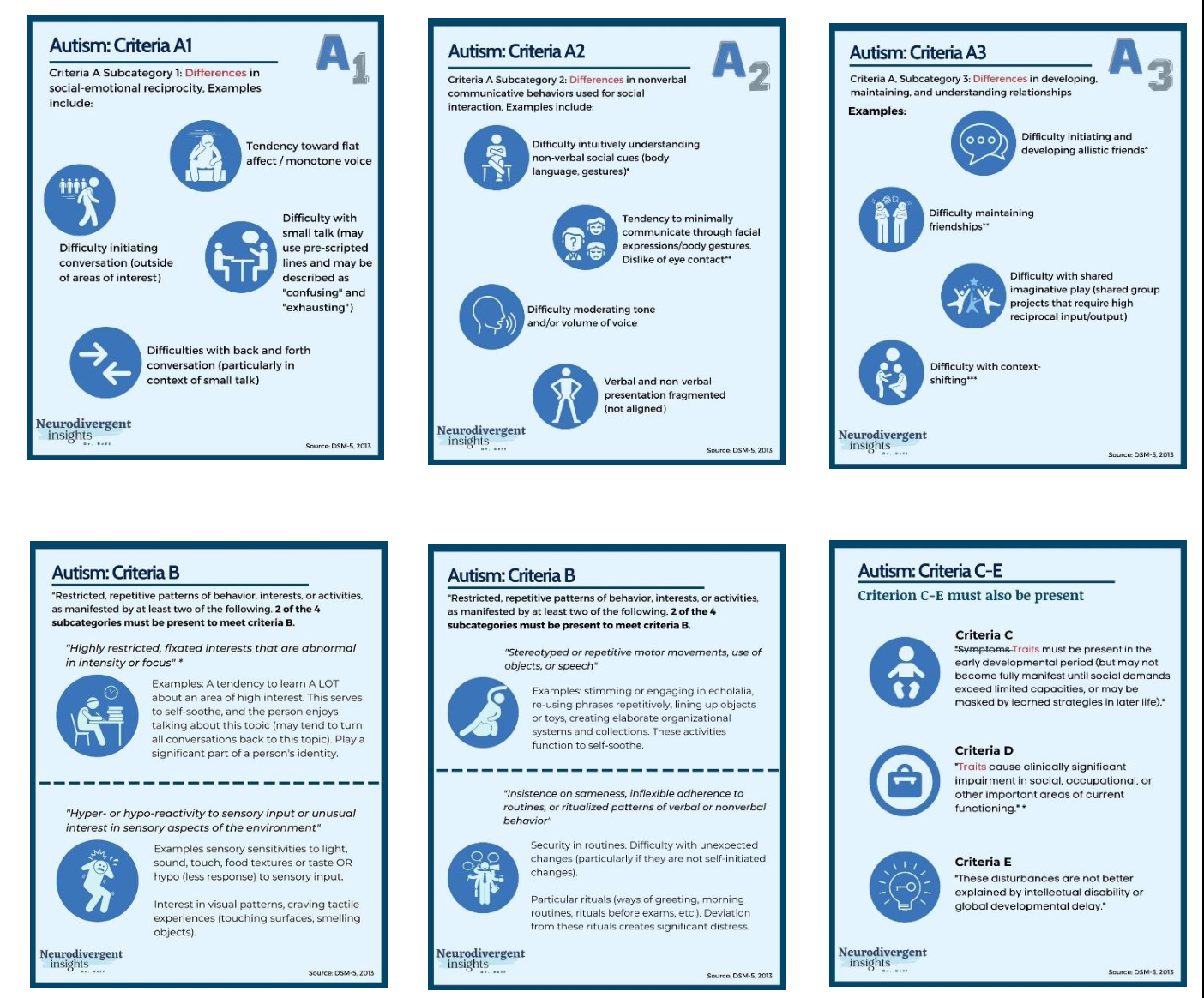
ADHD → characteristics
core behavioural symptoms impulsivity, hyperactivity &/or inattention
Child with ADHD have a 60% chance to have a second disorder & up to a 30% chance to have three or more.
Mayor issues in Executive Functions and WM
According to DSM-5 it must have →
Inattention
Hyperactivity & impulsivity
Inattention
Characterized by six or more symptoms, including avoiding tasks & distractibility as well as inability to pay attention to details, hold attention on tasks, listen follow instructions, organize and finish work.
Hyperactivity & impulsivity
Characterized by six or more symptoms including fidgeting, not remaining seated, running about, talking excessively, & inability to play & to take turns.
dyslexia
reading-related disorder
Dyscalculia
math-related disorder