Other Endocrine Glands
 Call Kai
 Learn
 Practice Test
 Spaced Repetition
 Match
 Flashcards
 Knowt Play
1/49

There's no tags or description
Looks like no tags are added yet.
50 Terms

Pineal gland
Location of pineal gland
hangs off roof of third ventricle beneath corpus callosum
what is involution
shrinkage with age that happnes with pineal gland
what are cells of pineal glands called and what do they secrete, whihc has what function (3)
pinealocytes → melatonin → circadian rhythm (day night cycle), promote sleep, influence puberty timing

yellow
thymus

Thymus
location
how many lobes
does it undergo involution
what 3 body systems is it part of
mediastinum
bilobed
yes
endocrine, lymphoid, immune
what does the thymus do and what 3 hormones
secrete hormones that stimulate development of other lymphoid organs and T lymphocyte activity
thymopoietin, thymosin, thymulin

Thyroid - largest endocrine gland

Thyroid
location
how many lobes and what are they
anterior of trachea under thyroid cartilage and larynx
biloped connected by isthmus (pyrimidal + lateral lobes)
What is the thyroid made up of
made up of thryoid follicles which contain protein rich colloid surrounded by follicular cells
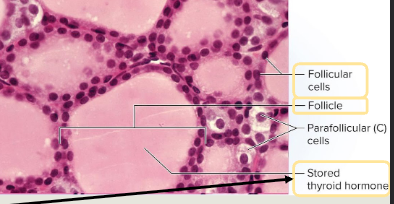
Colloid
Thyroglobulin + iodine → in lumen of thyroid follicle → make thyroid hormones
What does the thyroid gland secrete (2)
Thyroid Hormone (TH) → includes T3 (triiodiothyronine) and T4 (tetraiodothyronine/ thryoxine)
calcitonin
TH + functions
Thyroid hormones → T3 (10%) + T4 (mostly)
effects all cells of body
increases metabolic rate & heat production
Calcitonin - what is it produced by
parafollicular cells / C cells
What does calcitonin do
antagonist to parathyroid hormones
inhibits osteoclast activites (which breakdown/ resorb bone matrix to release Ca2+ into blood)
stimulates osteoblast activities & bone formation
LOWERS blood Ca2+

yellow
parathyroid
Parathyroid - where is it and what does it contain
4 small glands on thyroid gland posteriorly
contains chief cells that secrete parathyroid hormones (PTH)
PTH → 4 functions
Parathyroid hormones → increases Ca2+ levels
promote synthesis of calcitriol
increase Ca2+ absorption
decrease urinary excretion
increase bone resorption / breakdown by stimulating osteoclasts

adrenal gland / suprarenal gland
adrenal gland/ suprarenal gland
how many lobes, what shape
location
2 parts
2 lobes, pyramid shaped
above kidney (suprarenal)
cortex (outside) medulla(inside)


Adrenal cortex
Adrenal cortex and what does it produce
thicker outer layer of adrenal gland
produces corticosteroids/ corticoids (3 groups)
What are the three layers of the adrenal cortex from superficial to deep
zona glomerulosa
zona fasciculata
zona reticularis
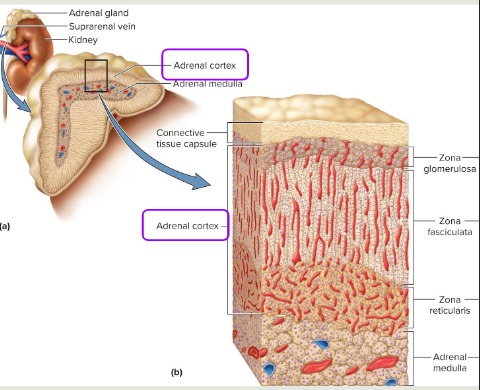
zona glomerulosa what layer and waht does it secrete
superficial layer → mineral corticoids (aldosterone)
z
zona fasciculata - what layer and waht does it secrete
middle layer → glucocorticoids (cortisol)
zona reticularis - what layer and waht does it secrete
innermost deep layer → gonadocorticoids ( sexhormones; androgens)
Mineral corticoids (aldosterone) → where , what does it regulate
zona glomerulosa of adrenal cortex
regulates electrolytes (Na+ and K+) in extracellular fluid
RAAS - renin angiotensin aldosterone system
low bp → angiotensin II → aldosterone → Na+ resorption and water retention by kideny (keep Na+ and water which follows Na+) → retaining fluid keeps bp up
Glucocorticoid (cortisol) - where, when is it released (3)
zona fasciculata and some in zona reticularis,released in response to adrenal corticotropin hormones by anterior pituitary gland + eating and activity + stress (fight or flight)
cortisol/ glucocorticoid main metabolic effect
+ 2 aditional effect
gluconeogenesis (formation of glucose from fat and protein) -
> incRease blood glucose level, fatty acids, and amino acids
keep bp constant - vasoconstrict
antinflamatory
gonadocorticoids (sex hormones) - where and when is it released
zona fasciculata and zona reticularis (mainly)
released in response to adrenocorticotropic hormones from anterior pituitary
2 main gonadocorticoids
androgen → testerosterone in male and estrogen in female
estradiol → source of estrogen during women menopause

Adrenal medulla
Adrenal medulla - what 2 systems
endocrine + autonomic nervous system (innervated by sympathetic preganglionic fibers)
What cells do adrenal medulla have which secrete what
chromaffin cells → catecholamines (mostly epinephrine, 20% norepinephrine, some dopamine)
Catecholamine functions
increase everything fight or flight
decrease digestion and urine
increase blood glucose level → glycogenolysis , glyconeogenesis, glucose sparing effect (epi)
norepinephrine → vasoconstriction → increase BP

Pancreas
what cells does the pancreas have
exocrine and endocrine cells
Pancreatic exocrine cell
acinar cells → produce pancreatic juice
Pancreatic endocrine cells
pancreatic islets (or islets of langerhorn) → alpha and beta
pancreatic islets alpha vs beta
alpha produces glucagon (hyperglycemic increasing blood glucose)
beta produces insulin (hypoglycemic decreasing blood glucose)
Glucagon targets ____ where it promotes
liver → glycogenolysis (glycogen → glucose) and gluconeogenesis
→ release glucose into blood
Insulin does what
inhibits glycogenolysis and gluconeogenesis → lower blood glucose level
increasing glucose transport into fat and muscle cells

Ovary

Testes
Gonads (ovary and testes) → exocrine product
ovaries → eggs
testes → sperm
gonads endocrine product
gonadal hormones (mostly steroids)
ovary → estradiol and progesterone
teste → testosterone, estrogen, weak androgens
ovaries produce what which does what
progesterone and estrogen → female development
Placenta secretes what
estrogen, progesterone, human chorionic gonadotropin
Testes produce what
testosterone→ male characteristics