SCM 410 - Week 9 Multiple Choice
 Call Kai
 Learn
 Practice Test
 Spaced Repetition
 Match
 Flashcards
 Knowt Play
1/19

There's no tags or description
Looks like no tags are added yet.
20 Terms
Strategic Sourcing?
Systematic, long-term approach to procurement that focuses on managing purchasing activities to optimize value, reduce total cost, and build strong supplier relationships.
Unlike traditional purchasing, which is often transactional and price-focused, strategic sourcing emphasizes a holistic evaluation of the suppliers, including factors of?
Quality, reliability, innovation, and risk.
Inventory Classification?
Process of categorizing inventory items into different groups based on specific criteria to support decision-making related to inventory management.
ABC Analysis?
Classification technique assigns inventory items to one of three groups according to the relative impact or value of items that make up the group (A reflects 80-20 Rule).
A ITEMS?
Category A items have high value and a significant impact on revenue; thus, high safety stock levels should be maintained. This reduces risk of stockouts and ensures critical items are on-hand to fill key orders.
B ITEMS?
Category B items have moderate value and demand; as such, safety stock levels should be balanced. The focus should be on optimizing (lower) ICC while maintaining reasonable levels of inventory availability.
C ITEMS
Category C items have low value and demand; thus, low safety stock levels is appropriate. Although still important to avoid stockouts, goal is to streamline reordering processes and/or use automated systems.
Kraljic Matrix?
Strategic purchasing tool that helps companies manage their supplier relationships and procurement strategy by classifying goods and services based on Profit Impact and Supply Risk Impact.
Profit Impact?
The extent to which an inventory item or service impacts an organization’s financial performance.
Supply Risk Impact?
The extent to which an inventory item or service is difficult to source at the required cost, time, quality, and quantity.
Leverage Items - Strategic Decisions?
Maximize Buying Power
Negotiate aggressively
Use competitive bidding
Exploit economies of scale
Strategic Items - Strategic Decisions?
Build Partnerships
Collaborate with suppliers
Invest in joint innovation
Ensure supply continuity
Non-Critical Items - Strategic Decisions?
Streamline & Automate
Reduce transaction costs
Use e-procurement
Focus on efficiencies
Bottleneck Items - Strategic Decisions?
Secure Supply
Create contingency plans
Manage inventory
Find alternative sources
The purpose of Inventory Ordering Models is to help organizations determine?
1) How much to order
(2) When to order
Effective inventory ordering models balance product availability with cost- efficiency. Selecting the right ordering method allows organizations to better manage?
Demand variability as well as minimize stockouts and excessive ICC.

Fixed Order Quantity Certainty
Technique involves ordering a fixed amount of inventory each time ordering takes place; amount depends on ordering costs and ICC.
Reorder point is determined to fulfill demand until restocking occurs.
Inventory items critical to operations and steady predictable demand.
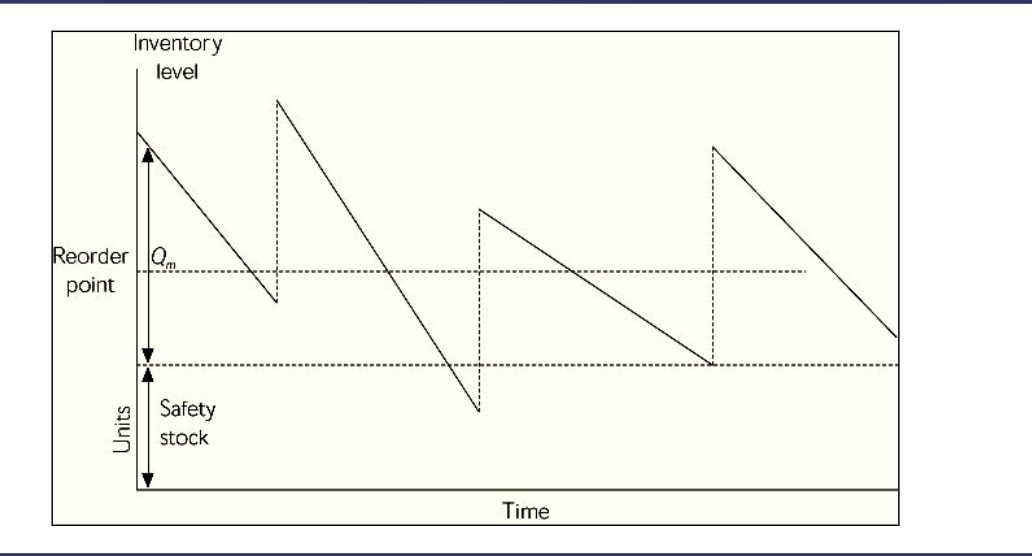
Fixed Order Quantity Uncertainty
Technique involves ordering a fixed amount of inventory each time
ordering takes place; includes safety stock to address uncertainty.
Certain conditions do not reflect what most companies experience.
Inventory items critical to service; variable demand and lead times.

Fixed Order Interval
Technique involves ordering inventory at fixed intervals; the amount
ordered depends on how much stock is available at time of review.
● Inventory is counted near interval end to determine order quantities.
● Inventory items with low ordering costs and relatively stable demand.
Economic Order Quantity (EOQ)?
Is a quantitative inventory management model used to determine the optimal ordering quantity that minimizes Total Annual Costs (TAC) associated with ICC and Ordering Cost.