Art History Module 3 Exam
 Call Kai
 Learn
 Practice Test
 Spaced Repetition
 Match
 Flashcards
 Knowt Play
1/59

There's no tags or description
Looks like no tags are added yet.
60 Terms
Geometric Krater, Greece, c. 750 BCE, Geometric Period
Found at a cemetery, made to mark a gravesight - very different from the usual vessel as it was open to the ground, covered with diamonds, triangles, circles, meanders, pictorial bands called friezes. Shows large central funerary scene, with very abstracted human forms

Black-Figure Amphora with Animal Friezes, Greece, c. 600 BCE, Orientalizing Period
Registers with animal scenes, filled background

“Lady of Auxerre,” Greece, c. 650 BCE, Orientalizing Period
Stiff frontal form, kore statue

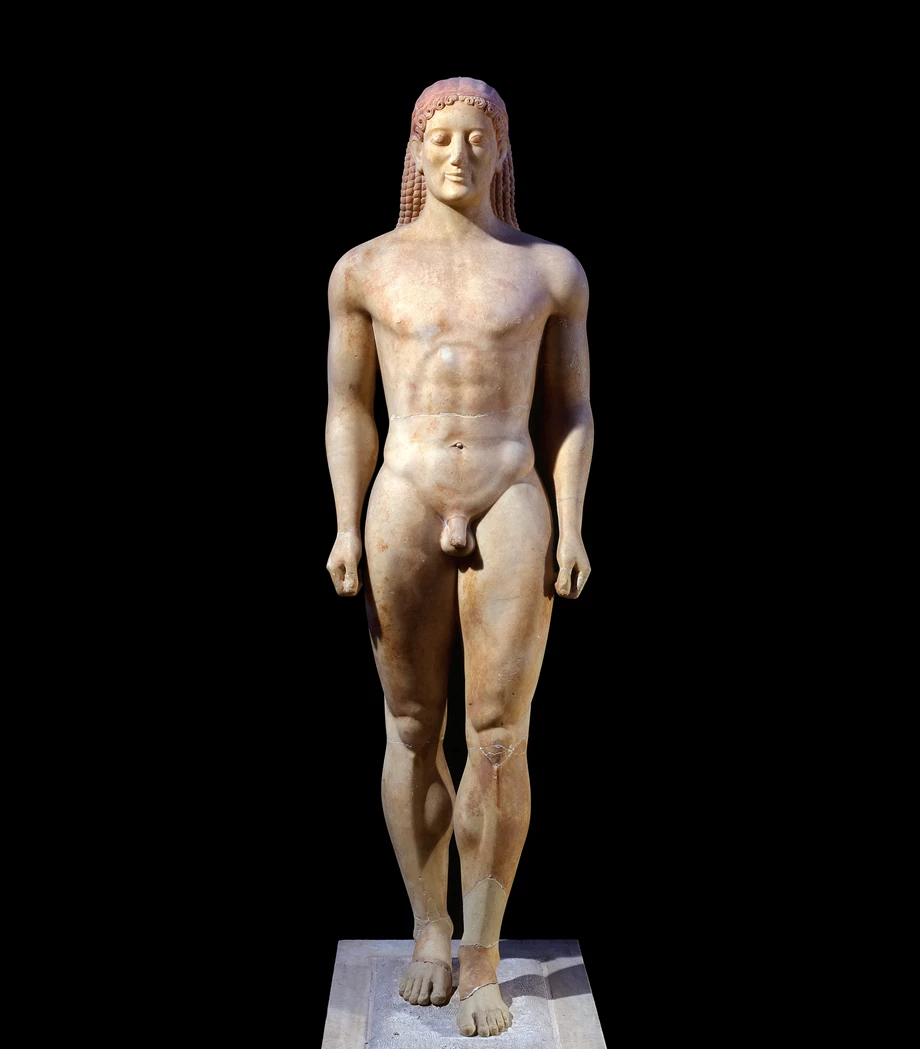
Statue of Kroisos (Anavysos Kouros), Greece, c. 525 BCE, Archaic Period
Kouros stature, arete & heroic nudity, grave marker of man named Kroisos
Achilles and Ajax Playing Dice, Bilingual Amphora, Andokides Painter, Greece, c. 525 BCE, Archaic Period
Black figure on one side, red figure on other side

Arete
Excellence, especially connected to one’s moral character, only a concept for men
Amphora
Greek ceramic vessel type used to hold oil or wine, large handles; Could be used as a prize for a running race, like a trophy
Black figure pottery
Made up until c. 525-520 BCE, then switched to red. Athens most famous for this. Slip applied, then incised, fired in kiln with oxygen which turned everything red, then fired without oxygen which turned everything black, then fired with oxygen which turns clay red and slip stays black.
Greek “Dark Ages”
1100-800 BCE - no evidence of metalwork and undecorated pottery vessels, limited artistic production. But this is a misnomer
Horror vacuai
Latin term for the “fear of empty spaces”
Kore (kourai)
Statue of a young woman, during this period could have been used to mark a grave
Kouros (kouroi)
Statue of a young man
Red figure pottery
Same subject matter as black - Gods, marriage & wedding gifts, erotic scenes (Dionisis Nights)
Riace Warrior A, Greece, c. 450 BCE, High Classical Period
Contrapposto, heroic nudity, original bronze, patina, highly naturalistic in terms of body proportions & musculature & added patinas

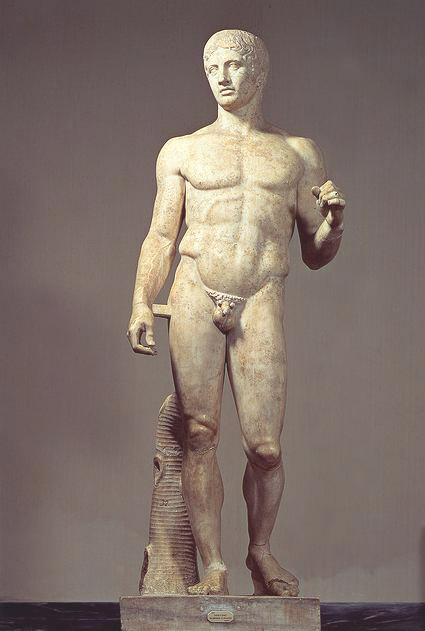
Doryphoros (Spear Bearer), Polykleitos, Greece, c. 450 BCE, High Classical Period
Perfect ideal proportions, called it canon of proportions (idealized form to be studied & replicated; 1:7), contrapposto, stoicism
Head of Alexander the Great, Lysippos, Greece, c. 325 BCE, High Classical Period
Idealized face, long shaggy hair similar to lion’s mane

Contrapposto
stance in which figure leans to side with weight shifted to one leg
Lost wax casting
Make statue of clay, make plaster mold around statue, interior of mold then filled with wax, mold removed and detailed touched up, funnels & channels attached to wax model, cover wax model in clay, heat & pour out wax, pour in molten metal, cool metal & break mold, polish surface & add detail with painted patinas. Only one can be made at a time, mold is destroyed in process.
Patina
Surface layer of metal object, corrosion of metal
Pediment
In ancient architecture, the triangular space (gable) at the end of a building
Stoicism
Showing no expression
Aphrodite of Knidos, Praxiteles, Greece, 4th century BCE, Late Classical Period
Shows goddess depicted as a woman, shown not quite like a goddess… she is shown in a vulnerable state; vulnerability makes sense for a culture that was knocked down for its hubris

Farnese Hercules, Lysippos, Greece, 4th century BCE, Late Classical Period
Colossal sculpture depicting a god in a state of exhaustion as opposed to triumphant. He has completed the 12 labors - impossible tasks. He asks the viewer to look all the way around the sculpture, to engage (apples of Hesperides held behind him). Shows idealized naturalism or a state of realism - a flaw shown in the Gods - which represents how Athenians feel after the Peloponnesian war

Hubris
Excessive pride
Strigil
Instrument used to scrape off dirt and skin
Dying Gaul and his Wife, Turkey, 3rd century BCE, Hellenistic Period
A defeated Gallic warrior kills his wife and himself rather than surrendering. Commemorates Pergamon's military victories while portraying its enemies with dignity. The enemy is shown in heroic nudity to show that the Pergamenes beat a heroic force, this makes the victory seem greater.

Seated Boxer, Italy, c. 2nd century BCE, Hellenistic Period
Body seems idealized but probably isn’t… this is realistic - he looks tired & beat up, possibly a slave forced to box for others’ entertainment, Hellenistic because it is not idealized

Hellenistic
“Greek-like,” Hellas = Greece
“Pergamine Baroque”
dramatic movement, intense emotion, and expressive realism in Hellenistic sculpture
“The Great Departure,” East Torana, Great Stupa at Sanchi, India, 1st century BCE, Indian, Post-Mauryan Period
Shows Siddartha leaving the palace, as it was fortold that he would either become a mighty king or an enlightened being, his father desperately wanted him to become kind, so he gave him so much within the palace walls, but eventually he wanted to leave. In the middle, the Bodhi Tree (the site of the Buddha’s enlightenment). Buddha is not shown, but footsteps and umbrellas, and a horse with no rider elude to his presence.

Standing Buddha, Gandhara, Pakistan, 3rd century CE, Pakistani
Shown standing which means this is a later depiction, includes a nimbus around the head to show enlightenment. Curvilinear line in the drapery, a heavy tunic, a Greco-Buddhist statue.

Edict pillar
Pillars erected throughout Ashoka Maurya’s empire, especially at Buddhist monasteries. Record Ashoka Maurya’s reforms & policies, provide suggestions about how to live a moral life, served as royal standards, topped with animal capitals, possibly influenced by Persian columns
Greco-Buddhist statue
Only come from Gandhara, Pakistan, date from 1st century BCE to 7th century CE
Mudra
Seal or sign, hand gestures that depict different states of being
Nimbus
Circle around the head to show Buddha enlightenment, later taken up in Christian art to show figures like Mary, the Saints
Nirvana
The achievement of enlightenment after which one no longer experiences samsara. Transcendent state of no suffering, desire, or sense of self. Released from samsara
Samsara
In Buddhism, the continuous cycle of life, death, and rebirth - it is believed that we are trapped in this cycle
Stupa
Not a temple, but a domed building that houses relics of the Buddha (or another important Budhhist individual), built in areas of the Buddha’s life events, the shape of which reflects the cosmos, designed for circumambulating
Syncretism
A merging of religious ideas, cultures, or schools of thought
Torana
Gateway for a stupa, aligned with the cardinal points
Ushnisha
Cranial protrusion - shows the Buddha’s enlightened state
Urna
Buddhist mark on the forehead - the third eye
Yaksha
Local nature-spirit, this predates Buddhism
Yakshi
Local goddess outside of religious affiliation, female spirit associated with reproductive forces of nature, fertility deities with large breasts, pubic triangles & large hips
Terracotta Soldier, China, 3rd century BCE, patron: Emperor Qin Shi Huang, Qin Dynasty Period
Rows upon rows of these, horses & chariots representing the emperor’s army. It was believed that they would animate in the afterlife and serve as his protectors

Painted Banner of Lady Dai, China, 2nd century BCE, Han Dynasty Period
Draped over the outside of the innermost coffin of 3 coffins. Its iconography identifies the deceased in the scene, it is a depiction of deceased going up into the heavens perhaps aided in her journey. 4 registers - heavenly realm, deceased & her attendants, body of deceased, and the underworld below

calligraphy
Greek for “beautiful writing,” paper & silk used as writing surface, examples from the Han Dynasty period exist only in later copies & rubbings (inked impressions made of stone inscriptions)
lacquer
the application of several coats of resin over a core surface of wood, bamboo, silk, etc. to create a hard but lightweight surface that can be painted, gilded, and/or carved.
silk
Made from fibers of silkworm cocoons, fine textile that can be dyed or painted; used for clothing, fans, wall hangings, and as a surface for writing & painting; process of making this textile is difficult
Statue of Apulu, Italy, 6th century BCE, Etruscan
Etruscan equivalent of Apollo (God of Sun), painted terracotta (Italian for “baked earth.” Figure is similar to sculpture from Greece during the Archaic period (same time): striding pose, slight smile, drapery & curving lines & folds; different: terracotta, no nudity

Sarcophagus with Reclining Couple, Italy, 6th century BCE
Painted terracotta, stylized faces & slight smiles (like Archaic smile), elongated figures, culturally different from Greeks because men & women dined together, this is a couple reclining on a dining couch (kline) which would not be acceptable in Greek culture

“Parade” Fibula, Italy, 7th century BCE
Made of very thinly beaten gold, uses the repoussé technique, one foot tall & never used for clothing, only for ceremonial use or a funerary environment, shows skill of metal smiths, shows connection to Egypt, & an example of granulation. Imagery shows parade of winged lions in rows, depiction of Hathor (Egyptian influence)

Bucchero ware
Etruscan incised & stamped black ceramics. Before firing: stamped & burnished (polished by rubbing) giving it black, shiny, metallic feel; before firing: incised decoration
Fibula
A brooch used to fasten clothing in the ancient world
Granulation
Process of fusing small balls of metal to the surface of a piece of jewelry. Etruscans did not invent this, but they were extremely good at it
Kline
A dining couch seen in Etruscan & Roman art
Symposium
A male-only Greek event dedicated to Dionysus; wine & poetry; held in an andron (room for men), shows men on dining couches
Terracotta
Italian for “baked earth,” fired clay used for Etruscan statuary & building materials
Triclinium
A dining room with couches on three sides of the room
Tumulus
Etruscan burial mound which covered one or more subterranean, multi-chambered tombs cut out of the local limestone (tufa), underground rooms under the mounds, many survived without being robbed because they looked like kills, buried outside of the city walls