Muscle physio
 Call Kai
 Learn
Learn Practice Test
 Spaced Repetition
 Match
Match Flashcards
 Knowt Play
1/49

There's no tags or description
Looks like no tags are added yet.
Name | Mastery | Learn | Test | Matching | Spaced | Call with Kai | Chat |
|---|
No analytics yet
Send a link to your students to track their progress
50 Terms
Which band of a sarcomere is changing while contraction
I band and H b

I band composition of sarcomere
Only thin filaments
H band composition of sarcomere
only thick filaments
A band composition of sarcomere
entire length of Myosin, overlaping parts counted

Acetylcholine is broken down by Ach Estrase to what
Choline and acetate
what is Lambert Eaton Myasthenic Syndrome (LEMS)?
Presynaptic autoimmune disorder of the NMJ - caused by antibodies against Calcium v gated channels - less Ca+2 - less Ach in the synaptic cleft - less action potential
what are common clinical features of Lambert Eaton Myasthenic Syndrome (LEMS)?
Lower extremities affect - waddling gait, upper extremities - difficulty raising arms
what is Latrotoxin and what is clinical importance regarding
Venom of the black widow spider, stimulates the production of presynaptic cation channels, allowing for a massive influx of Ca2+ without the need for presynaptic depolarisation. localised muscular cramps and stiffness to the bite area followed by whole body effects. ANS problems also relate
Whats botulinum toxin
Protein produced by bacteria Clostridium botulinum, It is a protease that interacts with synatobrevin and other proteins to prevent the exocytosis of ACh. Lack of ACh release leads to lack of muscle activation.
whats Myastenia Gravis (MG)
Myasthenia gravis is an autoimmune disease where auto-antibody target nicotinic receptor (Nm) for destruction. Treatment - Ach Estrase Inhibitors - Incerase Ach levels
Whats the test used to confirm the Myastenia Gravis (MG)
Tensilon test - Edrophnium drug used for the confirmation of diagnosis
Whats Tubocurarin drugs and how they work
Curare plant obtained alkaloid used as a poison. Action: blocks ACh action on the NMJ - no action potential - paralysis
What is the role of DHPR in skeletal muscle?
Voltage sensor — it detects T-tubule depolarization and is mechanically coupled to RyR1. It does not conduct Ca²⁺ into the cell.
What is the role of DHPR in cardiac muscle?
It is a voltage-gated L-type Ca²⁺ channel (Cav1.2) that conducts trigger Ca²⁺ into the cell, which then activates RyR2 via CICR.
Which RyR isoform is found in skeletal muscle? In cardiac muscle?
Skeletal = RyR1; Cardiac = RyR2.
What is the coupling mechanism between DHPR and RyR in skeletal muscle?
Mechanical coupling — direct physical interaction; no Ca²⁺ entry required.
What is the coupling mechanism between DHPR and RyR in cardiac muscle?
Ca²⁺-induced Ca²⁺ release (CICR) — trigger Ca²⁺ from DHPR binds RyR2, opening it.
What is the structure of the tubules and cisternae in skeletal muscle? Where is it located?
Triad = 1 T-tubule + 2 terminal cisternae; located at the A-I junction.
What is the structure of the tubules and cisternae in cardiac muscle? Where is it located?
Diad = 1 T-tubule + 1 terminal cisterna; located at the Z-line.
What are the sources of Ca²⁺ for contraction in skeletal vs. cardiac muscle?
Skeletal = SR only; Cardiac = SR (~90%) + extracellular (~10%).
What is preload
The preload is the resting force on the uncontracted (passive)
muscle.
What is contraction?
Contraction = generation of tension/force with or without shortening of a stimulated muscle.
What is afterload
Afterload - load the muscle works against during a contraction
Explain Isometric contraction
Isometric contraction occurs when the muscle is unable to generate
more than specific amount of force, and the muscle will not shorten
Explain Isotonic contraction
If the muscle is able to generate more than specific amount of force, then the weight
moves as the muscle shortens.
What lets the nuscle be the same lenght during isometric contraction even if the muscles still shorten?
Sarcomeres get shorter during the generation of force in isometric contraction. At the same time, series elastic components are stretched by a total amount equal to the
amount of sarcomere shortening.
What is "trigger Ca²⁺" and which muscle type requires it?
Trigger Ca²⁺ is the small Ca²⁺ influx through DHPR (Cav1.2) that activates RyR2. It is required in cardiac muscle only.
What are the phases of the cardiac action potential?
Phase 0 = rapid depolarization (Na⁺ influx); Phase 1 = early repolarization (K⁺ efflux); Phase 2 = plateau (Ca²⁺ influx via DHPR + K⁺ efflux); Phase 3 = repolarization (K⁺ efflux); Phase 4 = resting potential (Na⁺/K⁺ ATPase).
Why can't cardiac muscle tetanize?
The plateau phase (Phase 2) prolongs the refractory period, which almost equals the duration of contraction — preventing summation and tetanus.
What mechanisms mediate relaxation in skeletal vs. cardiac muscle?
Skeletal = SERCA + parvalbumin; Cardiac = SERCA + Na⁺/Ca²⁺ exchanger (NCX) + sarcolemmal Ca²⁺-ATPase.
How does digitalis (digoxin) increase cardiac contractility?
It inhibits Na⁺/K⁺ ATPase → ↑ intracellular Na⁺ → ↓ Na/Ca+2exchanger activity → ↑ intracellular Ca²⁺ → ↑ contractility.
Muscle relaxation - SERCA pump
Within the SR, Ca2+ is sequestered by Calsequestrin to ensure SERCA
operates in required mode.
Cause of Rigor mortis
Rigor mortis is the temporary stiffening of a body's muscles that happens after death
This happens because of the lack of ATP to unbind the myosin heads
what is Malignant Hyperthermia (MH).
myopathy due to genetic mutations or dysregulation of the Ryanodine receptor (RyR: Ca2+ release channel).
Causes: exposure to volatile inhalational anesthetic agents and the muscle relaxant succinylcholine, and in rare cases exposure to high environmental heat or strenuous exercise.
Mechanism of work: high release of Ca2+ from SR into the muscle fiber. Results in sustained muscle contraction and heat production.
Treatment: Dantrolene - directly interferes with muscle contraction by antagonising RyR
receptors.
V max and different types of muscles

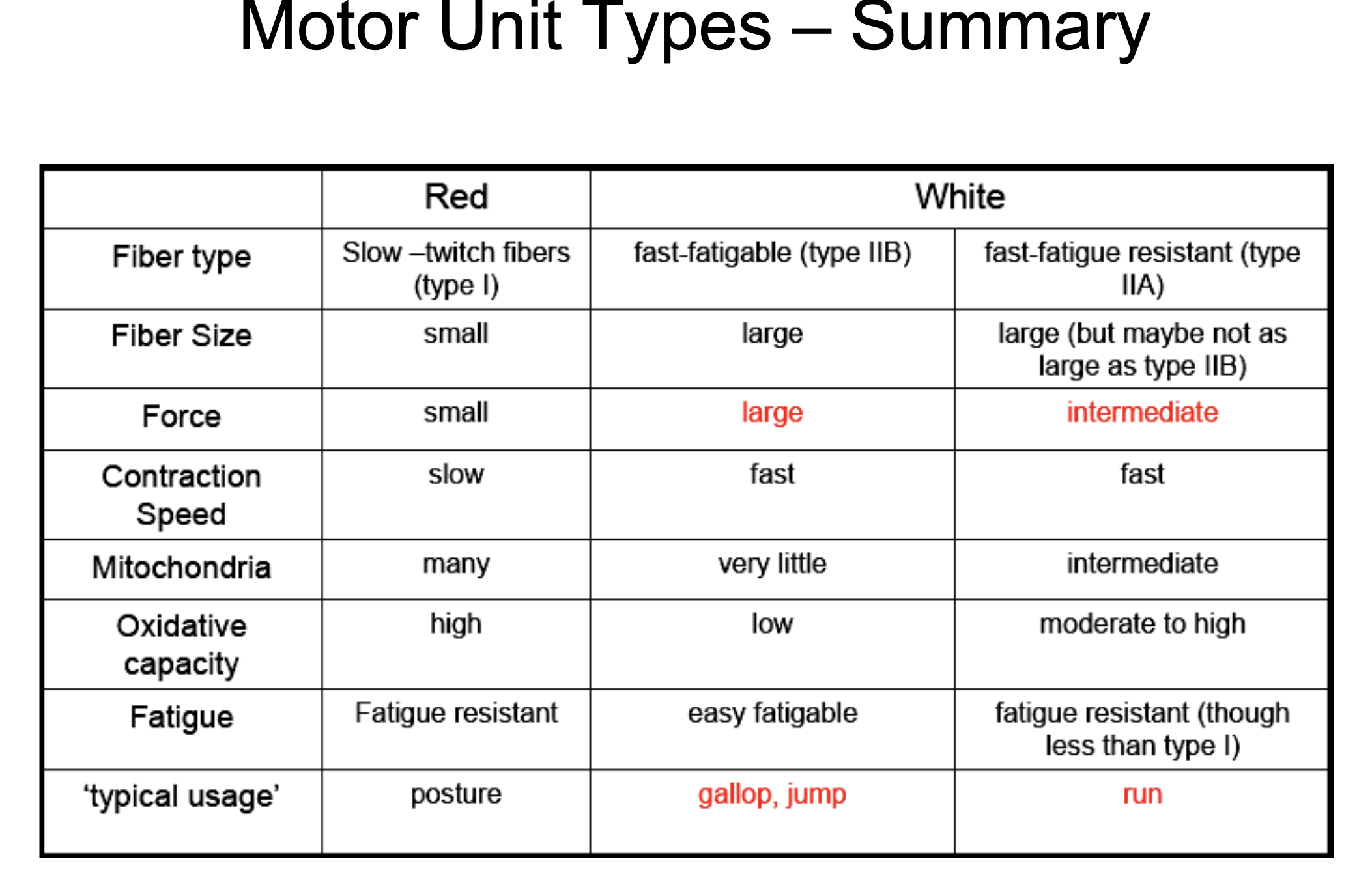
Motor units types
Tetanus
The toxin that is released blocks the release of inhibitory
neurotransmitters, such as γ-aminobutyric acid (GABA).
Inotropism
refers to the force or strength of heart muscle (myocardium) contraction
Positive Inotropes: Increase the strength of cardiac muscle contraction and raise cardiac output.
Negative Inotropes: Decrease the force of cardiac muscle contraction and reduce the heart's workload

PDE-3 inhibitor (Milrinone)
prevents cAMP degradation - increase in cAMP - phosphorylation of the v gated Ca+2 channels - more calcium - stronger contraction - positive inotropism
Activation of Myosin & Crossbridge
Cycling in Smooth Muscle
contraction is dependent on the Ca+2 levels
Ca+2 binds to calmodulin - this complex binds and activates Myosin light chain kinase(MLCK)
MLCK phosphorylates myosin and allows it to bind to actin, thus initiating cross-bridge formation and recycling
Structures or organs that have single unit type of innervation
Uterus, GIT
Structures or organs that have multi unit type of innervation
Large blood vessels, large airways, ciliary
muscle & iris
What does phosphodiesterase does
cleaves out cAMP
Millirone drug
phosphodiesterase inhibitor (PDEi) - inhibits cAMP cleavage
Terbutaline
beta-2 agonist used to relax uterine smooth muscles in pregnant women with premature labor
Albuterol
Beta-2 agonist inhaler is used in Asthma for bronchodilation
Control of smooth muscle contraction
Gq-protein-PLC-IP3 pathway
Norepinephrine, Epinephrine & Dopamine
(via alpha adrenoreceptors) in vascular
smooth muscles
• Acetylcholine (via M2 receptors) in GIT
• Angiotensin II (via angiotensin II receptors)
in vascular smooth muscles
• Endothelin (via ETA receptors)
Control of smooth muscle contraction - cAMP pathway
Norepinephrine, Epinephrine (via beta2
adrenoreceptor) in bronchial & uterine
smooth muscles
• Dopamine (via D1 receptors) in renal
vascular muscles
• Histamine (via H2 receptors) in skin
blood vessels
Control of smooth muscle contraction
Ca2+ sensitization and desensitization
Increased MLCK activity and decreased MLCP activity: Can produce a
stronger contraction even with a lower-than-normal calcium. This is
called calcium sensitization.
• Decreased MLCK activity and increased MLCP activity: Can produce a
weaker contraction even with a higher-than-normal calcium. This is
called calcium de-sensitization.
latch state in smooth muscle
Cross-bridge cycling occurs at a slow rate so that each remains in the
attached state for a longer time with least amount of energy and calcium
usage. Example: blood vessels to maintain BP for the entire life