Middle School Math Vocabulary: Units 1–7
 Call Kai
 Learn
Learn Practice Test
 Spaced Repetition
 Match
Match Flashcards
1/52

Earn XP
Description and Tags
Vocabulary practice cards categorized by units across numbers and operations, algebraic thinking, proportional reasoning, percents, statistics, probability, and geometry.
Name | Mastery | Learn | Test | Matching | Spaced | Call with Kai | Chat |
|---|
No analytics yet
Send a link to your students to track their progress
53 Terms
Integers
The set of whole numbers, their opposites, and zero, written as {…,−3,−2,−1,0,1,2,3,…}.
Negative numbers
Numbers with a value less than zero (<0), located to the left of zero on a standard horizontal number line.
Absolute value
The distance a number is from zero on a number line, written with vertical bars ∣x∣, which is always non-negative (∣x∣≥0).
Opposite Numbers
Two numbers that are the same distance from zero on a number line but in opposite directions (such as a and −a), whose sum is 0.
Zero pairs
A pair of numbers, one positive number and one negative number of equal value (such as +1 and −1) that add together to equal 0.
Evaluate
To solve for the numerical answer of a mathematical expression by performing the indicated operations.
Expression
A mathematical phrase that can contain numbers, variables, and operations, but does not contain an equality sign (=) or inequality symbol.
Rational Number
Any number that can be expressed as the quotient or fraction of two integers in the form ba, where b=0.
Reciprocal
The multiplicative inverse of a number; for any non-zero fraction ba, its reciprocal is ab, such that ba×ab=1.
Repeating decimal
A decimal representation of a number whose digits repeat in a pattern without terminating,with a bar over the repeating digits

Terminating Decimals
A decimal that ends or terminates
Complex Fractions
A fraction in which the numerator, denominator, or both contain fractions, such as dcba,
Equation
A mathematical statement showing that two expressions are equal, joined by an equal sign (=).
Equivalent Expression
Two or more expressions that have the same answer or value
Inequality
A mathematical sentence that compares two expressions using inequality symbols such as <, >, ≤, or ≥.

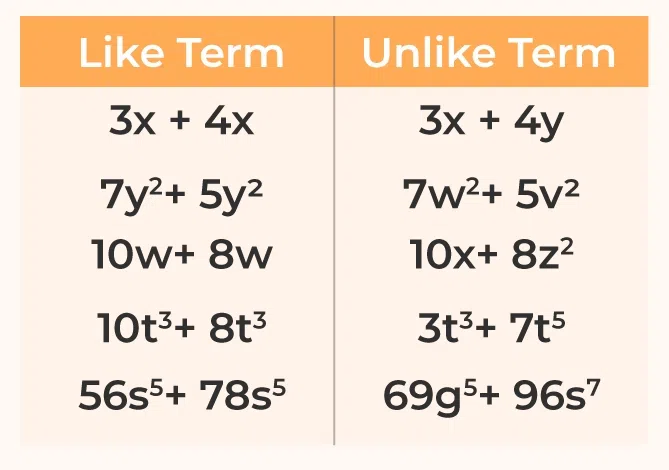
Like Terms
Terms in an algebraic expression that have the same variable and raised to the same powers, differing only by their numerical coefficients.
Factor
Numbers in a multiplication problem

Inverse Operations
Pairs of operations that undo each other, such as addition and subtraction, or multiplication and division.

Center of Circle
The inside point in a plane that is equidistant from all points along the outside of the circle.

Diameter
A straight line segment passing through the center of a circle connecting two points on its outside, having a length of d=2r .

Radius
A line segment from the center of a circle to any point on its outside, equal to half of the diameter (r=2d).

Circumference
The distance around the outside of a circle, given by the formulas C=2πr or C=πd.
Pi
The ratio of the circumference of a circle divided by its diameter, denoted by π and approximately equal to 3.14159 or 722.
Constant of Proportionality (COP)
The constant ratio between two proportional quantities, denoted by k=xy in the linear equation y=kx.
Proportional Relationships
A relationship between two variable quantities in which their ratio remains constant, represented graphically by a straight line passing through the origin (0,0).
Commission
A fee or percentage of sales paid to an agent or employee for executing a commercial transaction.
Mark Up
The amount added to the wholesale or cost price of an item to establish its retail selling price.
Mark Down
The reduction in the original selling price of an item to arrive at a discounted sale price.
Percent Increase
The ratio of the amount of increase to the original amount, expressed as a percent using Original AmountNew Amount−Original Amount×100%.
Percent Decrease
The ratio of the amount of decrease to the original amount, expressed as a percent using Original AmountOriginal Amount−New Amount×100%.
Discount
The money taken off from the original list (tag) price of a product or service.
Population
In statistics (Unit 5), the entire group of individuals, objects, or measurements about which information is desired.
Sample
A subset of individuals selected from a larger population used to represent the whole in a statistical study.
Random Sample
A sampling method in which every member of the target population has an equal likelihood of being chosen.
Simple Interest
Interest calculated solely on the principal sum, given by the formula I=Prt, where P is the principal, r is the annual rate, and t is time in years.
Event
An outcome or collection of outcomes from an experiment in probability.
Compound Event
An event in probability formed by combining two or more simple events.
Probability
A measure of the likelihood that a particular event will occur, represented by a value ranging from 0 (impossible) to 1 (certain).
Experimental Probability
The ratio of the number of times an event occurs to the total number of trials conducted in an actual statistical experiment.
Experiment
In Unit 7, a planned procedure or test carried out under controlled conditions to observe potential probability outcomes.
Outcome
A single possible result of a probability experiment or trial.
Theoretical Probability
The ratio of the number of favorable outcomes to the total number of possible outcomes when all outcomes are equally likely: P(event)=Total OutcomesFavorable Outcomes.
Tree Diagram
A branching diagram used in probability to systematically organize and list all possible outcomes of a sequence of events.

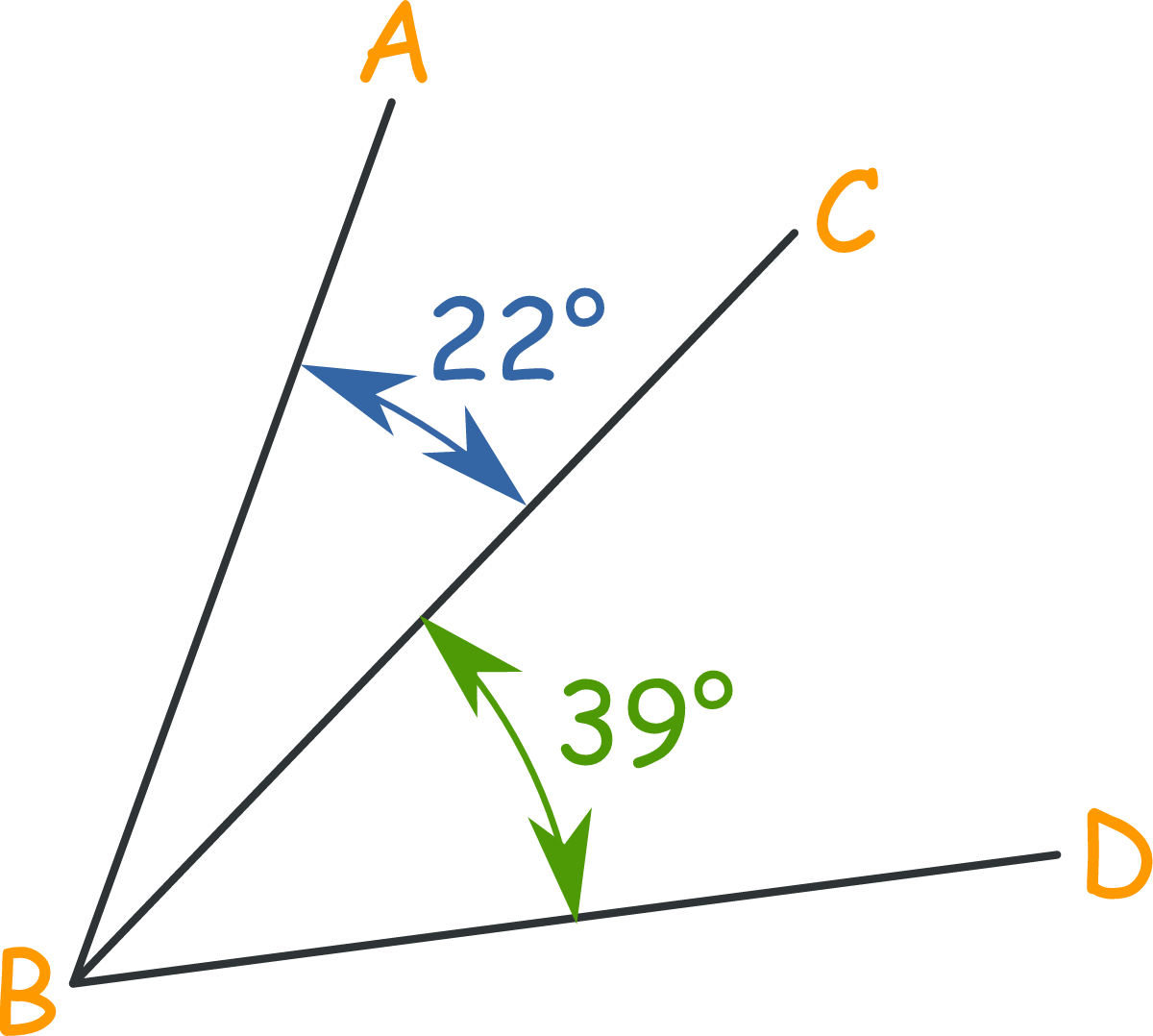
Adjacent Angles
Two angles that share a common vertex and a common side but do not overlap in their interiors.
Complimentary Angles
Two angles whose degree measures add up to a sum of 90∘,

Corresponding Angles
Angles that lie in the same relative position at each intersection where a transversal intersects two or more lines. (THey equal the same number of degrees)
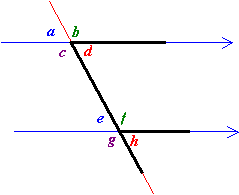
Transversal
A line that intersects two or more lines in the same plane at distinct points.

Straight Angle
An angle that forms a straight line and measures exactly 180∘.

Interior(corresponding) Angles
Angles positioned in the inner area between two lines cut by a transversal,

Exterior Angles(corresponding)
Angles positioned outside the space between two lines cut by a transversal.

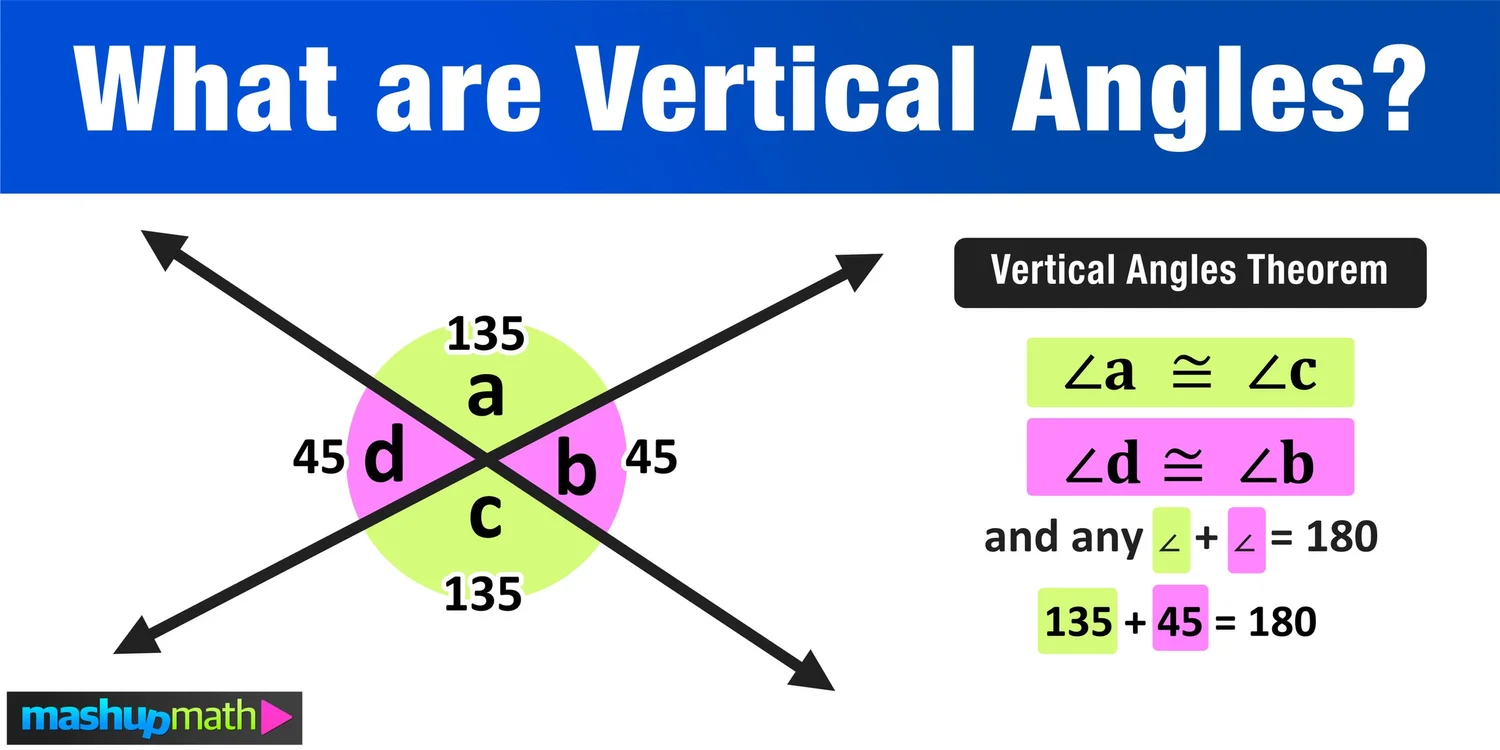
Vertical Angles
The opposite, non-adjacent angles formed by the intersection of two straight lines, which are always congruent in measure.
Supplementary Angles
Two angles whose angle measures add up to a sum of 180∘.
