BIOL1020 Exam 2 -- Riggs
 Call Kai
 Learn
Learn Practice Test
 Spaced Repetition
 Match
Match Flashcards
 Knowt Play
1/92

There's no tags or description
Looks like no tags are added yet.
Name | Mastery | Learn | Test | Matching | Spaced | Call with Kai | Chat |
|---|
No analytics yet
Send a link to your students to track their progress
93 Terms
3 basic requirements of a cell
membrane is present, stores and transmits information (DNA), has energy
photoroph
gets energy from light
chemotroph
gets energy from chemicals
autotroph
gets carbon from inorganic carbon sources (make its own)
heterotroph
gets carbon from organic carbon sources (find it, ex by eating it)
metabolism
ALL chemical reactions happening in a cell
anabolism
small molecules built to be bigger molecules, requires energy input, uses ATP
catabolism
breaks large molecules down to smaller, releases energy, makes ATP (usually in form of heat)
ATP
cells main energy source, Adenosine Triphosphate, Adenine + Ribose + 3 phosphate groups
Potential Energy
stored energy, based on position or structure
kinetic energy
energy in action
what energy is used for moving molecules? electrons? photons?
thermal, electricity, light
Chemical potential energy
energy stored in bonds
Lower potential energy
strong bonds
higher potential energy
weak bonds
energy chain
food > chemical energy > ATP > cellular work
First Law of Thermodynamics
energy cannot be created or destroyed, energy is released as heat or light, energy is trnasformed not created
second law of thermodynamics
energy transformations are not 100% efficient, energy becomes less available down the order of work
entropy
degree of disorder/spontaneity in the universe, as energy available for work decreases ______ increases
a chemical reaction ____ atoms
rearranges
bonds between atoms
what changes during chemical reactions
direction of a chemical equation…
depends on the concentrations of the subtances
Gibbs Free Energy
the energy available to do work (ΔG)
Endergonic
ΔG is positive, energy is being put IN, products have more free energy than reactants
Exergonic
ΔG is negative, energy is leaving, reactancts have more free energy than products
cytoskeleton
a network of fibers that organizes and supports the cell, cell structure support and transportation
parts of cytoskeleton
microtubules, intermediate filaments, microfilaments
Microtubules
movement and division, thickest part of cytoskeleton, cilia and flagella, moves vesicles around the cell
centrosome
microtubules grow here and are organized here, has 9 triplets of microtubules
in animal cells the _____ contains a pair of centrioles
cells with cilia/flagella
paramecium, sperm, airway epithelial cells
Intermediate Filaments
support the cell shape, diameter is about 8-12nm, hold organelles in place, more permanent than the others
microfilaments
made of actin, about 7nm in diameter
maintain cell shape, resist pulling forces, help cells move, form the core of the microvilli, help with muscle contraction
cortex
microfilaments form a 3D network called the _____
located just inside the plasma membrane
actin
microfilaments
myosin
motor protein
actin + myosin = _______
movement
amoeba movement, neuron growth, muscle contraction
muscle cells
Cilia v Flagella
______: shorter, usually many present, move back and forth, move fluid material across a cell OR move the cell, in airway cells
______: longer, usually few but often 1 present, whipping movement, usually move the cell, found in sperm cells
Dynein
makes cilia/flagella bend, arms grab > move > release, interact with microtubules, drives movement
Plant Cells : _____ / Animal Cells : ______
cell wall, extracellular matrix (ECM)
cell wall
provides protection, shape, and prevents excess water uptake. found in plants, fungi, prokaryotes, some protists
mainly cellulose
layers of plant cell wall
primary: thin and flexible
secondary: more cells, located between plasma and primary
middle lamella: between primary walls of neighboring plants cells, helps hold cells together
plasma membrane: inside the cell wall
Extracellular Matrix
outside of the cells
collagen, proteoglycans, fibronectin
integrins
ecm interacts with these receptor proteins called ______
Functions of ECM
support, adhesion, movement, regulation, gene expresson
Proteoglycans
part of ECM, made of protein core + glycosaminoglycan (GAG) side cahins
made and secreted by cells
Cell Junctions
plasmodesmata
tight junctions
desmosomes
gap junction
Plasmodesmata
found in plants
channels between the cells

tight junction
membranes of neighboring cell walls pressed together, prevent leakage of extracellular fluid, animal cells
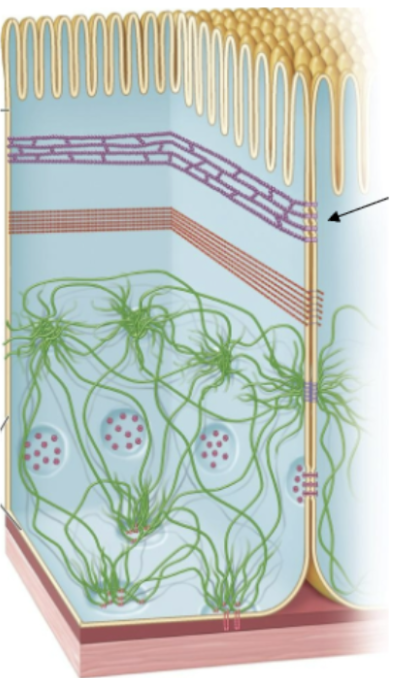
desmosomes
animal cells, anchors that fasten cells together into strong sheets

gap junction
animal cells, provide cytoplasmic channels between adjacent cells

cellular respiration
uses carbs, lipids, and proteins to convert energy to ATP
four stages of cellular respiration
glycolysis
pyruvate oxidation
citric acid cycler (aka Krebs or TCA)
oxidative phosphorylation
electron carriers
NADH and FADH2
carry high energy electrons to electron transport chain
produces in the first 3 stages of cellular respiration
Substrate level phosphorylation
ATP made directly during a chemical reaction that involves a substrate, phosphate is transferred to ADP that makes ATP
oxidative phosphorylation
ATP is made using the electron transport chain and ATP synthase
takes place at mitochondrial membrane
produces large amount of ATP through electron transport chain
Oxidation
electrons are lost
NAD+ —> NADH
glucose is ______ to CO2 in cellular respiration
Reduction
electrons are gained
NAD+ —> NADH
oxygen is ______ to water during cellular respiration
NADH and FADH2
electron carriers
high potnetial energy
high energy electrons
glycolysis
first stage of cellular respiration
occurs in the cytoplasm
does not require oxygen
glucose —> pyruvate
3 phases of glycolysis
preparatory phase
cleavage phase
payoff phase
preparatory phase
energy is consumed
a phosphate group is added
phosphate group carries energy
glucose is now phophorylated
(INVEST energy first)
cleavage phase
glucose is split into TWO
payoff phase
energy produced
get the energy back and make extra energy carriers
result of glycolysis
4 ATP produced but 2 used, 2 Net ATP
2 Net NADH
pyruvate oxidation, 2
pyruvate —> AcetylCoA
mitochondrial matrix
1 glucose made into ____ pyruvate after glycolysis
carbon is removed from pyruvate and exits as CO2, electrons transferred to NAD+, producing NADH
everything is 2x as much as glucose
products from one glucose
2 pyruvate —> 2 acetylCoA + 2 CO2 + 2 NADH
Citric Acid Cycle
happens in the mitochondrial matrix
oxaloacetate —> ____ —> oxaloacetate
finishes oxidizing the carbon molecules to capture all energy
products of citric acid cycle
CO2 (exits twice)
6 NADH
2 FADH2
2 ATP
citric acid cycle steps
acetyle co a enters
carbon is released as CO2
electron carriers produces (NAD+ —> NADH & FAD —>FADH2)
small amount of ATP produced through substrate level phosphorylation
Pyruvate oxidation (simple)
What? Acetyl-CoA, NADH, CO₂
How? Pyruvate is oxidized
Where? Mitochondrial matrix
citric acid cycle (simple)
What? NADH, FADH₂, ATP, CO₂
How? Acetyl-CoA is oxidized
Where? Mitochondrial matrix
oxidative phosphorylation
What? Lots of ATP
How? ETC creates H⁺ gradient → ATP synthase makes ATP
Where? Inner mitochondrial membrane
why are plants green?
chlorophyll that reflects green light
autotrophs
producer of the biosphere
use sunlight to make organic molecules (carbon)
chloroplasts
likely evolved from cyanobacteria
site of photosynthesis
chlorophyll is in the _______ of the thykaloid
membrane
photosynthetic electron transport chain is in the ________
thykaloid membrane
_____ is produced as a byproduct when water oxidizes
oxygen
first organisms believed to use water as an electron donor
cyanobacteria
endosymbiotic theory
a cyanobacterium was engulfed by a eukaryotic cell and that is why cells have organelle chloroplast
shorter wavelength - ______ amount of potential energy
longer wavelength - _______ amount of potential energy
higher, lower
visible wavelength
400-700nm
wavelength of light used by photosynthesis
380-750nm
Pigment
any organic molecule able to absorb light
can only absorb light at a specific wavelength
reflects what it is unable to absorb
accessory pigments
able to absorb light from regions of the visible spectrum that are poorly absorbed by chlorophyll
Carotenoids
red, orange, and yellow accessory pigments
anthocyanins
red and blue accessory pigments
Photosystem
reaction center complex surrounded by light harvesting complexes that excite the electron and transfers energy
PSII
P680 (absorbs light at 680nm)
starting point where water donates electrons
PSI
P700 (absorbs light at 700nm)
NADPH end product
Photosynthesis is…
a redox process, reverse direction of electron movement compared to respiration, endergonic
Linear Electron Flow (photosystems)
P680 to P700 to NADPH and ATP
(refer to drawing on paper)
Cyclic Electron Flow (Photosystems)
P700 to ATP
(refer to drawing on paper)