CHEE 370: Module 3
 Call Kai
 Learn
 Practice Test
 Spaced Repetition
 Match
 Flashcards
 Knowt Play
1/22

There's no tags or description
Looks like no tags are added yet.
23 Terms
Enzymes as catalyst
lower the activation energy of chemical reactions
enzymes do this by binding to the reactant (substrates) and holding them in such a way as to make the chemical bond breaking and bond forming process take place more readily
does not change delta G
enzymes return to their original state at the end of each reaction (recycled)

Transition state theory
the conversion of substrates into products passes through a transition state, also called activation complex (X*)
the collision of A and B to form X* can be modeled as reaching eqm, while the subsequent conversion of X* to C and D is irreversible
the conversion to X* is considered rate limiting
assumes that X* is in rapid eqm with reactants

Equations of transition state theory
v=d[c]/dt=d[D]/dt=k_1[A][B]=k’[X*]
K_eq=[X*]/[A][B]
v=k’K_eq[A][B]
delta G=-RTlnK_eq
k’=Kf → k’=f
f=k_bT/h
v=(k_bT/h)e^(-delta G/RT)[A][B]

Selectivity and specificity
enzymes bind very specific substrates and catalyze specific reactions
possible due to complex tertiary structure of proteins
can differentiates between stereoisomers
selectivity: ability of an enzyme to prefer one substrate over others in a mixture
specificity: ability of an enzyme to act on a particular substrate only
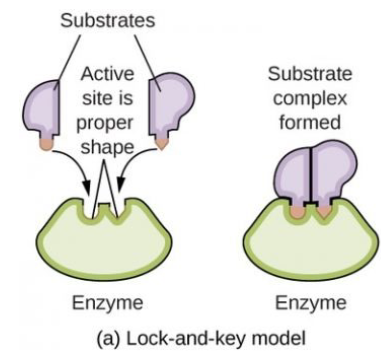
Active site- lock and key
substrate binds to substrate-binding site on enzyme
active site exist in the absence of the substrate and “fits” both chemically and geometrically with the enzyme’s substrate
active site → lock, substrate → key
shape of the active site is complimentary to the shape of the active site
forms and unusable intermediate, enzyme-substrate complex
active site- induced fit
substrate binding can trigger a change in enzyme conformation to create final conformation of active site
“closing in” on substrate
not typically permeant
describes a more dynamic interaction between enzyme and substrate
ideal binding arrangement

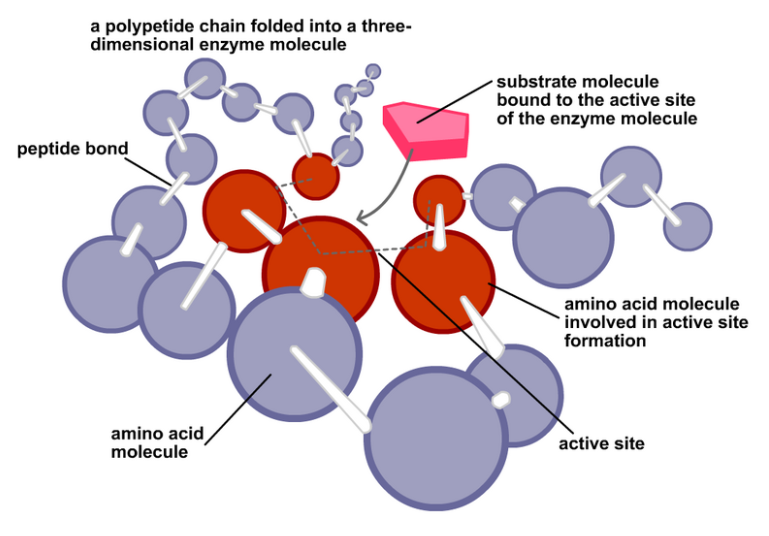
active site on enzyme
active site is a small portion of the enzyme
substrate interactions are mediated by the same type of interactions that stabilize the tertiary conformation: ionic, H-bonds, VdW, metal coordination, disulfide bonds.
small number of AA in the polypeptide chain form the active site
enzyme cofactors
include inorganic molecules or organic molecules (which are then called coenzymes)
the inactive enzyme before cofactor association → apoenzyme
active enzyme-cofactor complex →holoenzyme

enzyme nomenclature
can generally be recognized by the termination “ase”
name generally describes the purpose of the enzyme
some enzyme names give very little information on the function of the enzyme
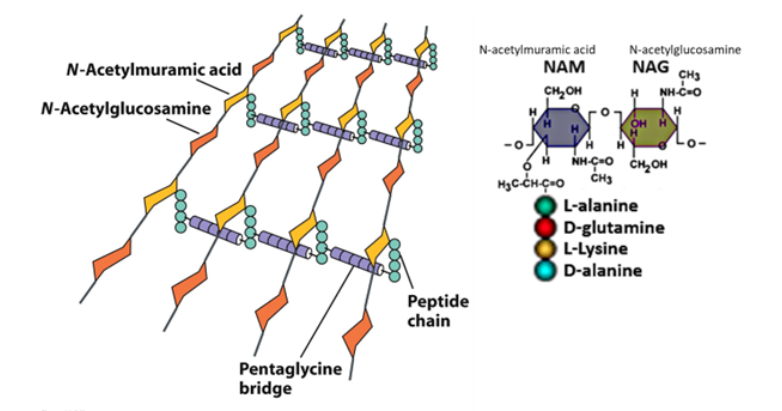
ex. lysozyme is the recommended name for an enzyme that catalyzes the degradation of peptidoglycan. systematic name of this enzyme is peptidoglycan N-acetylmuramoylhydrolase
Peptidoglycan cell wall of bacteria
Lysozyme hydrolyzes the β(1→4) glycosidic bond between NAM and NAG in thepeptidoglycan layer of bacterial cell walls.
This weakens the cell wall, causing the bacteria to lyse (burst).
Catalytic mechanism
Acid-base catalysis: side chains of acidic or basic AA can participate in the reaction by donating or accepting protons
covalent catalysis: side chains of AA can form covalent bonds with the substrate
metal ion catalysis: metal ions that form complexes with enzymes can intervene in the reaction mechanism. approximately 1/3 of enzymes require the presence of metal ions to be catalytic active
electrostatic catalysis: substrate binding to the active site of an enzyme can shield substrate from water. this can favorably change the electrostatic environment around the substrate
proximity and orientation effects: enzymes can bring two substrates close together and orient atoms to accelerate reactions
recycling enzymes

Michaelis-Menten kinetics
characterizes enzyme kinetics
substrate S binds reversibly to an enzyme E to form an enzyme-substrate complex ES, which then reacts irreversibly to generate product P and to regenerate the free enzyme

MM derivation set up

MM kinetics - steady state assumptions
in most enzymatic reactions, the [E] << [S]. therefore, the [E] limits the [ES] achieved until nearly all used up
while [E] is limiting, the [ES] remains relatively constant
period of time over which [ES] remains constant is termed the “steady-state” period

MM derivation
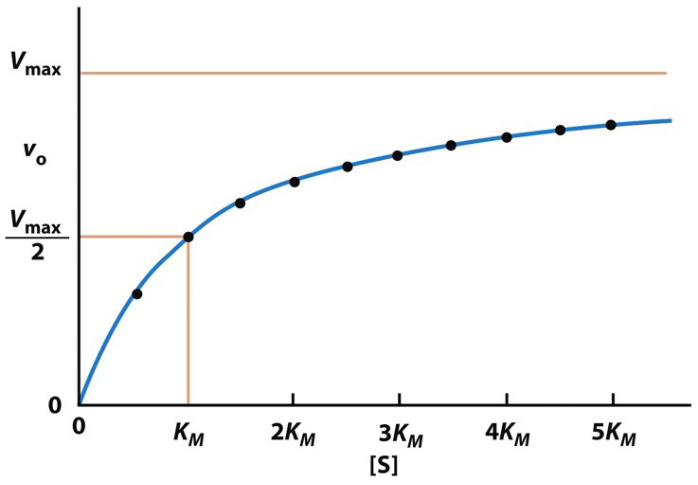
v= d[P]/dt = V_max[S]/(K_M+[S])

MM graph
initial reactions rate: v_0= V_max[S_0]/(K_M+[S_0])
K_M corresponds to the value of the substrate concentration that leads to a half-maximal reaction rate: K_M is the value of [S] at which v= 1/2V_max

Lineweaver-Burk Plot
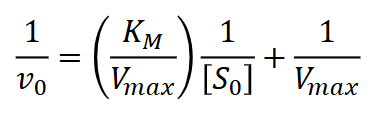
linearized MM equation
1/V_max is the intercept
K_M/V_max is the slope
issue: the graph displays the data unevenly
Hanes-Woolf plot
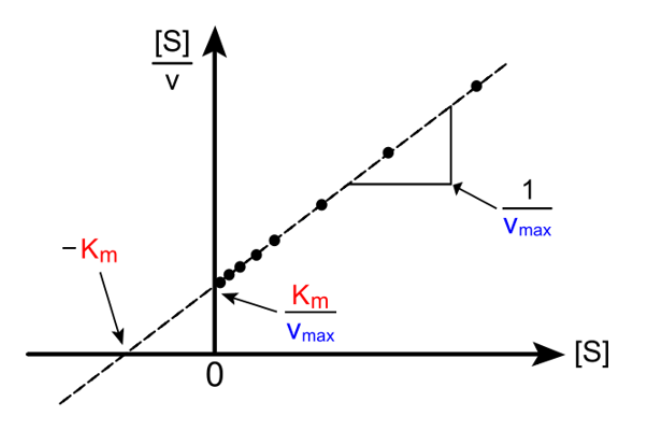
the plot of [S_0]/v_0 as a function of [S_0]
takes LB equation and multiples it by [S]
K_M/V_max is the intercept
1/V_max is the slope

Significance of K_M
provides insight on the affinity of the enzyme for its substrate, provided that k_2/k_1 is small
K_s is the dissociation equilibirum constant of the enzyme in the S+E ←>