Magnetism Exam Qs
 Call Kai
 Learn
 Practice Test
 Spaced Repetition
 Match
 Flashcards
 Knowt Play
1/15

There's no tags or description
Looks like no tags are added yet.
16 Terms
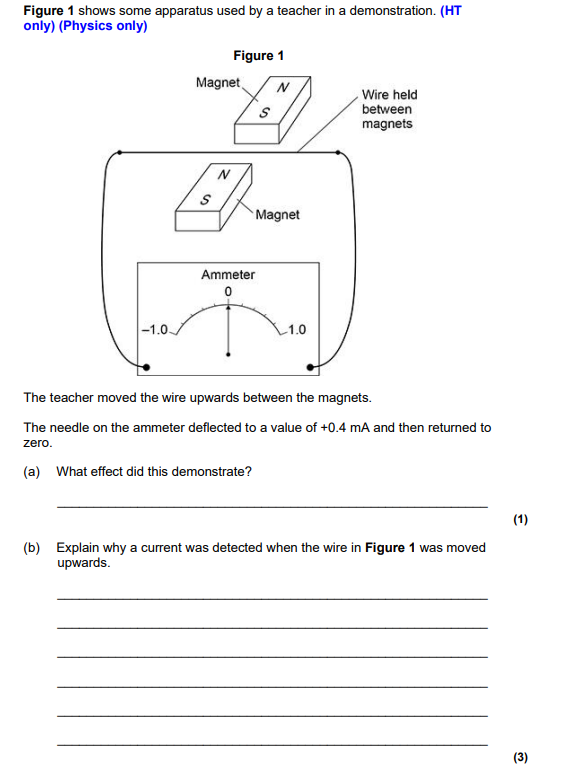
a) generator effect
b) wire cuts through the magnetic field, a p.d. was induced across the wire, the circuit was complete so current was induced
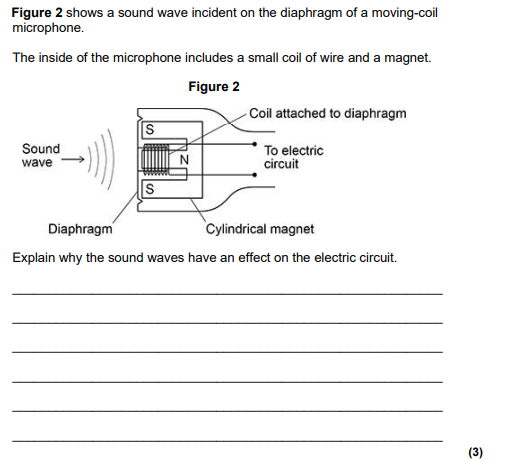
the pressure variations in the sound waves cause the diaphragm to vibrate
the diaphragm causes the coil to vibrate
the coil repeatedly changes direction, inducing an alternating current
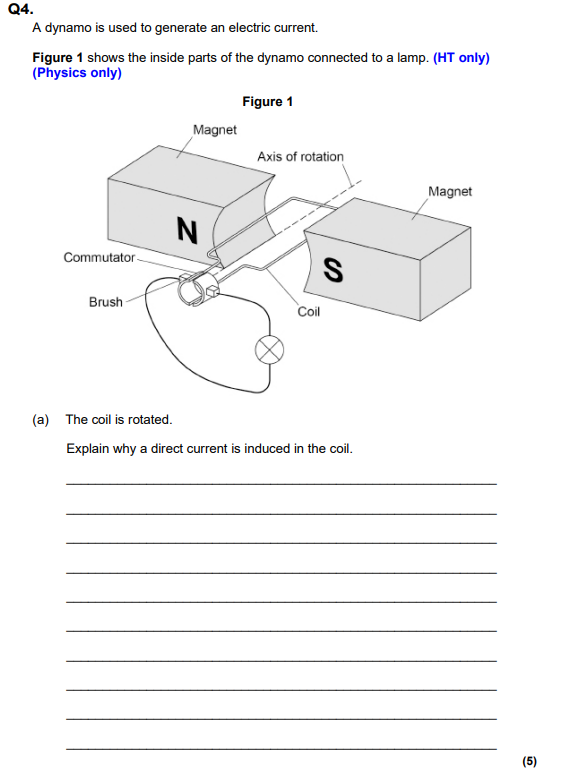
the coil moves/cuts through the magnetic field
a p.d is induced across the coil
there is a complete circuit so a current is induced
each half revolution, the split ring commutator switches brushes/contacts
so the direction of the induced current does not reverse every half rotation
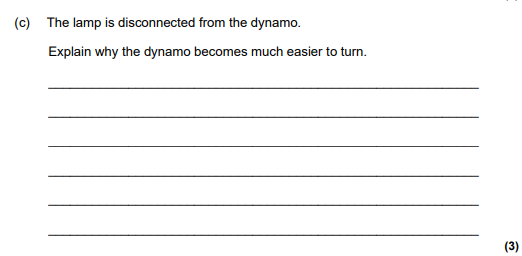
there is no induced current
so no magnetic field
to oppose the movement of the coil
the alternating current causes a changing magnetic field around the primary coil
the magnetic field changes direction in the core
this induces an alternating potential difference across the secondary coil, causing an alternating current
What assumption is made when using Fleming’s Left Hand Rule?
the wire/force is at right angles to the magnetic field
Difference between generator and motor effect
Motor effect: uses electricity to cause motion
Generator effect: uses motion to cause electricity
In a step down transformer, is the number of turns on the secondary coil greater, the same as or smaller than the number of turns on the primary coil?
less than
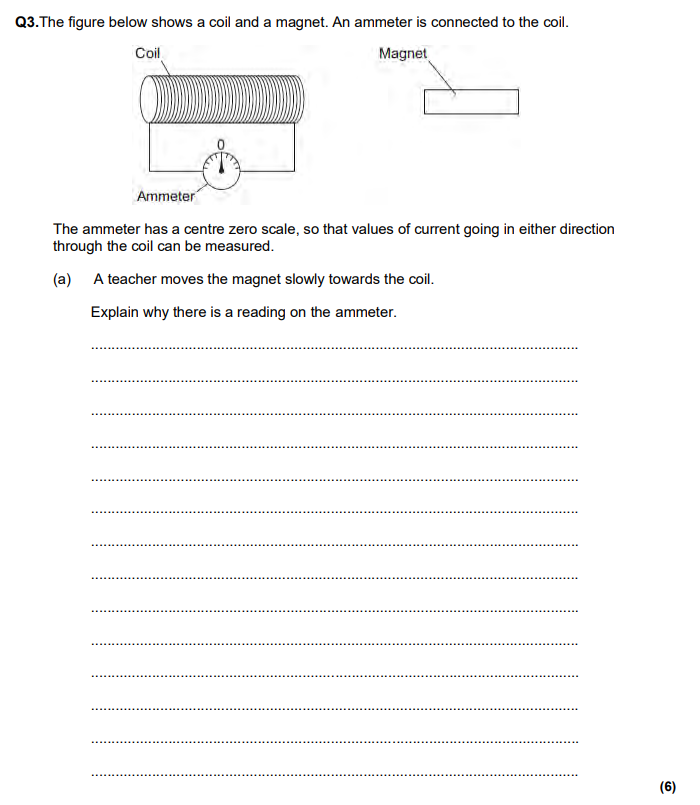
there is a magnetic field around the magnet
this magnetic field moves
and cuts through the coil
so a p.d is induced across the coil
the coil forms a complete circuit
so a current is induced
A student measured the strength of an electromagnet by counting the number of paper clips the electromagnet could hold.
Explain why it was important that all the clips were the same size (2)
so the paper clips have the same weight/mass
which allows the results for different numbers of turns to be compared fairly/ allows a fair test
Explain what is meant by the following statement: ‘A non-contact force acts on each magnet’ (when two magnets are brought close together) (2)
the magnets are not touching
but each experiences a force
Describe how to plot the magnetic field pattern of a bar magnet (3)
place a plotting compass near the pole of the magnet and mark the direction that the compass points
move the compass around the bar magnet marking at intervals the direction the compass points
join the points up and add an arrow pointing from the north pole to the south pole
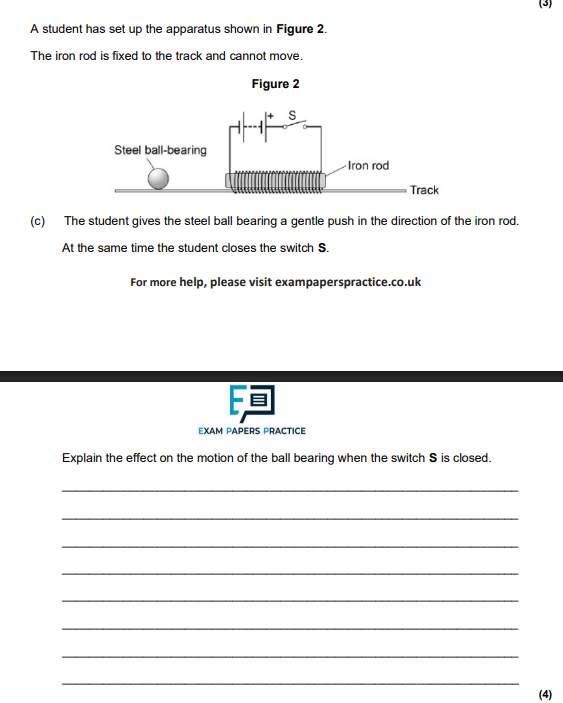
closing switch S causes a current in the coil
a magnetic field is created
a force of attraction acts on the ball-bearing
so the ball bearing accelerates towards the iron rod
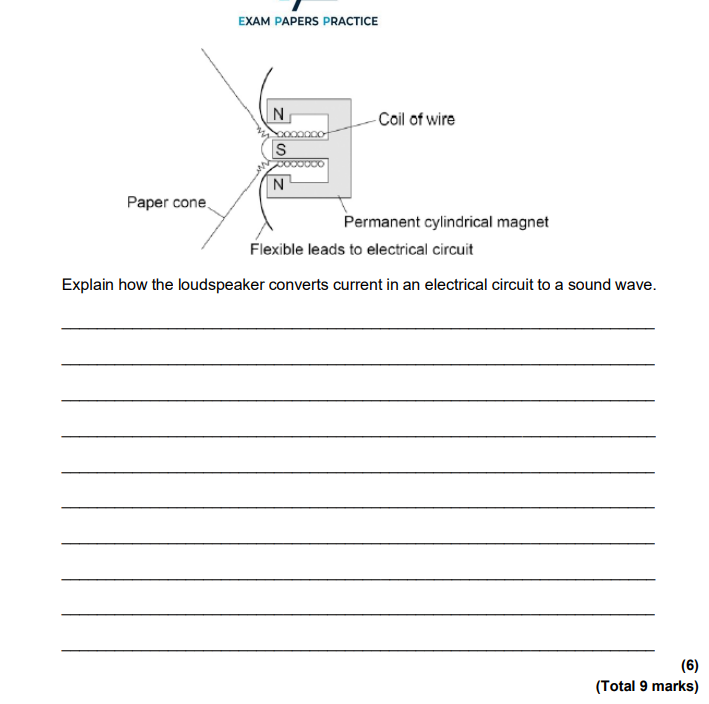
a varying/alternating current is passed through the coil of the loudspeaker
This creates a changing magnetic field around the coil
As the current is constantly changing direction, the direction of the magnetic field will be constantly changing
The magnetic field around the coil interacts with the field from the permanent magnet
The interacting magnetic fields will exert a force on the coil
As the magnetic field is constantly changing direction, the force exerted on the coil will constantly change direction
this makes the coil vibrate
the vibrating coil causes the speaker cone to vibrate
this makes the air vibrate, creating sound waves
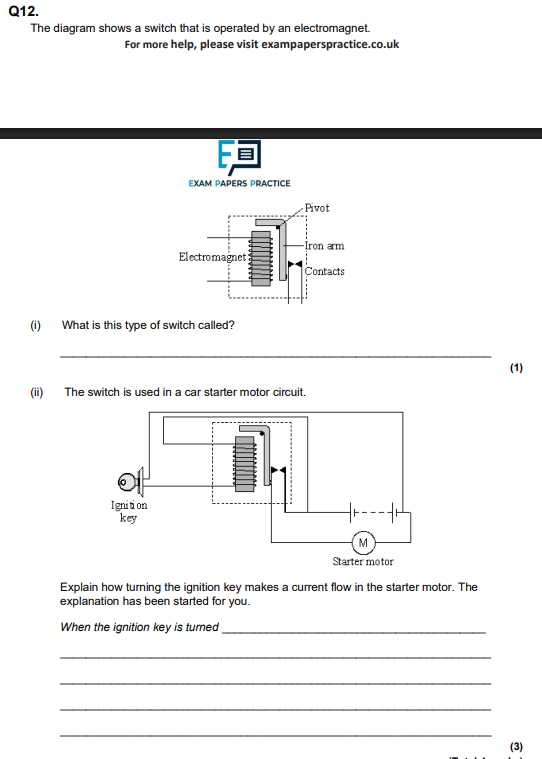
relay/solenoid
a current flows through the coil, the arm is attracted to the electromagnet, the contacts are pushed together