Mod 4 Explorer
 Call Kai
 Learn
Learn Practice Test
 Spaced Repetition
 Match
Match Flashcards
 Knowt Play
1/49

There's no tags or description
Looks like no tags are added yet.
Name | Mastery | Learn | Test | Matching | Spaced | Call with Kai | Chat |
|---|
No analytics yet
Send a link to your students to track their progress
50 Terms
List six things that explorers are used to detect.
Supra-marginal and sub-marginal calculus
Caries
Decalcification
Deposits - calculus or stains
Abnormalities of tooth morphology
Irregularities in cemental surfaces
Irregularities or defects in the surface, margins, or contour of restorations.
study definition fr bacterial/gemerical, sanitization, disinfection, sterilization, etc from exam 1 dh theory
not a question to answer rn, just study these
List two types of stimuli elicited by the explorer.
Auditory, tactile
What does auditory stimilu detect?
smooth enamel - makes a quiet sound
rough cementum or calc - makes a scratchy or noisy sound
metallic restoration - makes a squeak or metallic ring sound
Describe three types of basic tactile sensations that might be experienced when exploring and give specific examples of each.
Normal sensations - , Elevations - , Depressions or grooves - tooth surfaces like decalcification or pits as well as restoration
Describe three types of basic tactile sensations that might be experienced when exploring and give specific examples of each.
tooth surfaces, restorations - gold or ceremalic deposits, decalcification - the hard mineral layers start to come out of the tooth
What does normal tactile sensation detect
Tooth structure - Smooth enamel or root surface, (e.g. cingula, furcations)
Restored surfaces - smooth surface of metal, softer feeling of plastic, smooth, flush margins of restoration
What does depression or grooves tactile sensation detect
Tooth surface - Decalcified or carious lesion, Abrasion, Erosion, Pits (those resulting from improper tooth formation)
Restorations - Deficient or open margin, Rough surface
What does Tactile Elevations detect
The explorer will come out and up from the smooth surfaces.
Deposits, anomalies, thick stains - supra- or subgingival
Anomalies - such as a pronounced CEJ or enamel pearl
Restorations - overcontoured and overhanging at the margin
What are the abnormalities of the tooth morphology
Pronounced CEJ - overlap, end to end, gap, or an enamel pearl
What are some irregularities in the cemental surfaces
Root abrasions
What are some irregularities for restorations
overhanging - feels like an elevation, deficient margin, not enough filling material
Open margin - gap in filling around the base of the crown
Fracture - a gap or line in the filling or restoration
What are the causes of Depressions and grooves
caries, decalcification, abrasion, erosion
Know the definition of abrasion, erosion, and attrition - listen to audio
Abrasion Defintion
Erosion definition
Attrition Definition
Improper tooth formation
enamel hypoplasia - feels like a depression, which can cause pits or grooves
Based on tactile feeling, what can you tell
grainy or gritty - ledge of calculus
Bump or ledge - calculus subgingivally
inward - deficient margin
open margin -
a catch feeling - overhanging
For a beginning clinician, what is the reason for using scaling and root planing while using the explorer
not having a good tactile sensativity and still learning
State when an explorer is used in conjunction with scaling and root planing by a beginning clinician
Before - to assess the amount and distribution of calculus and cemental irregularities
During - to assess progress
After - to assess the completeness of the procedure
State when an explorer is used in conjunction with scaling and root planing by an experienced clinician.
after scaling
What is the rationale and justification for an experienced clinician exploring only after scaling and/or root planing rather than before, during and after.
To reduce the time required to complete the scaling/root planing procedure.
They can identify the need to scale and root plane by:
using the scaler's cutting edge in an exploratory manner to
check suspected tooth surfaces.
through visual clues provided by the appearance of the marginal gingiva
Describe the general characteristics and parts of the explorer. - listen to audio
parts - tip and shank
Shank - could be straight, curved, angulated
characteristic: flexible, wire-like, circular cross-section (full circle)
Name and describe the shepherd’s hook explorer found in your instrument kit.
We have shepherd’s hook explorer - #23, we uses it for pits and fissures, supragingival smooth surfaces, restorations, feeling for transition

Design feature on Shepherd's Hook Explorer #23
thick diameter or working end
Large and open curve
What are the uses of the Shepherd’s Hook Explorer
To examine
- pits and fissures
- supramarginal smooth surfaces
- surfaces and margins of restorations
To detect
- primarily caries
- in limited cases, calculus
what is the adaptibilty of the shepard explorer
Best suited for supramarginal caries and supramarginal calculus detection
Is difficult to adapt interproximally
Not adaptable for deep subgingival exploring due to potential for tissue trauma.
Describe the grasp needed for any explorer
Modified pen grasp, light, relaxed grasp
Describe the fulcrum needed for any explorer
Same arch, as close as possible
Describe Adaptation needed for any explorer
Positioning the working end so that:
Lower shank is as parallel to the long axis of the tooth
Tip rests on the tooth
Describe Insertion needed for any explorer
Incline the side of working end in toward the tooth, as needed, to allow tip to be inserted into sulcus
Describe Stroke needed for any explorer
Length: short
Pressure: light
Direction: vertical or oblique
Horizontal strokes: only supra marginally - Line angles of molars when vertical or oblique strokes cannot be achieved
What is the disadvantages of routine use of using horizontal strokes
Failure to detect calculus, trauma to the epithelial attachment

Interpreting what you feel, what does this image show and mean?

Interpreting what you feel, what does this image show and mean?
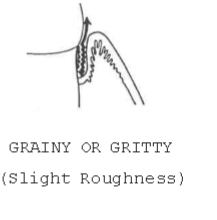
Interpreting what you feel, what does this image show and mean?

Interpreting what you feel, what does this image show and mean?

Interpreting what you feel, what does this image show and mean?

Interpreting what you feel, what does this image show and mean?
Pig tail or cowhorn explorer design features
double-ended, mirror image
Pig tail or cowhorn explorer used to detect
calculs (sub and supra), caries, restorations
What is the pig tail or cowhorn explorer adaptability
all surfaces, all crevices up to depth of 4mm
What is the ODU 11/12 Explorer adaptability
All surfaces, all crevices up to a depth of 4mm
What is the ODU 11/12 Explorer design features
Double ended, Mirror image, Fine tipped design, Long shank multiple bends
What is the ODU 11/12 Explorer used to detect
Calculus (sub and supra), Overhangs
Gracey-type Explorer design features
Double ended/mirror image
Fine working end
Greater shank length with multiple bends between point and handle
What is the Gracey-type Explorer used to detect
To examine
all anterior and posterior teeth
all surfaces
Calculus
What is the Gracey-type Explorer’s adaptability
Excellent in posterior for mesial, buccal, and lingual, and in anteriors.
What is the Gracey-type Explorer’s limitations
does not adapt well in pockets deeper than 4 or 5 mm on posterior distobuccal or distolingual line angles