WATER RELATIONSHIPS
 Call Kai
 Learn
Learn Practice Test
 Spaced Repetition
 Match
Match Flashcards
 Knowt Play
1/59

Earn XP
Description and Tags
Lecture 7.4
Name | Mastery | Learn | Test | Matching | Spaced | Call with Kai | Chat |
|---|
No analytics yet
Send a link to your students to track their progress
60 Terms
Why does water move through the plant?
Photosynthesis
Regulate temperature
Move solutes/nutrients through plant
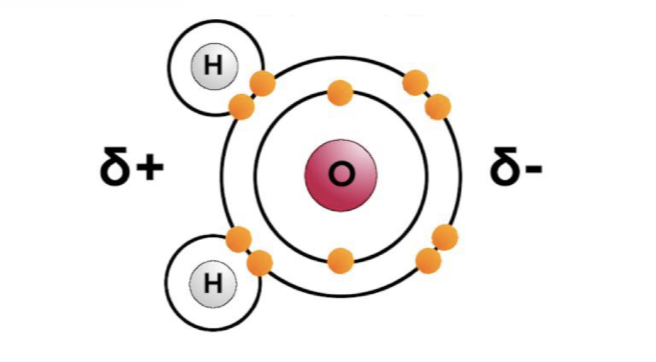
Water is a polar molecule
Oxygen is more electronegative than hydrogen.
It pulls shared electrons in the covalent bonds closer to itself.
Water is a polar molecule
Positive pole due to:
Fewer free electrons on one end of the molecule

Water is a polar molecule
Positive pole due to:
More free electrons on the other end of the H2O molecule.
Water properties:
Cohesion
Adhesion
Compressibility
Water properties:
Cohesion
Molecule of water sticks to each other via (long) H-bonds
important in water transport

Water properties:
Adhesion
Water sticks to other molecules via H bonds

Water properties:
Compressibility
Liquid water is incompressible because of H bonds.

How does water move in plants?
At a cellular level and molecular level by :
Diffusion.
How does water move in plants?
At a cellular level and molecular level by : Diffusion
Process by which molecules move from an area of higher concentration to an area of lower concentration, AKA: concentration gradient; until equilibrium is reached.

How does water move in plants?
At a cellular level and molecular level by : Diffusion
CONCENTRATION GRADIENT (down the gradient)
from an area of high concentration to an area of low concentration
How does water move in plants?
At a cellular level and molecular level by : Diffusion
How can we describe how fast they are moving?
Due to the FLUX = (quantity of substance transferred (mol)) (area x time)

How does water move in plants?
At a cellular level and molecular level by : Diffusion
How can we describe how fast they are moving? FLUX

How does water move in plants?
At a plant level by :
Bulk flow
How does water move in plants?
Water Potential
Quantifies the tendency of water to move from one area to another due to gravity, diffusion or mechanical pressure.
Water always moves from higher to lower potential.
Adding more solutes makes water potential more negative.

How does water move in plants?
Osmosis
Diffusion of water across a membrane. Passive movement across a selectively permeable membrane.

How does water move in plants?
Osmosis: Diffusion of water across a membrane. Passive movement across a selectively permeable membrane.
What are some characteristics of membranes?
lipid bilayer
selectively permeability
Characteristic of the molecules (size, charge) will permit the flow through the lipid bilayer
Transport proteins/ Aquaporins
How does water move in plants?
Complete:
Water can … through membranes by … but … make the process so much faster.
Water can diffuse through membranes by osmosis but aquaporins make the process so much faster.
How does water move in plants?
Osmosis: Diffusion of water across a membrane. Passive movement across a selectively permeable membrane.
Where the permeable membrane allow the passing of what types of molecules?
Small nonpolar molecules:
Gases O2, N2, CO2
fat soluble vitamins
Steroids
Small uncharged polar molecules
Water
urea, ethanol, glycerol
How does water move in plants?
Osmosis: Diffusion of water across a membrane. Passive movement across a selectively permeable membrane.
Aquaporins
Specialized integral membrane proteins that form pores in cell membranes to rapidly facilitate the transport of water and small neutral solutes.

How does water move in plants?
Water moves from … water potential to … solute concentration.
Water moves from high water potential to low solute concentration.

Osmotic potential
Measure of the potential of water to move between regions of differing concentrations across a water-permeable membrane.
Water moves down/up osmotic gradients?
Water moves down osmotic gradients.

Water moves down osmotic gradients
So, what happens here?
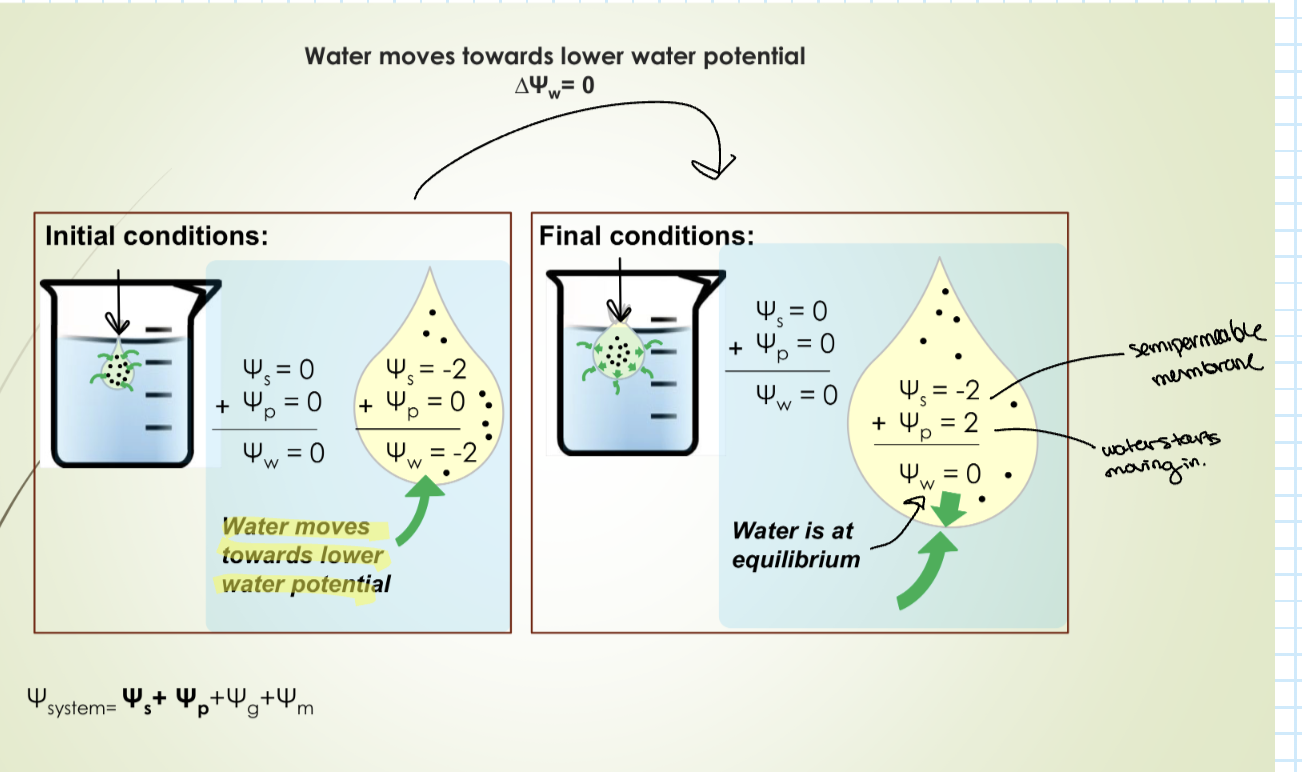
Water moves across a semipermeable membrane into a compartment containing salt.
Outside there is a high concentration of water.

Water moves down osmotic gradients
So, what happens here?
The water flows inward until the force of its pressure inside balances the osmotic driving force.

Water moves down osmotic gradients
So, what happens here?
The osmotic potential of pure water is 0.
The addition of solutes lowers the water potential.
Water moves towards a region with a lower water potential.
Turgor Pressure
Supports plant cells and tissues.
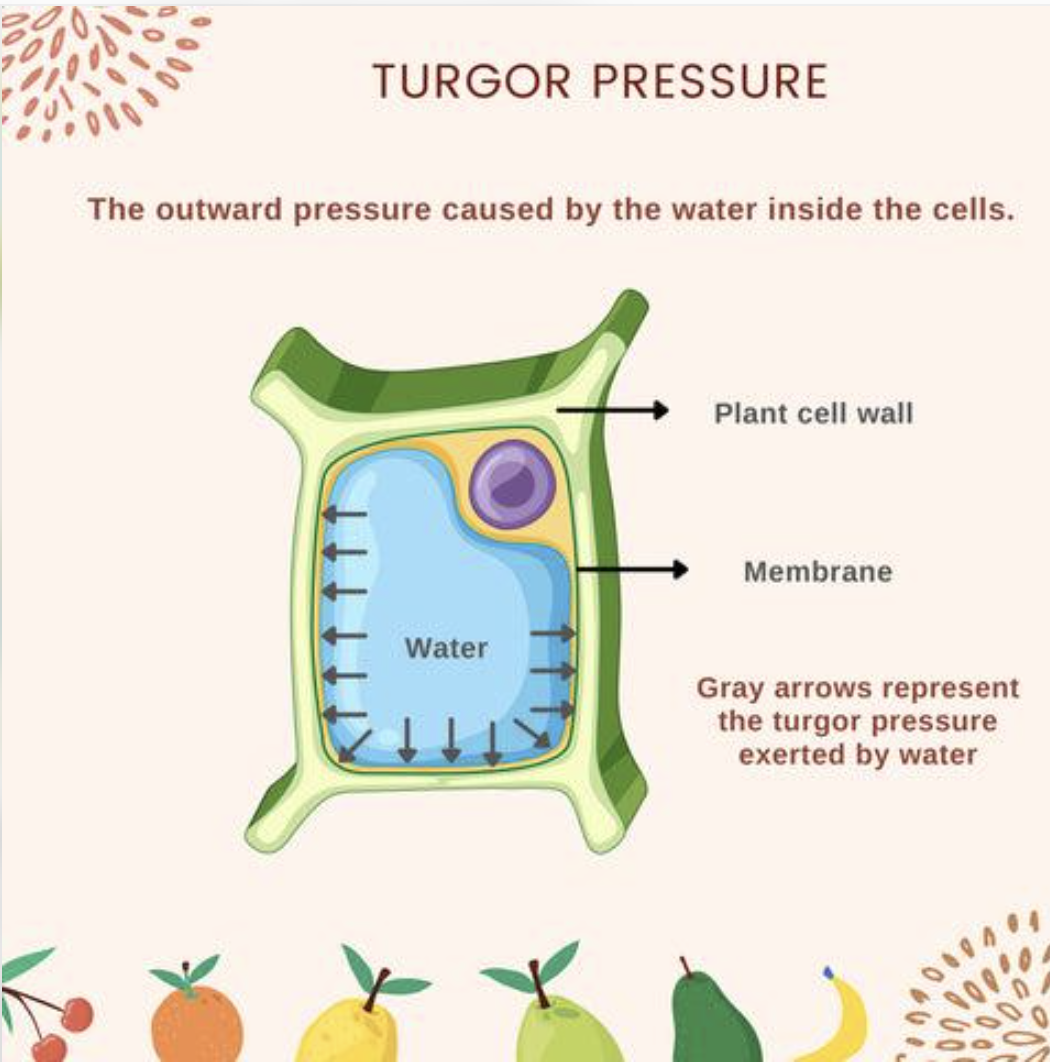
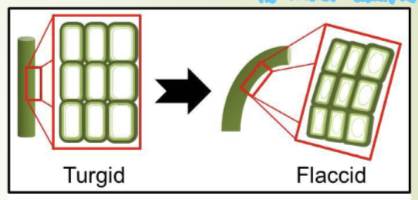
Turgor Pressure: Supports plant cells and tissues.
Process: How plants build up pressure
Step 1: Concentrate solutes
The plant cell accumulates dissolved salts in its cytoplasm/vacuoles.
Step 2: Lower water potential
More dissolved solutes make the cell’s water potential more negative
Step 3: Water enters
Water moves into the cell by osmosis, from higher to lower water potential.
Step 4: Pressure builds up
The cell expands, and water pushes the membrane against the cell wall, creating turgor pressure.
Turgor Pressure: Supports plant cells and tissues.
Process: How plants build up pressure
Turgor pressure allows plant to have:
Structural support
Cell expansion
Stomata movement
Diffusion
The movement of particles
Different substances diffuse independently, each according to its own concentration gradient.
Results in the net movement of molecules from higher to lower concentration.
The rate of diffusion depends on:
-concentration gradient (d(c))
-diffusion coefficient (D).
Diffusion Flux
Amount of a substance that moves through a given area per unit of time due to diffusion.
Measured using Fick’s law
Diffusion Flux: Amount of a substance that moves through a given area per unit of time due to diffusion.
Fick’s law
J = -D (d[c]) / dx
J is the diffusion flux
D is the diffusion coefficient (depends on the molecule and medium)
d[c] is the concentration change
dx is distance
Bulk Flow
Molecules of water move all together from one place to another because of the differences in potential energy (water potential) → higher to lower
Pressure driven bulk flow mechanism responsible for long-distance transport of sap.
Quick reminder: Types of sap
Xylem sap:
Water and minerals and its transport
Mainly upward
Driving force: transpiration pull and pressure differences
Phloem sap:
Sugars and organic nutrients
Phloem
Food transport
Pressure flow mechanism
Water rises to treetops by …, the process by which water evaporates from leaves through stomata.
Water rises to treetops by transpiration, the process by which water evaporates from leaves through stomata.
Water Potential Ψw
Measure of the potential energy in water.
Difference in potential energy between a given water sample and pure water (at atmospheric pressure and ambient pressure)
Quantifies tendency of water to move from one area to another due to osmosis, gravity, mechanical pressure.
measured in units of pressure: megapascals MPa
Water Potential Ψw
Which way does water move along a water-potential gradient?
From higher water potential to lower water potential.
Water Potential
By definition, the potential of pure water is Ψw is =
Ψw = zero
… Ψw of a solution is always going to be negative -MPa
Water Potential Ψw
What is the usual water potential of plant cells relative to pure water?
Usually negative because of dissolved solutes and other factors.
Water Potential Ψw
What is the usual water potential gradient in a transpiring plant?
Pure water/soil → root → leaf;
values generally become more negative.
Water Potential Ψw
Where is water potential usually most negative in a transpiring plant?
The leaf, because transpiration helps create a lower water potential.
Water Potential Ψw
Components of water potential in plant solutions:
solute concentration, pressure, gravity and other factors (matric effects)
Water Potential Ψw
Components of water potential in plant solutions: solute concentration, pressure, gravity and other factors (matric effects).
Ψsystem =
Ψsystem = Ψs + Ψp + Ψg + Ψm
where
s = solute, more solutes, more negative
p = pressure — such as turgor pressure
g = gravity
m = matrix ( the effect of water sticking to surfaces )
Water Potential Ψw
Water potential in a system refers:
Potential in the:
soil water Ψsoil
root water Ψroot
leaf water Ψleaf
water in the atmosphere Ψatmosphere
Water Potential Ψw
Water potential in a system refers to potential in the:
soil water Ψsoil
root water Ψroot
leaf water Ψleaf
water in the atmosphere Ψatmosphere
Water moves to equilibrate what?
equilibrate the system or compartment from higher Ψ to the one with lower Ψ until the difference is back to zero.
ΔΨw = 0
, where water moves in response to ΔΨw not individual components.
Solute Potential Ψs—Osmotic potential
Ψsystem = Ψs + Ψp + Ψg + Ψm
Pure water has Ψs = 0 MPa
Dissolved solutes lower potential, making Ψs negative
Plant cell cytoplasm typically has Ψs aroundPressure -0.5 to -1.0 MPa
Increase solute concentration makes Ψs more negative
Difference in water potential contribute to osmotic water uptake from soil into root cells.
Pressure Potential Ψsystem = Ψs + Ψp + Ψg + Ψm
Effect of physical pressure on water potential.
Pressure PotentialΨp
Effect of physical pressure on water potential.
How does positive pressure affect total water potential?
It increases total water potential.
Pressure PotentialΨp
Effect of physical pressure on water potential.
What is the typical turgor pressure in living plant cells?
About 0.6 - 0.8 MPa some cells reach around 1.5 MPa.
Pressure PotentialΨp
Effect of physical pressure on water potential.
What does Ψp= 0 mean?
There is no pressure contribution to water potential.
Pressure PotentialΨp
Effect of physical pressure on water potential.
What happens when a plant cell loses turgor?
The cell becomes flaccid; loss of turgor can contribute to wilting.
Pressure PotentialΨp
Effect of physical pressure on water potential.
How does negative pressure (tension) affect water potential?
It decreases total water potential.
Pressure PotentialΨp
Effect of physical pressure on water potential.
How does transpiration help water move up the xylem?
It creates tension in xylem water, helping pull water upward from the roots.
Pressure PotentialΨp
Effect of physical pressure on water potential.
What is the difference between turgor pressure and xylem tension?
Turgor is positive pressure; xylem tension is negative pressure that helps pull water upward.

Pressure PotentialΨp
Effect of physical pressure on water potential.
What happens when Ψp = 0?
No pressure contribution to water potential.
Gravitational Potential Ψsystem = Ψs + Ψp + Ψg + Ψm
Negative close to 0 in a plant with no height → not very important in small plants
Taller trees become more important Ψg→ 100m, column of water is 1MPa
Matrix Potential Ψsystem = Ψs + Ψp + Ψg + Ψm
Adhesion of water surfaces.
→ Removes energy from the system because water molecules bind to the cellulose matrix of the plant’s cell walls.
The more humidity, Ψw in atmosphere =
The more humidity, Ψw in atmosphere = 0

Water moves through:
Diffusion and bulk flow

Transpiration
Loss of water vapor from plants from above ground tissue (mainly leaves)
-PASSIVE (no ATP)
-Driving energy = water potential between soil vs plant/atmosphere
-Uptake of CO2 for photosynthesis and the loose of water by transpiration are necessary for life.