DNA Repair, RNA modifications, Transcription, some translation
 Call Kai
 Learn
Learn Practice Test
 Spaced Repetition
 Match
Match Flashcards
 Knowt Play
 Podcast
1/37

There's no tags or description
Looks like no tags are added yet.
Name | Mastery | Learn | Test | Matching | Spaced | Call with Kai | Chat |
|---|
No analytics yet
Send a link to your students to track their progress
38 Terms
3 types of DNA repair
Direct repair, base excision repair, nucleotide excision repair
Direct repair
covalent modifications of nucleotides can be reversed by specific enzymes
Enzymes used in direct repair
photolyases and alkyltransferases
Photolyase
can repair thymine dimers, splits the dimers, uses engery of visible light for photoreactivation
Alkyltransferase
repairs alkylated bases, transfers the methyl/ethyl group from base to a cysteine side chain within alkyltransferase, permanently inactivates the enzyme after repair.
Base excision repair
involves a category of enzymes known as DNA N-glycosylases
DNA N-glycosylases
enzymes recognize an abnormal base and cleaves the bond between the sugar in the DNA
Nucleotide excision repair
repairs thymine dimers, chemically modified bases, missing bases, some cross links. 4 key proteins UvrA, UvrB, UvrC, UvrD. They recognize and remove short segment of damaged DNA while DNA pol. and ligase finish the repair
RNA Modifications
4 kinds. RNA splicing, RNA processing, Add 5’ cap, add 3’ poly A tail
RNA splicing
coding sequences called exons are interrrupted by introns. Transcription produces a pre-mRNA corresponding to the entire gene sequence. Introns are removed and exonds are connected (spliced)
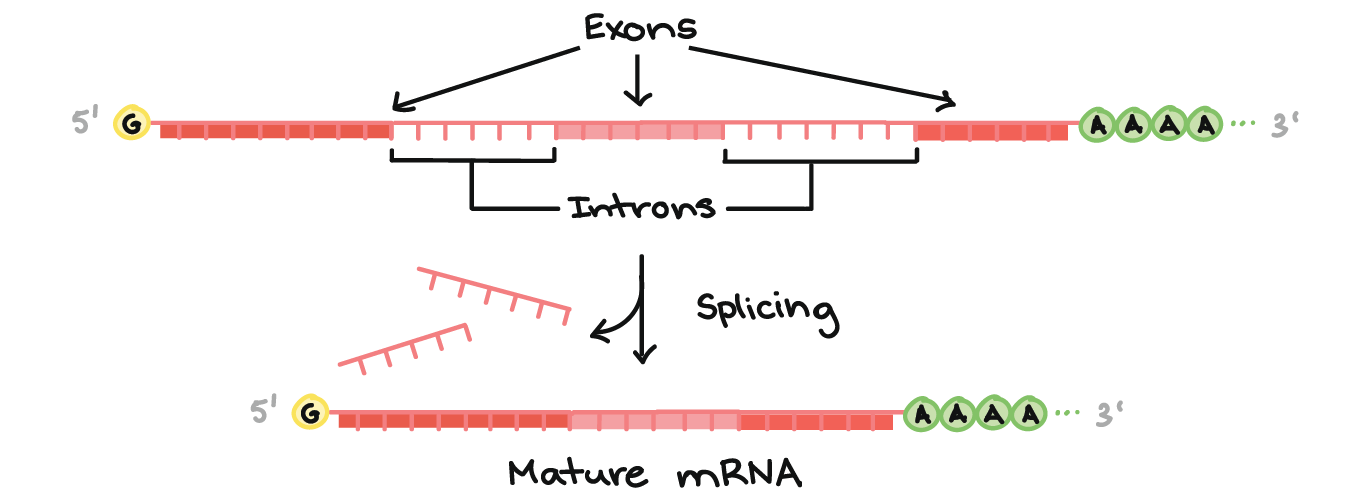
Alternative splicing
Exons are in different combinations are RNA splicing. This creates more variations in proteins that are formed from one specific gene
Processing of ribosomal RNA
Creates multiple different rRNA from rRNA encoding genes
How many kinds of rRNA
3 main types, never get translated
Attachment of a 7-methylguanosine cap
to the 5’ end it helps with nuclear transport
Polyadenylation signal sequence
Adding a poly A tail to the 3’ end
Transcription 3 stages
Initiation, elongation, termination
Initiation
sigma factor of RNA pol recognizes -35 and -10 seq of the promoter. The whole enzyme is called RNA pol. holoenzyme
Transciption starts at ___site
+1 site
Promoter specifices direction of transcription
3’ end is adjacent to the promoter
Elongation
sigma factor is relased, carried out by RNA pol.
Termination
Two kinds; Rho-dependent, rho-independentR
Rho-dependent
Requires protein rho, stemp-loop, rho-binding site in RNA

Rho-independent
stem-loop, follwed by a U/A rich sequences, causes the RNA pol to pause and fall off
Transciption in Eukaryotes
core promoter is relatively short, and has a TATA box which is the transcription start site
Core promoter itself prodouces a low level of trasncription
basal transcription
Regulatory elements
DNA sequences that affect the binding of RNA pol. to the promoter
2 kinds of regulatory elements
enhancers and silencers
Enchancers
stimulate transcription and help RNA pol bind
Silencers
inhibit transcription and prevent RNA pol from bindng`
kinds of RNA pol. for Euk.
3 types
Transcription factors (proteins)
bind to these elements and influence the rate of transcription
__ many kinds of transceiption factors
5 kinds
Translation
start codon sets the reading frame for all remaining codons, anticodons on tRNA are complementary to codons
Codon types
sense codons (encoding AA), initiation codons (AUG), stop codons (UAA, UAG, UGA)
Recognition between tRNA and mRNA
the anit-codon in tRNA vinds to the complementary codon in mRNA
enzymes attach the specific AA to the tRNA are known as
aminoacyltRNAsynthetases
Anticodon is __ to codon
antiparllel
Function Sites of ribosomes
peptidyl site (p), aminoacyl site (a), exit site (e)