WILD 346 Exam 4
 Call Kai
 Learn
 Practice Test
 Spaced Repetition
 Match
 Flashcards
 Knowt Play
1/50

There's no tags or description
Looks like no tags are added yet.
51 Terms
What is osmoregulation?
keeping water and salt balanced in the body
Why is osmoregulation important?
keeps cells from bursting or shrinking due to dehydration
ensures enzymes function properly
What water and salt problems do freshwater fish face?
gills will take on too much water and lose salt (too low of salt in the water)
What water and salt problems do marine fish face?
gills taking in too much salt and lose water (too high of salt in the water)
What water and salt problems do marine birds and mammals face?
taking on too much salt though their diet
What is a solute?
any type of dissolved particles in a solution
What is a solvent?
what the particles are dissolved in (oftentimes water)
Does the identity of dissolved particle (solute) matter?
no, just how many there are
What is osmosis?
the movement of water from low to high solute concentration
What is osmotic pressure?
the pressure of water to enter, given the solute concentration
What does a high osmotic pressure mean?
a higher solute concentration draws more water in
What does a low osmotic pressure mean?
a lower solute concentration draws water out
Where does water move from in terms of osmotic pressure?
water always moves from an area of low osmotic pressure to an area of high osmotic pressure
What is the only way water can move?
if there is a higher solute concentration
What is osmolarity?
the concentration of solutes in a solution
What is the difference between osmolarity and molarity?
molarity counts whole molecules, while osmolarity counts every dissolved particle
e.g. 150 mM NaCl = 300 mOsm NaCl (counts the # of dissolved particles in both Na and Cl)
What does isoosmotic mean?
osmotic pressure is equal
What does hyperosmotic mean?
higher osmotic pressure (higher solute)
What does hypoosmotic mean?
lower osmotic pressure (lower solute)

What is this visual depicting?
inside gill (yellow) = more solute concentration (hyperosmotic)
pond water (blue) = lower solute concentration (hypoosmotic)
water is moving from low to high
What is an osmoregulator?
organisms that have a constant internal water and solute balance, regardless of changes in their surrounding environment
What is an osmoconformer?
an animal whose body fluid is isoosmotic with the environment
Are freshwater teleosts (bony fish) osmoregulators or osmoconformers?
osmoregulators
hyperosmotic to environment (higher solute)
What are the problems associated with being hyperosmotic to the environment for freshwater teleosts?
they intake more water by osmosis and lose salt by diffusion
What are the solutions to freshwater teleosts being hyperosmotic to their environment?
lots of dilute urine
move more salt into the blood
What are chloride cells?
specialized cells that result in active uptake of ions across gills
What does the graph of osmoregulators look like?
a flat line (constant)
body fluid osmolarity does not change with environmental osmolarity
What does the graph of osmoconformers look like?
1:1 line
body fluid osmolarity changes in proportion with environmental osmolarity
How do amphibians actively transport salts via their skin?
active transport of Na+ into the animal
Cl- follows passively (electric gradient)

What are the problems amphibians face with osmosis?
water gain and salt loss
What are the solutions amphibians use for salt loss?
dilute urine
pump salt into the body via skin

What are the marine vertebrate classes?
jawless fish (lampreys, slime hags)
chondrycthes (sharks & rays)
teleosts (bony fish)
reptiles
birds
mammals

What is this graph communicating?
the osmolarity of body fluid (concentration of Na and Cl) in each species compared to seawater

Who are the osmoconformers on this graph?
slime hag
cartilaginous fish (chimera, dogfish, ray)
coelacanth (ancient teleost)
How do marine osmoconformers conform their body to seawater?
by adding urea to their blood
changes the osmolarity of their plasma so they don’t lose water (low solute) to seawater (high solute)

Who are the osmoregulators on this graph?
only teleosts
What is an ionoconformer?
an organism thatallows its internal ion concentration to closely match the surrounding external environment (typically seawater)
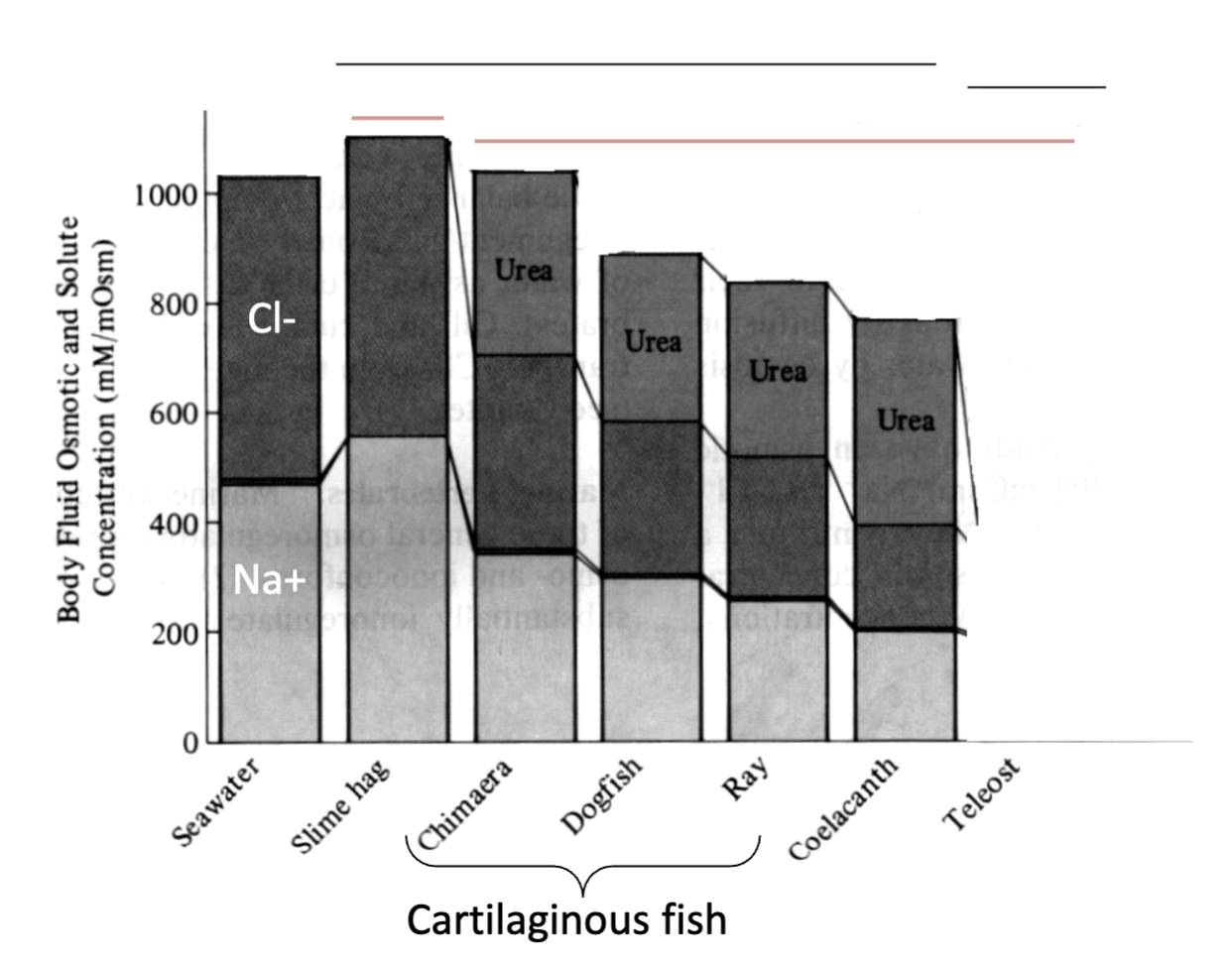
Who are the ionoconformers on this graph?
only slime hags (jawless fish)
they have a similar ion concentration to seawater
What is an ionoregulator?
an organism that actively maintains the concentration of ions in its body fluids, keeping them relatively constant despite changes in its external environment

Who are the ionoregulators on this graph?
cartilaginous fish (chimera, dogfish, ray)
coelacanth (ancient teleosts)
teleosts
Are marine teleosts osmoregulators or osmoconformers?
osmoregulators
What are the problems associated with being hypoosmotic to the environment for marine teleosts?
they intake more salt by osmosis and lose water by diffusion
What are the solutions to marine teleosts being hypoosmotic to their environment?
gain water via ingestion (food, drink)
produce little urine (isoosmotic to plasma)
excrete salts with chloride cells in gills
How do chloride cells in gills excrete salts in marine teleosts?
they actively pump ions out
actively extrude Cl-
active/passive outflux of Na+
Are marine reptiles and birds osmoregulators or osmoconformers?
osmoregulators
What problems do marine reptiles and birds face?
their blood is hypoosmotic to seawater → water loss, salt gain
can’t concentrate their urine
How do marine reptiles and birds get rid of their huge salt loads?
they use specialized salt glands that act as desalination filters because their kidneys are not strong enough to process the high levels of sodium and chloride found in seawater
Where are the salt glands found in marine birds?
in their heads, just above their eyes


What percentage of salt is concentrated in ingested seawater, nasal fluid, and urine in marine birds?
ingested seawater: 3% salt
nasal fluid (salt gland excretion): 5% salt → more concentrated than seawater
urine: 0.3% salt → not very concentrated
How do marine birds use their salt glands to get rid of excess salt?
blood vessels flow close to salt glands, using active transport to pull excess Na and Cl from the bloodstream and create a concentrated salt solution
solution drips out of their nostrils, runs down their bills, and is shaken/sneezed off
these glands can clear salt up to 10 times faster than the birds' kidneys can
How is marine reptile salt excretion different than that of marine birds?
they also rely on specialized salt glands but they are located in different places (e.g. sea snake, sea turtle, marine iguana)