Renal Physiology Pearls/Cases

0.0(0)
Studied by 0 people
call kaiCall Kai
learnLearn
examPractice Test
spaced repetitionSpaced Repetition
heart puzzleMatch
flashcardsFlashcards
GameKnowt Play
Card Sorting

1/28

encourage image

There's no tags or description

Looks like no tags are added yet.

Last updated 9:48 PM on 10/6/26
Name
Mastery
Learn
Test
Matching
Spaced
Call with Kai
Chat

No analytics yet

Send a link to your students to track their progress

29 Terms

1
New cards

What physiologic mechanisms normally prevent hyponatremia when plasma osmolality falls?

Drop in osmolality suppresses ADH → increased free water excretion → restoration of plasma osmolality.

knowt flashcard image


<p>Drop in osmolality suppresses ADH → increased free water excretion → restoration of plasma osmolality.</p><img src="https://assets.knowt.com/user-attachments/1ea258c1-9c79-4559-9136-8ba4293b1f5d.png" data-width="50%" data-align="center" alt="knowt flashcard image" style="display: block; width: 50%; margin-left: auto; margin-right: auto;"><p></p>
2
New cards

What distinguishes true hyponatremia from pseudo-hyponatremia?

True hyponatremia is always hypotonic (hypo-osmolar)

knowt flashcard image


<p>True hyponatremia is always hypotonic (hypo-osmolar)</p><img src="https://assets.knowt.com/user-attachments/b28651fb-998f-41e8-ae26-5fc314d2194e.png" data-width="50%" data-align="center" alt="knowt flashcard image" style="display: block; width: 50%; margin-left: auto; margin-right: auto;"><p></p>
3
New cards

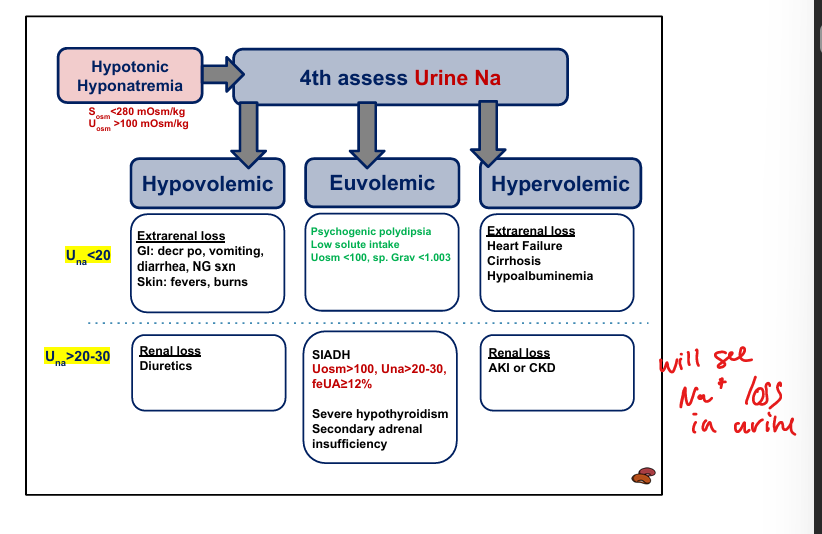
What are the steps towards evaluating hyponatremia?

  1. Serum osmolality to determine whether the hyponatremia is hypo-(<275), iso-(275-295), or hypertonic(>295) (is it true hyponatremia with hypoosmolarity)

  2. Urine osmolarity (is ADH level suppressed, appropriately elevated, or inappropriately elevated)

  3. Assess volume status

  4. Assess urine Na content (is Na concentrated/is kidney working?)

knowt flashcard imageknowt flashcard image


<ol><li><p>Serum osmolality to determine whether the hyponatremia is hypo-(&lt;275), iso-(275-295), or hypertonic(&gt;295) (is it true hyponatremia with hypoosmolarity)</p></li><li><p>Urine osmolarity (is ADH level suppressed, appropriately elevated, or inappropriately elevated)</p></li><li><p>Assess volume status</p></li><li><p>Assess urine Na content (is Na concentrated/is kidney working?)</p></li></ol><img src="https://assets.knowt.com/user-attachments/67a9095a-a6c7-41c0-a978-d3506c23ba03.png" data-width="50%" data-align="center" alt="knowt flashcard image" style="display: block; width: 50%; margin-left: auto; margin-right: auto;"><img src="https://assets.knowt.com/user-attachments/51c01eb9-7f52-4809-97e9-3a9d04075d8f.png" data-width="50%" data-align="center" alt="knowt flashcard image" style="display: block; width: 50%; margin-left: auto; margin-right: auto;"><p></p>
4
New cards

What does urine osmolality reveal in the evaluation of hyponatremia?

Whether ADH is appropriately suppressed (<100 mOsm/kg)→water excreted or present/inappropriately elevated (>100 mOsm/kg)→less free water excretion

knowt flashcard image


<p>Whether ADH is appropriately suppressed (&lt;100 mOsm/kg)→water excreted or present/inappropriately elevated (&gt;100 mOsm/kg)→less free water excretion</p><img src="https://assets.knowt.com/user-attachments/c7c99c1c-63c8-4c23-9a1d-a38cc5e9a0c8.png" data-width="50%" data-align="center" alt="knowt flashcard image" style="display: block; width: 50%; margin-left: auto; margin-right: auto;"><p></p>
5
New cards

What urine osm finding suggests normal suppression of ADH? What level suggest ADH Present?

Urine osm <100 mOsm/kg. Urine osm >100 = ADH present

knowt flashcard image


<p>Urine osm &lt;100 mOsm/kg. Urine osm &gt;100 = ADH present</p><img src="https://assets.knowt.com/user-attachments/7417e5ba-e3ac-4d48-b34a-2576c98f81c0.png" data-width="50%" data-align="center" alt="knowt flashcard image" style="display: block; width: 50%; margin-left: auto; margin-right: auto;"><p></p>
6
New cards

What conditions cause hyponatremia with suppressed ADH and very dilute urine?

Primary polydipsia and low-solute intake (tea-and-toast, beer potomania).

knowt flashcard image


<p>Primary polydipsia and low-solute intake (tea-and-toast, beer potomania).</p><img src="https://assets.knowt.com/user-attachments/338332d2-ba00-440c-8b79-987c75c364a4.png" data-width="50%" data-align="center" alt="knowt flashcard image" style="display: block; width: 50%; margin-left: auto; margin-right: auto;"><p></p>
7
New cards

What is the physiologic reason SIADH causes hyponatremia?

Non-osmotic ADH release → water retention → dilutional hyponatremia despite normal volume status.

knowt flashcard image


<p>Non-osmotic ADH release → water retention → dilutional hyponatremia despite normal volume status.</p><img src="https://assets.knowt.com/user-attachments/4ee07375-ebd8-4370-9d29-67206f3813a8.png" data-width="50%" data-align="center" alt="knowt flashcard image" style="display: block; width: 50%; margin-left: auto; margin-right: auto;"><p></p>
8
New cards

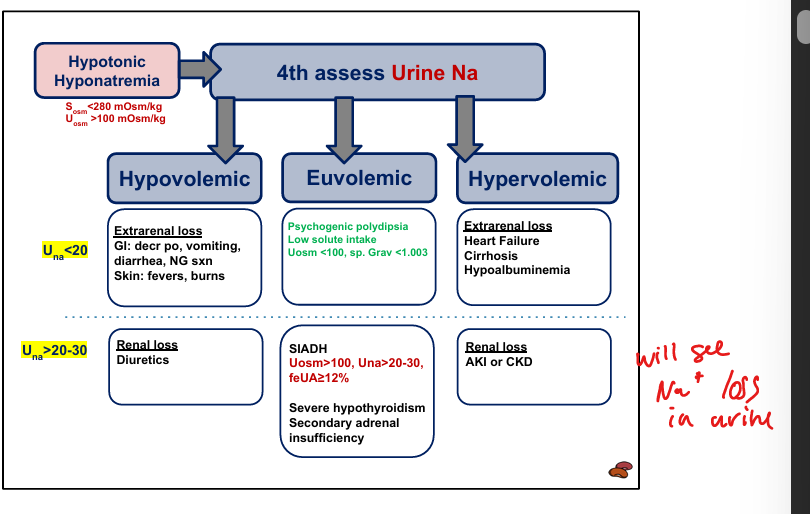
What urine sodium level helps differentiate renal vs extrarenal volume loss in hypovolemic hyponatremia?

Urine Na <20 suggests extrarenal loss. Urine Na>20-30 suggests Renal loss (because kidney damage leading to Na release when it shouldnt)
knowt flashcard image


<p>Urine Na &lt;20 suggests extrarenal loss. Urine Na&gt;20-30 suggests Renal loss (because kidney damage leading to Na release when it shouldnt)</p><img src="https://assets.knowt.com/user-attachments/27e2fdba-dbd5-4b8c-b28d-e32269f023fa.png" data-width="50%" data-align="center" alt="knowt flashcard image" style="display: block; width: 50%; margin-left: auto; margin-right: auto;"><p></p>
9
New cards

Why does hypovolemic hyponatremia produce high urine osm?

Volume depletion triggers ADH release → concentrated urine.

knowt flashcard image


<p>Volume depletion triggers ADH release → concentrated urine.<br></p><img src="https://assets.knowt.com/user-attachments/c21e12e9-3a3a-44ce-8299-5e0fa9ba4787.png" data-width="50%" data-align="center" alt="knowt flashcard image" style="display: block; width: 50%; margin-left: auto; margin-right: auto;"><p></p>
10
New cards

What is the major danger of rapidly correcting chronic hyponatremia?

Osmotic demyelination syndrome due to rapid water movement out of brain cells.

knowt flashcard imageknowt flashcard image


<p>Osmotic demyelination syndrome due to rapid water movement out of brain cells.</p><img src="https://assets.knowt.com/user-attachments/08ee1a15-ae6e-47a1-8b35-68677f1e1f50.png" data-width="50%" data-align="center" alt="knowt flashcard image" style="display: block; width: 50%; margin-left: auto; margin-right: auto;"><img src="https://assets.knowt.com/user-attachments/76f33193-8dcf-46eb-bc7a-40da7f72ffee.png" data-width="50%" data-align="center" alt="knowt flashcard image" style="display: block; width: 50%; margin-left: auto; margin-right: auto;"><p></p>
11
New cards

What is the safe correction goal for chronic hyponatremia?

6–8 mEq/L per 24 hours (never exceed 10–12 mEq/L).

knowt flashcard image


<p>6–8 mEq/L per 24 hours (never exceed 10–12 mEq/L).</p><img src="https://assets.knowt.com/user-attachments/4204da8a-2b08-4389-b791-ee10d81104df.png" data-width="50%" data-align="center" alt="knowt flashcard image" style="display: block; width: 50%; margin-left: auto; margin-right: auto;"><p></p>
12
New cards

What is the physiologic adaptation of the brain in chronic hyponatremia?

Loss of electrolytes (hours) and organic osmolytes (days) to prevent cerebral edema.

knowt flashcard image


<p>Loss of electrolytes (hours) and organic osmolytes (days) to prevent cerebral edema.</p><img src="https://assets.knowt.com/user-attachments/f96e61f6-b57d-4a2a-af4c-d4928945a092.png" data-width="50%" data-align="center" alt="knowt flashcard image" style="display: block; width: 50%; margin-left: auto; margin-right: auto;"><p></p>
13
New cards

What finding differentiates SIADH from hypovolemic hyponatremia?

SIADH has urine Na >20–30 and euvolemia

knowt flashcard image


<p>SIADH has urine Na &gt;20–30 and euvolemia</p><img src="https://assets.knowt.com/user-attachments/d7785ba0-d72a-412f-bd37-f7013dd0d6f6.png" data-width="50%" data-align="center" alt="knowt flashcard image" style="display: block; width: 50%; margin-left: auto; margin-right: auto;"><p></p>
14
New cards

What distinguishes water diuresis from osmotic diuresis in hypernatremia?

Water diuresis: Uosm <600

knowt flashcard imageknowt flashcard image


<p>Water diuresis: Uosm &lt;600</p><img src="https://assets.knowt.com/user-attachments/4a58e6dd-5f89-44d1-97a7-aeb22f913af5.png" data-width="50%" data-align="center" alt="knowt flashcard image" style="display: block; width: 50%; margin-left: auto; margin-right: auto;"><img src="https://assets.knowt.com/user-attachments/917cd0e0-4216-46f0-9716-7503306b41e7.png" data-width="50%" data-align="center" alt="knowt flashcard image" style="display: block; width: 50%; margin-left: auto; margin-right: auto;"><p></p>
15
New cards

What physiologic defect causes central diabetes insipidus?

Absent ADH production → inability to concentrate urine.

knowt flashcard image


<p>Absent ADH production → inability to concentrate urine.<br></p><img src="https://assets.knowt.com/user-attachments/e054cb69-2c9a-4597-8948-48b619fc1767.png" data-width="50%" data-align="center" alt="knowt flashcard image" style="display: block; width: 50%; margin-left: auto; margin-right: auto;"><p></p>
16
New cards

What physiologic defect causes nephrogenic diabetes insipidus? Common causes?

Kidneys fail to respond to ADH → inability to concentrate urine. Causes: Lithium, Hypercalcemia,

knowt flashcard image


<p>Kidneys fail to respond to ADH → inability to concentrate urine. Causes: <strong>Lithium, Hypercalcemia</strong>, </p><img src="https://assets.knowt.com/user-attachments/d1af5149-7de3-4fb8-b3b3-50ecc67d6a0a.png" data-width="50%" data-align="center" alt="knowt flashcard image" style="display: block; width: 50%; margin-left: auto; margin-right: auto;"><p></p>
17
New cards

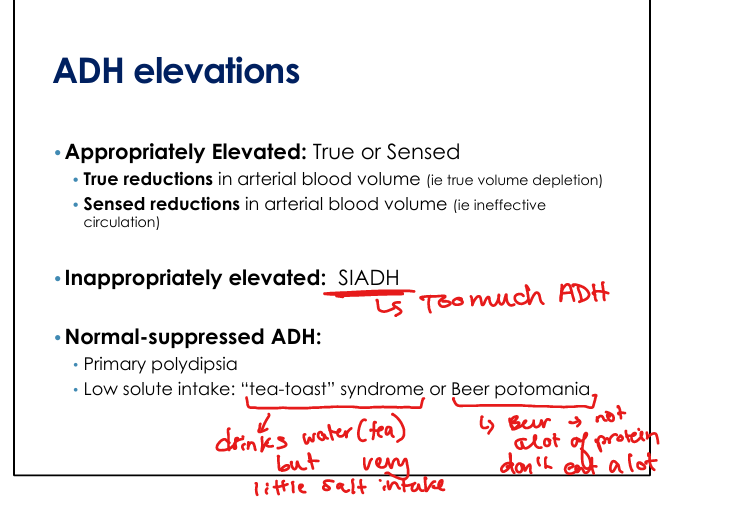
Why does beer potomania cause hyponatremia?

Low solute intake limits renal free water excretion → dilutional hyponatremia.
knowt flashcard image


<p>Low solute intake limits renal free water excretion → dilutional hyponatremia.</p><img src="https://assets.knowt.com/user-attachments/fa4018f4-e3a3-4790-a69a-3759a35e5688.png" data-width="50%" data-align="center" alt="knowt flashcard image" style="display: block; width: 50%; margin-left: auto; margin-right: auto;"><p></p>
18
New cards

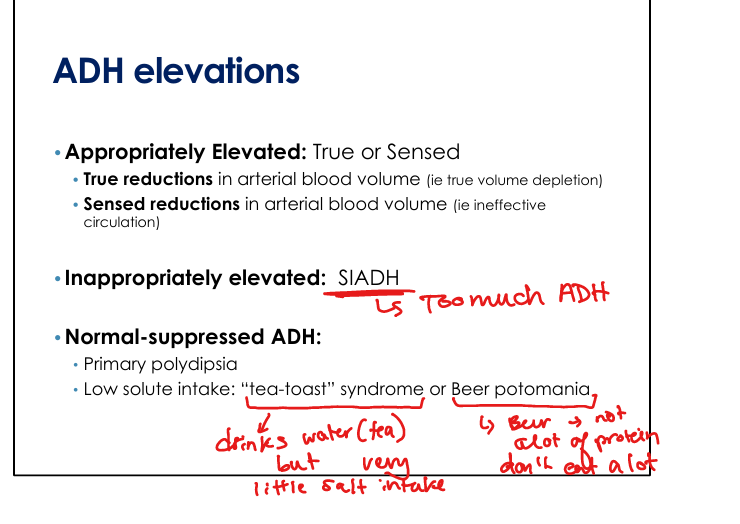
Why does primary polydipsia(urge to drink fluids/excessive thirst) cause hyponatremia?

Excess water intake overwhelms maximal renal free water excretion → dilute urine and low serum Na.
knowt flashcard image


<p>Excess water intake overwhelms maximal renal free water excretion → dilute urine and low serum Na.</p><img src="https://assets.knowt.com/user-attachments/6ec0df2a-bc13-4f6b-bb31-c83c19b26b77.png" data-width="50%" data-align="center" alt="knowt flashcard image" style="display: block; width: 50%; margin-left: auto; margin-right: auto;"><p></p>
19
New cards

Why does SIADH produce high urine osm and high urine Na?

ADH causes water retention

knowt flashcard image


<p>ADH causes water retention</p><img src="https://assets.knowt.com/user-attachments/d17cf187-4edb-4534-90c7-cae8c92e7396.png" data-width="50%" data-align="center" alt="knowt flashcard image" style="display: block; width: 50%; margin-left: auto; margin-right: auto;"><p></p>
20
New cards

Common causes of SIADH

CANCER, pulmonary disorders, Drugs(SSRIs, HCTZ), CNS disorders,

knowt flashcard image


<p>CANCER, pulmonary disorders, Drugs(SSRIs, HCTZ), CNS disorders, </p><img src="https://assets.knowt.com/user-attachments/39629327-2a1d-487f-be26-dc4df50e1603.png" data-width="50%" data-align="center" alt="knowt flashcard image" style="display: block; width: 50%; margin-left: auto; margin-right: auto;"><p></p>
21
New cards

Why does vomiting/diarrhea often cause hypovolemic hyponatremia?

Loss of Na-rich fluid + ADH activation → water retention → dilutional hyponatremia.
knowt flashcard image


<p>Loss of Na-rich fluid + ADH activation → water retention → dilutional hyponatremia.</p><img src="https://assets.knowt.com/user-attachments/19d024d9-5d79-4ebe-9ed0-6e5ef9d5a733.png" data-width="50%" data-align="center" alt="knowt flashcard image" style="display: block; width: 50%; margin-left: auto; margin-right: auto;"><p></p>
22
New cards

Why does adrenal insufficiency cause hyponatremia?

Low cortisol → increased ADH

knowt flashcard image


<p>Low cortisol → increased ADH</p><img src="https://assets.knowt.com/user-attachments/2b8f3b4b-e2f5-4c89-bac8-46557a0470e1.png" data-width="50%" data-align="center" alt="knowt flashcard image" style="display: block; width: 50%; margin-left: auto; margin-right: auto;"><p></p>
23
New cards

Why does thiazide-induced hyponatremia occur?

Impaired urinary dilution + volume depletion → ADH activation.

knowt flashcard image


<p>Impaired urinary dilution + volume depletion → ADH activation.</p><img src="https://assets.knowt.com/user-attachments/fdb38831-d235-42ba-a8c2-2d4101640224.png" data-width="50%" data-align="center" alt="knowt flashcard image" style="display: block; width: 50%; margin-left: auto; margin-right: auto;"><p></p>
24
New cards

Why does furosemide NOT worsen hyponatremia in SIADH?

Loop diuretics reduce medullary gradient → impair urine concentration → increase free water excretion.

knowt flashcard image


<p>Loop diuretics reduce medullary gradient → impair urine concentration → increase free water excretion.</p><img src="https://assets.knowt.com/user-attachments/28c1824d-07cc-4e3f-9dc2-46b24ebf5973.png" data-width="50%" data-align="center" alt="knowt flashcard image" style="display: block; width: 50%; margin-left: auto; margin-right: auto;"><p></p>
25
New cards

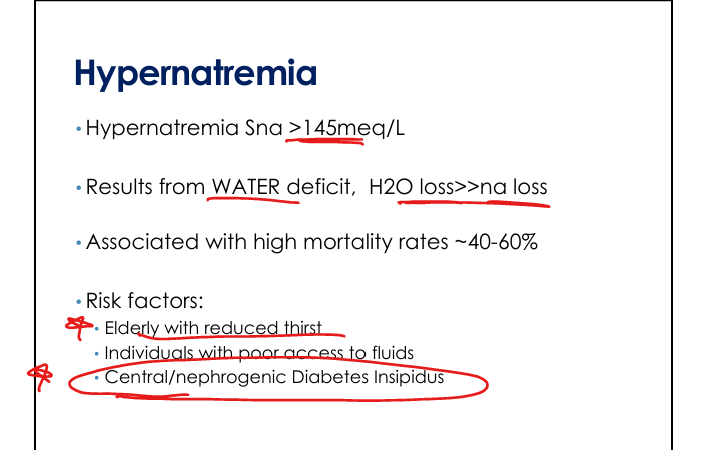
Hypernatremia

>145 meq/l; results from water deficit; risk factors include: elderly with reduced thirst, poor access tof luids, diabetes insipidus
knowt flashcard imageknowt flashcard image


<p>&gt;145 meq/l; results from water deficit; risk factors include: elderly with reduced thirst, poor access tof luids, diabetes insipidus</p><img src="https://assets.knowt.com/user-attachments/fb34a37c-d62e-4004-a669-b406d9facd82.png" data-width="50%" data-align="center" alt="knowt flashcard image" style="display: block; width: 50%; margin-left: auto; margin-right: auto;"><img src="https://assets.knowt.com/user-attachments/4cd9faf6-776b-4392-a5f3-8ab9a0a22e73.png" data-width="50%" data-align="center" alt="knowt flashcard image" style="display: block; width: 50%; margin-left: auto; margin-right: auto;"><p></p>
26
New cards

Renal forms of water loss

Osmotic diuresis: hyperglycemia, mannitol

Water diuresis: Central or Nephrogenic DI

27
New cards

Non-renal water loss

Diarrhea, burns, sweat, respiratory ventilation

knowt flashcard image


<p>Diarrhea, burns, sweat, respiratory ventilation</p><img src="https://assets.knowt.com/user-attachments/471cccb3-70be-49a9-8150-0e3fda068de7.png" data-width="50%" data-align="center" alt="knowt flashcard image" style="display: block; width: 50%; margin-left: auto; margin-right: auto;"><p></p>
28
New cards

Na correction for hyperglycemia

For every 100 inc in glucose over 100, decrease Na by factor of 1.6 (for blood glucose <400) or 2.4 (for blood glucose >400)

knowt flashcard image


<p>For every 100 inc in glucose over 100, decrease Na by factor of 1.6 (for blood glucose &lt;400) or 2.4 (for blood glucose &gt;400)</p><img src="https://assets.knowt.com/user-attachments/2f3b8e6f-238b-4291-ae4a-706924824f5b.png" data-width="50%" data-align="center" alt="knowt flashcard image" style="display: block; width: 50%; margin-left: auto; margin-right: auto;"><p></p>
29
New cards

Acute vs Chronic Hyponatremia timeline

<48hrs is acute; >48hrs is chronic

knowt flashcard image


<p>&lt;48hrs is acute; &gt;48hrs is chronic</p><img src="https://assets.knowt.com/user-attachments/8e66b3c2-0329-4152-a0e6-1475ffe6616c.png" data-width="50%" data-align="center" alt="knowt flashcard image" style="display: block; width: 50%; margin-left: auto; margin-right: auto;"><p></p>