Hypo/Hyper thermia
 Call Kai
 Learn
Learn Practice Test
 Spaced Repetition
 Match
Match Flashcards
 Knowt Play
1/16

There's no tags or description
Looks like no tags are added yet.
Name | Mastery | Learn | Test | Matching | Spaced | Call with Kai | Chat |
|---|
No analytics yet
Send a link to your students to track their progress
17 Terms
Distinguish between primary and secondary hypothermia
What makes heat loss more rapid?
Primary: From exposure to low temperature
Secondary: Due to thermoregulatory dysfunction
***Hypoglycemia, Hypothyroid or Sepsis* **
Heat loss occurs more rapidly with high wind velocity/windchill factor, water exposure, wet clothing, or direct contact with a cold surface
What are the effects of hypothermia
hypothermia causes:
generalized slowing of enzymatic activity
peripheral vasoconstriction
uncoupling of oxygen-dependent metabolism
Differentiate between accidental and environmental hypothermia
What increases risk of hypothermia
Accidental Hypothermia
occur iatrogenically in hospital setting due to:
rapid infusion of IV fluids
prolonged exposure during resuscitation or surgical procedures
admin of large amounts of refrigerated stored blood products (without rewarming).
Environmental Hypothermia
Exposure to an environment that brings the core body temperature (CBT) to </= 35C/95F
Ambient temp: 40-50; 60 if combined w/ wind, sweat, precipitation, and inadequate shelter
What increases risk of hypothermia
Age extremes,
underlying medical conditions
decreased muscle mass

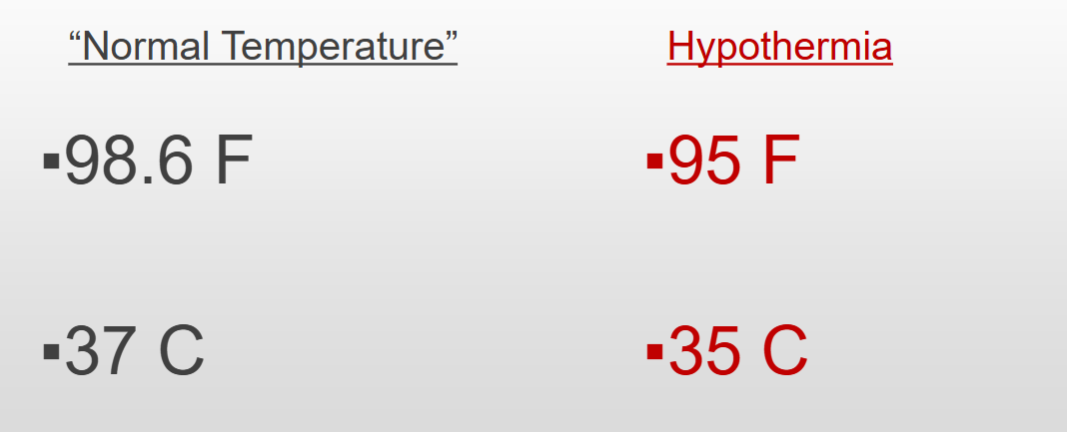
List the Hypothermia Signs and Symptoms:
32C/89.6F - 35C/95F:
32C/89.6 F - 28C/82.4 F
< 28C (82.4F) (severe)
Hypothermia Signs and Symptoms:
32C/89.6F - 35C/95F:
Tachycardia, tachypnea, HTN, shivering
impaired coordination
poor judgment
apathy
32C/89.6 F - 28C/82.4 F
General metabolic and physiologic slowing
Bradycardia, dilated pupils, slowed reflexes, cold diuresis, confusion and lethargy
Shivering stops
< 28C (82.4F) (severe)
Blue or puffy skin
Coma
Apnea
Loss of reflexes
Asystole or V-Fib
What can prolonged hypothermia lead to?
Prolonged hypothermia may lead to
Dysrhythmias
Acidemia
Hyperkalemia
Rhabdomyolysis
Pulmonary edema
Kidney disease
Pneumonia
Pancreatitis
Hypoglycemia or Hyperglycemia
Coagulopathy
How do we treat hypothermia?
What are the rewarming concerns?
Hypothermia Treatment
ABC's
REWARMING
Prevent further heat loss
Remove cold, wet clothing
Rectal or bladder probe to monitor temps
Associated conditions
Rewarming Concerns
regularly vs continuously monitor core temperature, vital signs, cardiac rhythm, and glucose
Complications often occur as colder peripheral blood returns to central circulation
core temp afterdrop
lactic acidosis
V-fib and other arrhythmias
Differentiate between passive and active external rewarming
Passive External Rewarming
reserved for mild hypothermia
Methods
Remove cold, wet clothing
Cover with blankets
Use external radiant heat (if possible)
Active External Rewarming
Safe and effective
Noninvasive
Methods:
Apply external heat to patient's skin
Warm bedding (heated blankets)
Heat packs
Immersion into a 40C bath
NOTE: Patients with mild hypothermia (>33 C) and prior good health usually respond well to passive and active external warming
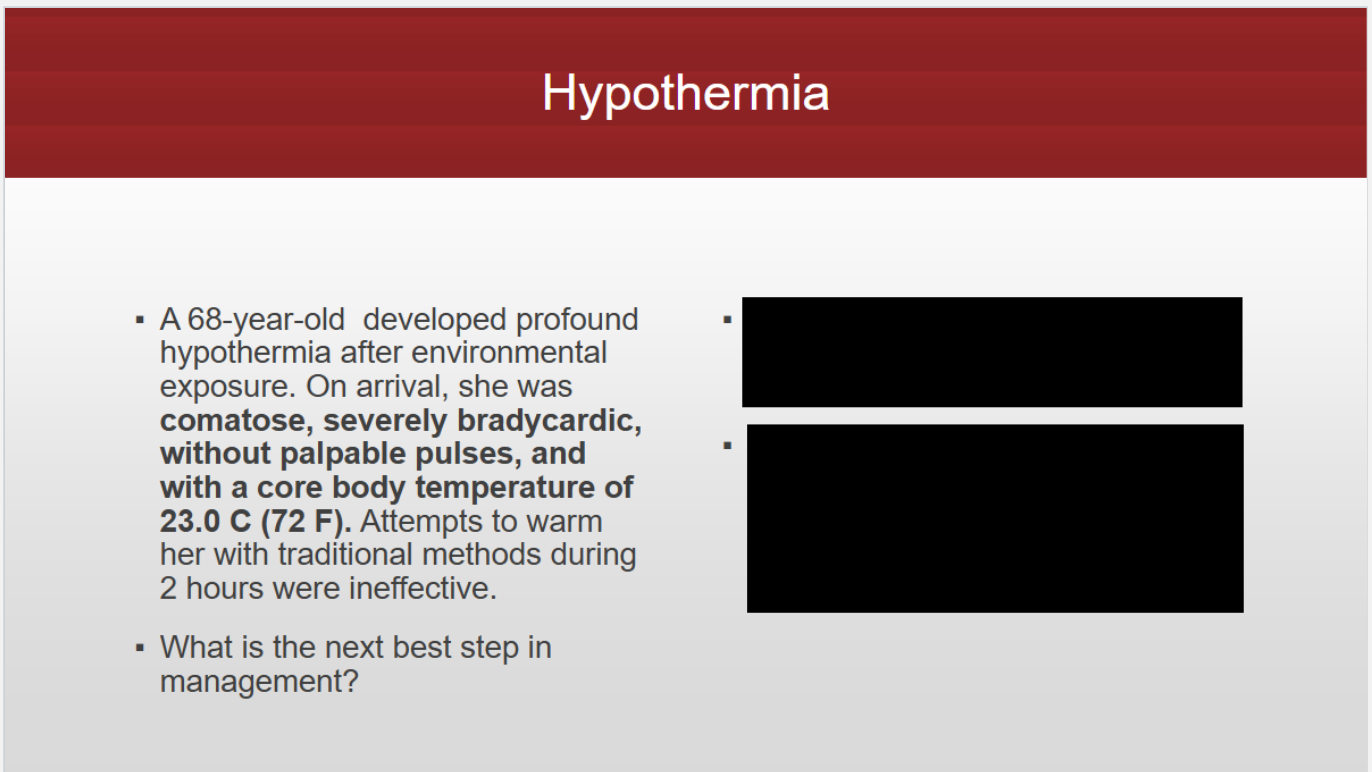
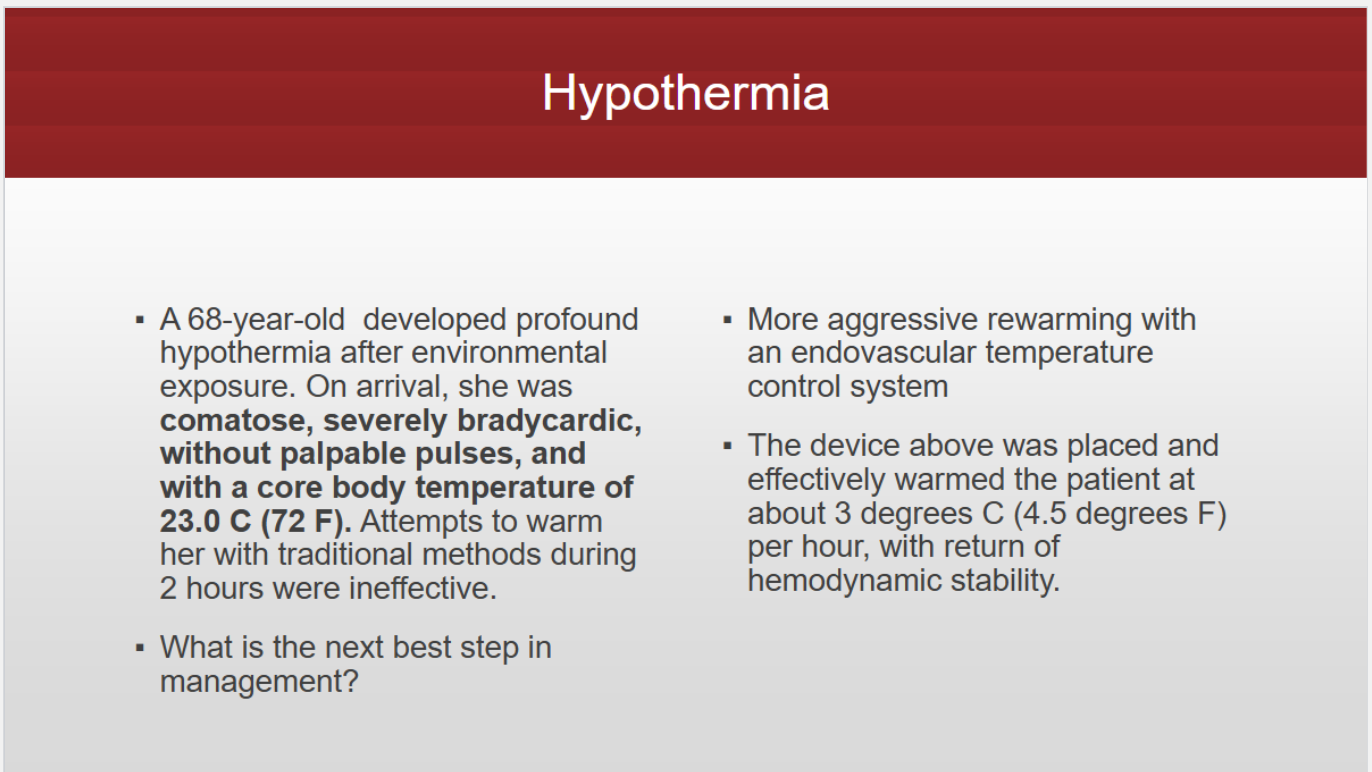
How would you manage the < 30C victim
Initial Treatment
Once CBT reaches 30C
initial treatment
Active rewarming
CPR
No more than one shock attempt for dysrhythmia
Withholding IV cardiac medications
Once CBT reaches 30C
Cardiac meds can be given but @ intervals longer than standard
Defibrillation may be utilized
Continue resuscitation until CBT at least 35C/95F
Describe Hypothermia Prognosis
Prognosis is poor with?
Hypothermia Prognosis
If treated early, most otherwise healthy patients survive moderate or severe hypothermia
Prognosis is poor with
low pH <6.6,
elevated potassium >4
serious underlying condition
Treatment delay
List the Heat Related Disorders
What are the risk factors
Heat cramps-mild
Heat exhaustion-moderate
Heat syncope-moderate- severe
Heat stroke-severe
Risk Factors for Heat disorders
Exertion in hot climate
Insufficient acclimatization and/or obesity
Medical conditions that inhibit sweat production and evaporation
Dehydration
Seizures
Hypotension -> Reduced cardiac output -> Reduced cutaneous blood flow
Drugs which increase metabolism/muscle activity or impair sweating
Describe Heat Cramps/Exhaustion
Distinction
Characterized by
Clinical Findings
Treatment
Heat Cramps/Exhaustion
Distinction:
Heat cramps: fluid and electrolyte depletion
Heat exhaustion: activity in hot environment w/ inadequate water or salt intake
Characterized by
dehydration,
sodium depletion,
isotonic fluid loss w/ accompanying cardiovascular changes
Clinical Findings
Slow, painful muscle contractions and severe muscle spasms lasting 1-3 minutes
usually in muscles that are most heavily used
Skin = moist and cool, temperature = normal
Muscles = tender, hard and lumpy
Muscle twitching may be present
History of vigorous activity just preceding onset of symptoms often present
Normal labs
Treatment:
Move to cool location
Oral hydration
Salt replacement
Rest 1-3 days before returning to activity.
Describe Heat Exhaustion
Symptoms
Treatment
Heat Exhaustion: Clinical Findings
CBT > 37.80 (100.4 F)
Increased pulse,
Orthostatic hypotension
Moist skin, Sweating
HA, dizziness, fatigue, anxiety
Respiratory alkalosis
Lactic acidosis
Variable:
N/V, malaise,
Myalgias,
hyperventilation,
thirst,
weakness
Treatment
Move to cool environment
Fluid and electrolyte replacement
May need IV fluids
Active cooling: fans, cool packs
At least 24 hours of rest and rehydration
Describe Heat Syncope
What is it
MOA
Signs
Treatment
What is it?
sudden collapse/LOC
after prolonged vigorous activity or prolonged standing in a hot environment
MOA:
volume depletion + cutaneous vasodilation -> systemic/cerebral hypotension
Signs
Cool moist skin
Weak pulse
Low systolic blood pressure
Treatment
Move to a cool location
Lie down
Rest
Fluid and electrolyte replacement
IV fluid if necessary
Describe Heat Stroke
What is it?
Groups @ greatest Risk
Physical Findings
Lab Abnormalities
Treatment Goal/Methods
Complications
Heat Stroke
What is it?
Cerebral dysfunction/altered sensorium
Core body temp > 40 C/104 F
Groups at greatest risk:
Extremes of age
chronically debilitated
Taking meds that interfere with heat-dissipating mechanism:
anticholinergics,
antihistamines,
phenothiazines
Physical Findings
Hot skin, initially covered with perspiration
later dries: Sweating may not be present
Strong pulse initially
Widened pulse pressure
Hypotension develops later in clinical course
Tachycardia
Hyperventilation
Irrational behavior
Confusion/Altered LOC
Heat Stroke: Lab Abnormalities
Hemoconcentration
Rhabdomyolysis
Elevated BUN/Creatinine
Elevated WBC
Lactic acidosis
Disseminated Intravascular Coagulation (DIC)
Anuria
Treatments Goal
Reducing CBT within 1 hr while supporting circulation to prevent Irreversible tissue damage and death
Treatments:
IV fluid replacement
Rapid cooling
Look for possible causes
Infection
Trauma
drug effects
Close monitoring
vitals,
temperature,
cardiac rhythm
Shivering must be stopped
Benzodiazepines suppresses
Skin Massage
Cont. tx/rx until cbt -> 39C/102.2; Admit to hospital
Complications
Rhabdomyolysis,
Renal failure,
DIC
seizures
Metabolic abnormalities,
Cardiac arrhythmias,
coagulopathy,
ARDS,
hypoglycemia,
Organ dysfunction,
Infection
Differentiate between Evaporative and Conductive Cooling
What is it?
Method?
Evaporative cooling:
What is it?
Cools through heat evaporation
Method
Large fans while undressed pt is sprayed with lukewarm water
Conductive cooling:
What is it
Cools through skin contact
Method:
cool fluid infusion,
lavage,
ice packs,
immersion into cool water
IV cool fluids,
hemodialysis