Developmental psychopathology
 Call Kai
 Learn
 Practice Test
 Spaced Repetition
 Match
 Flashcards
 Knowt Play
1/223

Earn XP
Description and Tags
I will get a 10.0
224 Terms
Atypical/abnormal
Deviates from what is considered standard or average (positively or negatively)
Psychopathology
study of atypical behaviours that are harmful and interfere with the normal functioning of the individual
Disorders
Syndromes ( intrinsic or extrinsic (reaction to environment)) that cause significant disturbances in behaviour, cognition or emotions, reflecting a dysfunction in mental processes and leading to distress or disability in key areas of life
Developmental norms
Typical growth rates, growth sequences and forms of physical skills, language, cognition, emotion and social behaviour, used to evaluate behaviour
The prevalence of a condition depends on (4)
Definition and criteria established for identifying a disorder
Measurement used
Source of the information (child themselves, parent, teacher, etc)
Characteristics of the population under study
Types of Classification of abnormal behaviour
Categories: discrete; either the individual has or does not have the disorder
Dimensions: continuous; individuals may have high/moderate/low levels of a disorder
Clinical approach of classification
Diagnosis is classified when there are clusters of persistent symptoms that cause significant distress or impair major life areas
Clinical consensus
Problems are categorical
Focus on quantitative differences
Eg. DSM
Empirical approach of classification
Identifying interrelated patterns of behaviour and symptoms using research and statistical methods to understand psychopathology
Research-driven (based on empirical methods)
Problems are dimensional
Focus on qualitative differences
Eg. Achenbach (CBCL)
Research-based approach to classification
Understanding mental disorders through underlying biological, psychological, and behavioural processes rather than traditional diagnoses
Research-driven
Dimensional: symptoms exist on a spectrum rather than being simply present/absent
Focuses on underlying mechanisms (e.g., fear, reward, cognition)
Uses multiple levels of analysis, such as genes, brain circuits, behaviour, and self-report
Referral bias
Boys who are more likely to exhibit a disruptive behaviour are more likely to be referred to a professional than girls who exhibit the same behaviour
Law of effect (Thorndike)
Behaviour is shaped by its consequence
Thomas Kuhn
Believed science is not completely objective but is influenced by the perspective (view, approach, and cognitive disposition) of the researcher
Paradigm
Assumptions, concepts, and ways of evaluating the assumptions and concepts shared by researchers
Interaction models
Assume that variables are interrelated to produce an outcome (eg., vulnerability-stress model, which conceptualizes multiple causes of psychopathology as the cooperation of a vulnerability factor and stress factor)
Transactional models
Emphasize the reciprocal relationship between different influences
Assumes that the individual is an active agent and whose history has shaped his functioning
System models
Models that involve multiple levels of functioning (systems) that interact over time
Bio-psycho-social model
Idea that mental health and behaviour are influenced by a combination of biological, psychological, and social factors
Medical model
Views disorders as discrete entities resulting from specific and limited biological causes within the individual, and it ignores context
Has been challenged as there is no single cause for abnormal behavior
Mediator factors
Factor or variable that explains or brings an outcome (DV) indirectly
Moderator
A third variable that affects the direction or strength of the relationship between an independent and dependent variable
Necessary cause
Must be present for the disorder to occur
Sufficient caus
A cause that can lead to a disorder by itself
Contributing causes
Causes that are neither sufficient nor necessary, but can accumulate and multiply their effects until the threshold of disorder is reached and a problem arises
Pathways of adaptation and maladaptation drawing
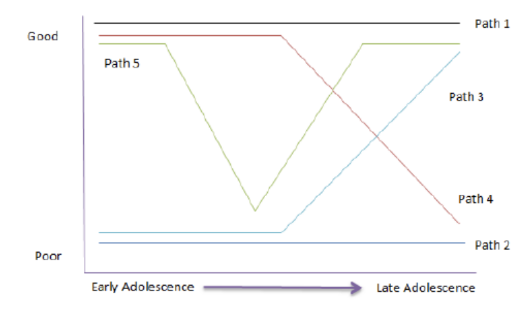
Stable adaptation (Path 1)
Youths who follow this path have little exposure to negative circumstances, have positive self-esteem and show few problems
Stable maladaptation (Path 2)
Characterised by chronic setbacks in the environment and insufficient resources to alleviate them
Reversal of maladaptation (Path 3)
maladaptation turns into a positive outcome because of life changes that create new opportunities
Decline of adaptation (Path 4)
Indicates initial adaptation that, due to environmental or biological shifts, ends in decline
Temporal maladaptation (Path 5)
Can reflect transient experimental risk taking
Equifinality
different factors can lead to the same outcome
Multifinality
A similar start state, risk factor, or early experience can lead to many different, divergent outcomes
Risks/ risk factors
Variables that precede and increase the likelihood of mental disorders
Direct cause/effects
X leads directly to the result
Indirect cause/effects
X influences other variables that in turn lead to the outcome
Distal influence
Factor that is further removed from the person’s direct experience and affects them indirectly
Proximal influence
Factor that is closer to the person’s direct experience and affects them more directly
Vulnerability
Tendency to react inappropriately to life circumstances
Sensitivity period model
proposes that exposure to a risk over a period can have lasting effects
Developmental programming model
Suggests that early environmental phenomena can program certain characteristics of an individual
Resilience
Relatively positive outcome in the face of significantly adverse or traumatic experiences
Promotive/protective factors for resilience
Personal characteristics
Family characteristics
Support from outside the family
Heterotypic continuity (symptom)
The persistence of a disorder, but symptoms manifest differently over time
Heterotypic continuity (disorder)
the persistence of a disorder as another disorder (eg. an anxiety disorder transitioning into a mood disorder)
Homotypic continuity
the same condition or symptom persists over time
Fear
Reaction to an immediate threat to promote survival (adaptive & useful)
Anxiety
Reaction to the anticipation of an event
Can be considered adaptive if in moderation
Tripartite model
Pattern of 3 types of reactions to a perceived threat:
Physiological: physical reactions (eg. increased heart rate)
Cognitive: thoughts and interpretations (eg. “Something bad will happen”)
Behavioural: actions or responses (eg. avoiding the situation)
Specific phobia
Almost immediate irrational fear or anxiety about a specific object or situation that is actively avoided, persistent for at least 6 months, and causes clinically significant distress or dysfunction
Social anxiety disorder
Fear or anxiety about one or more situations in which the individual is exposed to possible scrutiny by others, persisting for at least 6 months and causing clinically significant distress or dysfunction
Selective mutism
Failure to speak in specific social situations which interferes with functioning, persisting for at least one month
Separation anxiety disorder
Developmentally inappropriate and excessive fear or anxiety concerning separation from those whom the individual is attached to, causing significant distress or dysfunction, with at least 3 symptoms
At least 4 weeks in children and adolescents, and 6 months in adults
Generalized anxiety disorder
Excessive anxiety and worry about multiple events or activities, occurring more days than not for at least 6 months, difficult to control, and causing clinically significant distress or dysfunction
Panic disorder
Recurrent, unexpected panic attacks, followed by at least 1 month of persistent concern about further attacks or their consequences, and/or maladaptive behavioural change
Agoraphobia
Marked fear or anxiety about at least 2 situations, due to concerns that escape or help may be difficult, persisting for at least 6 months and causing clinically significant distress or dysfunction
Biological causes of anxiety & related disorders
Children of anxiety-disordered mothers are 2x more likely to meet the criteria for an anxiety disorder by 15-years-old
Heritable
Roles of serotonin and GABA in regulating anxious arousal
Roles of limbic system and amygdala in fear processing
Role of prefrontal cortex in emotional regulation and coping behaviour
Psychological causes of anxiety & related disorders
Direct experience
Modeling
Transmission of information
Parent practices/style
Peer relationships
Negative affectivity: persistent disposition towards negative mood
Behavioral inhibition
Social causes of anxiety & related disorders
Parenting:
Direct classical conditioning
Vicarious observational learning
Transmission of verbal threat information
Anxiety disorders epidemiology
2-13% prevalence, more common in girls
Specific phobia epidemiology
10% in children, more common in girls
Social anxiety epidemeology
1-2% prevalence in children, 3-4% in adolescents
Separation anxiety disorder epidemiology
3-13% prevalence, declines in adolescence
Generalized anxiety disorder epidemiology
2-14% prevalence
Panic disorder epidemiology
16% prevalence in adolescents
Interviews & self-report instruments
Ask individual about their anxiety, feelings, thoughts, and symptoms
Multidimensional anxiety scale for children (MASC)
Questionnaire that measures different types and symptoms of anxiety in children
Direct observations
Observe a person's behaviour in anxiety-provoking situations
Self-monitoring diaries
People record when they feel anxious, what triggers it, and how they react
Physiological recordings
Measuring physical signs of anxiety, such as heart rate, sweating, or breathing rate
Relaxation
Learn techniques to calm the body and reduce anxiety, such as slow breathing and muscle relaxation
Cue-controlled relaxation
Learn to relax by associating relaxation with a specific cue, such as a word
Systematic desensitisation
Gradually face feared situations while practising relaxation
Modelling
Learn to cope with fears by watching someone else do it
Contingency management
Reward behaviours that help reduce avoidance and manage anxiety
Cognitive-behavioural therapy (CBT)
Change unhelpful thoughts and behaviours that maintain anxiety
Selective serotonin reuptake inhibitors (SSRIs)
Medications that affect serotonin levels in the brain and can help reduce anxiety symptoms
Obsessive-compulsive disorder (OCD)
Presence of obsessions (intrusive, unwanted thoughts or urges) and/or compulsions (repetitive behaviours or mental acts performed to reduce anxiety or prevent a feared event), which are time-consuming or cause clinically significant distress or dysfunction
OCD epidemiology
1-2% prevalence in youth
More common in prepubertal boys and equalizes out in adolescence
OCD etiology
1-2% prevalence in youth
More common in prepubertal boys and equalizes out in adolescence
Posttraumatic stress disorder (PTSD)
After direct exposure to death, threatened death, actual or threatened serious injury, or actual or threatened sexual violence, the individual persistently re-experiences the event, avoids trauma-related stimuli, has negative thoughts or feelings, and experiences trauma-related arousal and reactivity (at least 2 times)
Symptoms must last more than 1 month and cause serious distress or functional impairment
Trauma-focused CBT
address and change unhelpful thoughts and feelings related to the trauma
Psychoeducation
Learn about PTSD, its symptoms, and how it affects people
Relaxation skills
Learn techniques to calm the body and manage stress
Affective modulation
Learn to recognise and regulate strong emotions
Cognitive coping
Develop healthier ways of thinking about and responding to the trauma
In vivo mastery
Gradually face safe situations that have been avoided because they remind the person of the trauma
Acute stress disorder (ADS)
Symptoms of intrusion, negative mood, dissociation, avoidance, and/or arousal following exposure to a traumatic event, lasting from 3 days to 1 month and causing clinically significant distress or dysfunction
Reactive attachment disorder
Inhibited and withdrawn behaviours towards caregivers due to social neglect
Disinhibited social engagement disorder
Culturally inappropriate familiarity towards unfamiliar adults
Emotion
short-lasting, intense reaction to a specific event or stimulus, usually with a clear cause
Mood
Longer-lasting, less intense emotional state that may not have a clear cause and can influence how you perceive things
Masked depression
Underlying depression is masked by other problems like hyperactivity or delinquency
Major depressive disorder (MDD)
individual displays 5 (or more) of the following symptoms over 2 weeks
Depressed mood for most of the day
Diminished interest in pleasure
Significant weight change
Insomnia or hypersomnia
Fatigue or loss of energy
Feelings of worthlessness
Diminished ability to think or concentrate
Recurrent thoughts of death
Persistent depressive disorder (dysthymia)
Chronic form of depression, in which at least 2 of the following symptoms persist for at least 2 years (1 year for children)
Poor appetite or overeating
Insomnia or hypersomnia
Low energy or fatigue
Low self-esteem
Poor concentration or difficulty making decisions
Feelings of hopelessness
Disruptive mood dysregulation disorder
Persistent irritability with frequent temper outbursts (at least 3x a week) for at least 1 year, in multiple different settings
Diagnosis should be made between ages 6-18
Onset and symptoms should be apparent before age 10
Depression development
Infancy/toddlerhood: withdrawal, reduced activity, irritability, and changes in eating or sleeping
Preschool: irritability, sad facial expressions, crying, loss of interest in play, sleep disruptions, and physical complaints
School age: sadness or irritability, social withdrawal, low self-esteem, and difficulties at school (more verbal about symptoms)
Adolescence: persistent sadness or irritability, loss of interest, hopelessness, social withdrawal, and changes in sleep or appetite
Empirical taxonomy
Identifies syndromes that combine depressive symptoms with anxiety and withdrawal
Biological factors in depression
Dysregulation of serotonin, norepinephrine and acetylcholine
Structural and functional brain abnormalities in the prefrontal cortex and amygdala
High negative affectivity and low positive affectivity
The 5-HTTLPR gene is associated with an increased rate, only when exposed to stressful life events
Behavioural models
Emphasize that loss reduces positive social reinforcement
Anaclitic depression
Describes infant withdrawal following prolonged parental separation
Learned helplessness
Believing you cannot control or change a situation because of repeated negative experiences