Hypertension Pharmacology: Diuretics, RAAS, CCBs, and Sympatholytics
 Call Kai
 Learn
 Practice Test
 Spaced Repetition
 Match
 Flashcards
 Knowt Play
1/107

There's no tags or description
Looks like no tags are added yet.
108 Terms
What is the formula for Mean Arterial Pressure (MAP)?
MAP = Cardiac Output (CO) x Peripheral Vascular Resistance (PVR)
What are the two primary ways to decrease Cardiac Output (CO)?
By decreasing heart rate and contractility, and by decreasing ventricular filling pressure.
What is diuretic braking?
A compensatory process where the body becomes resistant to diuretics, leading to increased sodium reabsorption.
What is the general mechanism of action of diuretics?
Diuretics increase renal solute excretion, leading to increased urine production.
What are the major classes of diuretics?
Osmotic, Loop, Thiazide/Thiazide-like, Potassium-sparing, Aldosterone Antagonists, Carbonic Anhydrase Inhibitors.
What is the primary purpose of diuretics?
To reduce volume, which decreases ventricular filling pressure and cardiac output.
What physiological effects do diuretics have aside from diuresis?
They can alter blood levels of ions such as Na+, K+, Cl-, and others.
What role do calcium channels play in antihypertensive effects?
Calcium channels regulate cardiovascular physiology; altering their activity can lead to beneficial antihypertensive effects.
What is the mechanism of action for loop diuretics?
They inhibit the Na/K/Cl symporter in the thick ascending limb of the Loop of Henle.

What ions are excreted more due to the action of loop diuretics?
Increased Na+, Cl-, Mg2+, and Ca2+ excretion.
What is the significance of sulfonamide in carbonic anhydrase inhibitors?
Sulfonamide is critical for activity and enhances lipophilicity for ocular distribution.
What are the two major non-dihydropyridine calcium channel blockers (CCBs)?
Verapamil and Diltiazem.
What is the effect of α1 and β2 receptors in vascular smooth muscle?
α1 receptors cause vasoconstriction, while β2 receptors cause vasodilation.
How do RAAS agents affect renal function?
They can either positively or negatively influence renal function depending on their mechanism.
What is the role of hepatic esterases in ACE inhibitors?
They are involved in the activation of ACE inhibitor prodrugs.
What is the mechanism of action of direct vasodilators?
They directly relax vascular smooth muscle, leading to vasodilation.
What is the pharmacological mechanism of α and β antagonists?
They block adrenergic receptors, leading to decreased heart rate and vasodilation.
What is the effect of thiazide diuretics on peripheral vascular resistance?
Thiazide diuretics reduce peripheral vascular resistance.
What is the significance of combining agents with different mechanisms of action?
It can have a synergistic effect in treating hypertension.
What happens to Na+ reabsorption during diuretic braking?
There is a compensatory increase in Na+ reabsorption due to activation of the SNS and RAAS.
What is the mechanism of action of unique vasodilators like nitroprusside?
They release nitric oxide, leading to relaxation of vascular smooth muscle.
How do diuretics affect ion concentrations in the body?
They can alter concentrations of ions such as Na+, K+, Cl-, H+, Ca2+, Mg2+, PO43-, and HCO3-.
What is the importance of the macula densa in relation to loop diuretics?
It detects Na+ levels and can trigger renin secretion when loop diuretics prevent Na+ absorption.
What are the physiological effects of sympatholytic drugs?
They inhibit sympathetic nervous system activity, leading to decreased heart rate and vasodilation.
What is the role of the sympathetic nervous system (SNS) in hypertension?
The SNS is a major target for antihypertensive agents due to its role in vasoconstriction and increased heart rate.
What is the effect of adrenergic receptor localization in the heart and vasculature?
It relates to the physiological effects of sympatholytic drugs and their ability to lower blood pressure.
What ions are excreted due to increased Na+ and Cl- excretion?
Increased Mg2+ and Ca2+ excretion.
What is the primary mechanism of action for thiazide diuretics?
Inhibit the Na+/Cl- symporter on the luminal membrane in the distal convoluted tubule.

What is the medicinal chemistry characteristic of thiazide diuretics?
They share a thiadiazine 1,1-dioxide nucleus and contain a sulfonamide group.
Name a common thiazide diuretic.
Hydrochlorothiazide (Hydrodiuril®).
What are thiazide-like diuretics derived from?
Quinazolinone, phthalimidine, and indoline derivatives.
What effect do thiazide diuretics have on peripheral vascular resistance?
They cause vasodilation, reducing peripheral vascular resistance.
What happens during the subacute phase of thiazide diuretic treatment?
There is a decline in diuretic efficacy, but the antihypertensive effect persists.
What is the role of potassium-sparing diuretics?
They reduce Na+ absorption in the principal cells of the cortical collecting tubule.
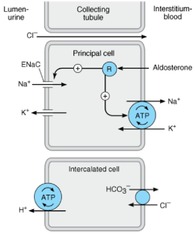
What is the mechanism of action for eplerenone?
It inhibits the aldosterone receptor, leading to decreased expression of Na+ channels.
Name a potassium-sparing diuretic that directly inhibits sodium channels.
Amiloride (Midamor®).
What is the effect of osmotic diuretics on water?
They cause a loss of water from tissues and increase renal blood flow.
What ions are increased in excretion due to osmotic diuretics?
Na+, K+, Ca2+, Mg2+, Cl-, HCO3-, PO43-.

What are the main agents affecting the Renin-Angiotensin-Aldosterone System (RAAS)?
Renin inhibitors, ACE inhibitors, and ARBs.
What is the function of the macula densa in the nephron?
It senses NaCl concentration and transmits signals to granular cells to affect renin secretion.
How does angiotensin II affect blood pressure?
It raises blood pressure via direct and indirect routes.
What is the role of AT1 receptors in vascular smooth muscle?
They regulate vascular tone and are coupled to Gq proteins, leading to vasoconstriction.
What is the significance of aliskiren in RAAS therapy?
It is a direct renin inhibitor designed for high affinity to the renin active site.
What happens to potassium levels with loop and thiazide diuretics?
They can lead to potassium wasting due to enhanced secretion.
What is the effect of thiazide diuretics on calcium reabsorption?
They increase Ca2+ reabsorption due to intracellular Na+ depletion.
What is the primary action of potassium-sparing diuretics like spironolactone?
They antagonize the aldosterone receptor, reducing Na+ absorption.
What is the mechanism of action for osmotic diuretics?
They draw water from tissues and retain excess water in the filtrate.
What is a common side effect of spironolactone?
It has potential for causing gynecomastia.
What physiological effect persists during the chronic phase of thiazide diuretic treatment?
The antihypertensive effect persists despite the reversal of diuretic effect.
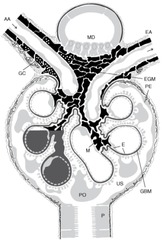
What is the role of the juxtaglomerular apparatus?
It regulates renin secretion in response to various stimuli.
What is the impact of Na+ depletion on Ca2+ levels?
Na+ depletion increases Na+ entry and Ca2+ exit across the Na+/Ca2+ exchanger.
What is the relationship between angiotensin II and renal blood flow?
Angiotensin II can reduce renal blood flow while maintaining or increasing GFR.
What is the primary effect of thiazide diuretics on sodium?
They increase Na+ and Cl- excretion.
What is the effect of potassium-sparing diuretics on K+ levels?
They increase K+ reabsorption due to repulsion by a positively charged lumen.

What are the physiological effects of Direct Renin Inhibitors?
Decreased peripheral vascular resistance (PVR) and increased renal blood flow.
What is the pivotal mechanism of renal protection mediated by RAAS inhibitors?
Dilation of efferent arterioles, which reduces glomerular pressure and damage.
What are the three types of ACE inhibitors based on their medicinal chemistry?
Sulfhydryl-containing (e.g., captopril), dicarboxyl-containing (e.g., enalapril, lisinopril), and phosphorous-containing (e.g., fosinopril).
What distinguishes prodrugs from non-prodrugs among ACE inhibitors?
Prodrugs like enalapril and fosinopril must be activated in the liver, while non-prodrugs like captopril and lisinopril are active in their parent form.
What is the mechanism of action (MOA) of ACE inhibitors?
Inhibit the conversion of angiotensin I to angiotensin II by blocking ACE activity, also inhibiting bradykinin degradation.
Name two major tissues that express ACE.
Plasma and vascular endothelial cells.
What are the contraindications for ACE inhibitors?
History of angioedema, use within 36 hours of neprilysin inhibitor, and renal artery stenosis.
How do RAAS inhibitors provide renoprotection?
They relieve glomerular pressure by dilating efferent arterioles, protecting against hypertension-induced damage.
What are the two classes of Calcium Channel Blockers (CCBs)?
Non-dihydropyridine (Non-DHP) and dihydropyridine (DHP).
What is the primary action of CCBs on L-type calcium channels?
They inhibit calcium entry, which lowers blood pressure by relaxing arteriolar smooth muscle.
What factors increase intracellular calcium levels that CCBs oppose?
Epinephrine, norepinephrine, angiotensin II, and vasopressin.
What are two examples of dihydropyridine CCBs?
Nifedipine and clevidipine.
What are two examples of non-dihydropyridine CCBs?
Diltiazem and verapamil.
What is a major adverse effect associated with CCBs?
Peripheral edema due to arteriolar dilation raising hydrostatic pressure in capillaries.
How does the addition of an ACE inhibitor or ARB affect edema from DHP CCBs?
It reduces edema, while adding a diuretic has little effect.
What is the role of the AT1 receptor in the action of Angiotensin 1 (AT1) Receptor Antagonists?
Inhibiting the AT1 receptor reverses vasoconstriction and reduces sodium reabsorption.
What is the marketed prototype for Angiotensin 1 (AT1) Receptor Antagonists?
Losartan.
What is the effect of blocking the AT1 receptor in the adrenal cortex?
It reduces aldosterone release.
What is the significance of bradykinin in the effects of ACE inhibitors?
ACE inhibitors may exert some physiological effects through bradykinin, which is a vasodilator.
What happens to glomerular pressure in renal artery stenosis when RAAS inhibitors are used?
They lower glomerular pressure further, which can lead to reduced filtration and accumulation of harmful substances.
What is the mechanism of action for Calcium Channel Blockers?
They inhibit L-type calcium channels to decrease cardiac inotropy and chronotropy, as well as vascular smooth muscle contraction.
What is the relationship between calcium entry and blood pressure regulation?
Increased calcium entry leads to vasoconstriction and higher blood pressure, which CCBs counteract.
What is the therapeutic benefit of combining DHP CCBs with ACE inhibitors or ARBs?
It may provide better control of blood pressure and reduce the risk of edema.
What is the role of hepatic esterases in the activation of prodrugs?
They cleave esters in the liver to convert prodrugs to their active forms.
What major drug interaction is associated with Verapamil?
It increases digoxin and cyclosporine levels.
What is the mechanism by which Verapamil increases digoxin and cyclosporine levels?
Inhibition of P-gp-mediated elimination in the intestine, liver, and kidneys.
What are the two main classes of sympathetic nervous system agents mentioned?
Beta-blockers and Alpha-1 Blockers.
What is a key principle of drugs affecting the sympathetic nervous system?
They can act centrally or peripherally, affecting their adverse effects.
What limits the usefulness of sympathetic nervous system agents as monotherapy?
Compensatory effects, such as fluid retention.
What role does the sympathetic nervous system play in blood pressure control?
It innervates muscle cells and conduction nodes in the heart and smooth muscles of blood vessels.
What are the major mediators of the sympathetic nervous system that antihypertensive drugs interfere with?
Epinephrine and norepinephrine.
What is the basic structure of a sympathomimetic amine?
It contains a phenylethylamine backbone with substitutions on the aromatic ring, α and β carbons, or terminal amino group.
What increases β receptor activity in sympathomimetic amines?
Alkyl substitutions at the amino group.
What are the major endogenous catecholamines?
Norepinephrine and epinephrine.
What is the mechanism of action of α1 adrenergic receptor antagonists?
They limit SNS-triggered cytosolic Ca2+ influx, resulting in decreased arteriolar resistance and increased venous capacitance.
What is the prototype α1 adrenergic receptor antagonist?
Prazosin.
What is the mechanism of action of β1 adrenergic receptor antagonists?
They prevent endogenous catecholamines from stimulating effector phosphorylation in cardiomyocytes, reducing myocardial contractility and heart rate.
What is a significant effect of β1 antagonists during exercise?
They limit the heart's ability to compensate for increased energy needs.
What are some β blockers that also block alpha-1 receptors?
Carvedilol and Labetalol.
What can result from the abrupt discontinuation of β-blocker therapy?
Rebound hypertension due to receptor upregulation and unopposed catecholamine activity.
What is the role of α2 agonists in the sympathetic nervous system?
They replicate the negative feedback of norepinephrine and epinephrine, inhibiting their release.
What is the active metabolite produced from Methyldopa?
α-methylnorepinephrine.
What is the mechanism of action of Methyldopa?
It substitutes for norepinephrine, activating presynaptic α2 receptors and reducing norepinephrine release.
What is the general mechanism of direct vasodilators?
They relax smooth muscle of arterioles, decreasing peripheral vascular resistance.
What is the mechanism of action of Minoxidil?
It opens ATP-modulated K+ channels in vascular smooth muscle, causing hyperpolarization and relaxation.
What are the two direct vasodilators mentioned?
Hydralazine and Minoxidil.