RT 203 MODULE 3: ELECTRICITY AND MAGNETISM
 Call Kai
 Learn
Learn Practice Test
 Spaced Repetition
 Match
Match Flashcards
 Knowt Play
1/127

There's no tags or description
Looks like no tags are added yet.
Name | Mastery | Learn | Test | Matching | Spaced | Call with Kai | Chat |
|---|
No analytics yet
Send a link to your students to track their progress
128 Terms
PHOTON
First described by ancient Greeks
The smallest quantity of any type of electromagnetic energy
ELECTROMAGNETIC ENERGY
Today, photons are known as
QUANTUM
Pictured as a small bundle of energy called a
JAMES CLERK MAXWELL
19th century
both electric and magnetic properties
hence the term electromagnetic energy
VELOCITY
AMPLITUDE
WAVELENTH
FREQUENCY
PROPERTIES OF ELECTROMAGNETIC ENERGY
Velocity
Photons are considered as energy disturbances that move through space at the speed of light
Speed of light
3 X 10 ^8 m/s
186,000 mi/s
Amplitude
They have electric and magnetic fields that are continuously changing in a sinusoidal fashion
One - half
Is the range from crest to valley over which the sine wave varies
no mass and no identifiable form
Photons have ?
Amplitude

Crest
What is number 1?

Valley
What is number 2?

WAVELENTH
The distance of one crest to another, from one valley or any from any point on the sine wave to the next corresponding point
Greek letter lambda λ
SINE WAVE
It is the model of EM energy describes variations in the electric and magnetic fields as the photon travels with velocity c
lambda λ
What represents a Greek letter
FREQUENCY
the number of crests or the number of valleys that pass the point of an observer per unit of time
The rate of rise and fall of the sine waves
hertz (Hz)
what is the unit of frequency measurement
CYCLES PER SECOND
frequency is identified as
WAVE PARAMETERS
Velocity, Frequency, and wavelength
A change in one affects the value of the others
Constant
In Wave Parameters Velocity is?
INVERSELY PROPORTIONAL
At a given velocity, wavelength and frequency are
WAVE EQUATION
Sound waves differ from electromagnetic energy by how they are propagated and their velocity varies greatly
sound and electromagnetic energy.
What is the use of Wave equation
Wave Equation
What formula is this?

INVERSELY PROPORTIONAL
Electromagnetic energy, frequency and wavelength are?
186,000 mi/s
3X10^8 m/s
C
Looking for wavelength

Looking for frequency
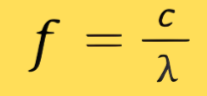
Looking for Speed

ELECTROMAGNETIC SPECTRUM
Group of different types of electromagnetic energies
Includes the entire range of electromagnetic energy
10² to 10^24 Hz
Frequency ranges from
10^7 to 10^-16m
Wavelength ranges from approximately
VISIBLE LIGHT
Red, Orange, Yellow, Green, Blue, Indigo, and Violet
Longer wavelength
Lower frequency
Lower energy
Radio wave, Microwave, and Infrared are considered as?
Shorter wavelength
Higher frequency
Higher energy
Ultraviolet, Xrays and Gamma Rays are considered
IONIZING RADIATION
Ultraviolet, Xrays and Gamma Rays they are also classified as
NON IONIZING RADIATION
Radio wave, Microwave, and Infrared are also classified as a
eV
Electron Volts or Energy
Hz
Hertz or Frequency
m
Wavelength
MeV
Mega electron Volts
1 MeV
10^6
1 nm
10^-9m
1 KeV
10³
1 eV
neutral 10^0
Energy group (eV)
1 MeV
1 KeV
1 eV
MeV
Megaelectron volts
KeV
Kiloelectron volt
1 GHz
10^9
1 MHz
10^6
1 KHz
10³
Frequency group (Hz)
1 GHz
1 MHz
1 KHz
GHz
GigaHertz
MHz
MegaHertz
KHz
KiloHertz
1 km
10³
1 m
10 as constant
1 cm
10^-2
1 μm
10^-6
1 nm
10^-9
Wavelegnth (m) group
1 nm
1 μm
1 cm
1 m
1 km
km
kilometer
m
meter
cm
centimeter
μm
micrometer
nm
nanometer
Visible light
Radiofrequency
X-ray Radiation
Gamma Radiation
Regions important to Radiologic Science
Diagnostic Ultrasound
is not part of the electromagnetic spectrum?
Ultrasound
is not produced in photon form and does not have a constant velocity
EM can exist in a vacuum
Diagnostic Ultrasound is not part of the electromagnetic spectrum because what does it required a matter to propagate?
Visible Light
Identified by wavelength
Occupies the smallest segment of the electromagnetic spectrum yet it’s the only portion we can sense directly
Wavelengths
700 nm
What is red, orange, yellow?

400 nm
what is green, blue, violet?

RADIOFREQUENCY RANGE
• Identified by frequency
• Covers a considerable portion of the electromagnetic spectrum.
• Relatively low energy and relatively long wavelength.
X-RADIATION AND GAMMA RADIATION
• Identified by energy.
• Used to be differentiated based on their energy ranges.
• Due to technological advancements, they are now differentiated through their origins
XRAYS

GAMMA RAYS

WAVE-PARTICLE DUALITY
• Electromagnetic wave behaves like a particle or vice versa.
• Photons interact with matter most easily when the matter is approximately the same size as the photon wavelength.
• RF with wavelengths measured in meters interact with antennas.
• Microwaves with wavelengths measured in centimeters interact with hotdogs or hamburgers
• Visible light with wavelength measured in nanometers interacts with living cells such as the rods and cones of the eye.
• UV light interacts with molecules
• X-radiation interacts with electrons and atoms.
• In general, all electromagnetic radiation with wavelength longer than those of x-radiation interacts primarily as a wave phenomenon.
VICE VERSA
Electromagnetic wave behaves like a particle
TRUE
Photons interact with matter most easily when the matter is approximately the same size as the photon wavelength?
ANTENNAS
RF with wavelengths measured in meters interact with
HOTDOGS OR HAMBURGERS
Microwaves with wavelengths measured in centimeters interact with
RODS AND CONES OF THE EYE
Visible light with wavelength measured in nanometers interacts with living cells such as the
X-RAY RADIATION
interacts with electrons and atoms
MOLECULES
UV light interacts with
WINDOW GLASS
TRANSPARENT
FROSTED GLASS
TRANSLUCENT
BLACK GLASS
OPAQUE
ATTENTUATION
reduction in intensity that results from scattering and absorption
WAVE MODEL:VISIBLE LIGHT
• Visible light behaves like a wave Interactions of visible light with matter
• Reflection
• Transmission
• Absorption
• Attenuation
RADIOPAQUE
Structures that absorb x-ray are called
RADIOLUCENT
Structures that transmit x-rays are called
ANATOMICAL STRUCTURES
The terms radiopaque and radiolucent are used routinely in x-ray diagnosis to describe the visual appearance of ?
PARTICLE MODEL: QUANTUM THEORY
• X-rays behave as though they are particles.
• X-rays are identified by their energy, measured in
electron volts (eV).
• X-ray energy ranges from approximately 10 keV to 50
MeV with wavelengths ranging from
approximately 10^−10 to 10^−14 m and frequencies
ranging from approximately 10^18 to 10^22 Hz.
MAX PLANCK’S QUANTUM THEORY
Photons are created with the speed of light (c), and they
exist with velocity (c) or they do not exist at all
DIRECTLY PROPORTIONAL
This theory also dictates that “the energy of a photon is ______________? to its frequency
what is number 1
Electric field

Speed of light
What is number 2?
