Chemistry
 Call Kai
 Learn
 Practice Test
 Spaced Repetition
 Match
 Flashcards
 Knowt Play
1/70

Earn XP
Description and Tags
Assessment
71 Terms
How is a covalent bond formed
It is formed by two atoms sharing a pair of electrons
When does a covalent bond form
When an two atoms shares one or more pairs of electrons
What charge does electrons have
Electrons are negatively charged
What charge are protons
They are positively charged
What are the electrons that get shared attracted to?
The positive nuclei in both atoms
Why are the nuclei positive
Because of the positively charged protons
What does the attraction between the atoms do
Holds the two atoms together
Example, Hydrogen
Each Hydrogen atom has one electron the two hydrogen atoms share their electrons
What is a covalent bond
A covalent bond is the strong electrostatic attraction between a shared pair of electrons and the positive nuclei of two bonded atoms. The shared electrons are attracted to both nuclei, holding the atoms together.
What does the shared electrons do
Help the atoms to achieve a full outer shell
Covalent bond and electrostatic attraction
A covalent bond is the strong electrostatic attraction between the negative shared electrons and the positively charge nuclei from the protons
Dot and cross diagram for hydrogen
H •× H
Dot and cross diagram for chlorine

Dot and cross diagram for oxygen

Dot and cross diagram for nitrogen

Dot and cross diagram for hydrogen chloride

Dot and cross diagram for water

Dot and cross diagram for ammonia (NH4)

Dot and cross diagram for carbon dioxide

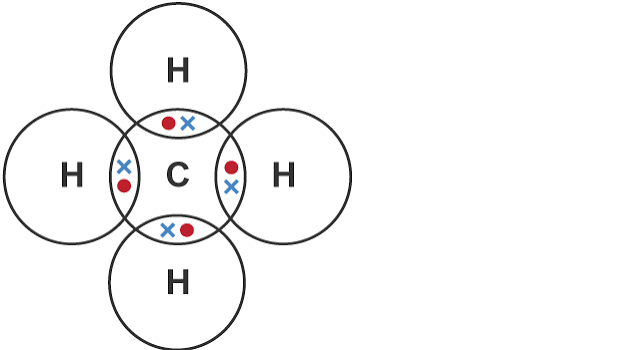
Dot and cross diagram for methane (CH4)
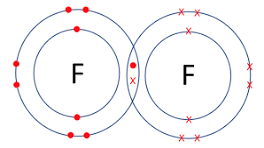
Dot and cross diagram for Fluorine
Shares one pair of electrons
Dot and cross diagram for Bromine
Shares one pair of electrons like Chlorine Fluorine and Iodine

Dot and cross diagram for Iodine

What are the four halogens
Chlorine, Bromine,Fluorine and iodine
Dot and cross diagram for ethene C2H4

In simple molecular substance their are
Strong covalent bonds inside each molecule but weak intermolecular forces between molecules
What does weak intermolecular forces mean
Do not need much energy to separate them
What do simple molecular substance generally have
Low melting points
Low boiling points
Generally liquids and gases
Important (covalent bonds)
You don't break the covalent bonds when melting or boiling. You overcome the forces between molecules
What is the relationship between the relative molecular mass and the melting boiling points
The relative molecular mass increases as the melting and boiling points increase
Why does the molecular mass and melting and boiling points increase?
This is because larger molecules have more electrons which can produce stronger intermolecular forces therefore more energy is needed to separate the molecules
Name 3 examples of giant covalent structures
Diamond, Graphite and Silicon dioxide
What do covalent structures contain
They contain huge numbers of atoms joined together by covalent bonds
Why is a lot of energy needed break the covalent bonds
Because there are many strong covalent bonds
What do all Giant covalent structures have in common?
Very high melting/boiling points
They are usually solids at room temperature
Properties of diamond
1.Each carbon bonds to four other carbon atoms
2. Forms a solid 3d structure
3.Very hard
Does not conduct electricity because there are no free electrons
High melting and boiling points due to strong covalent bonds
Properties of Graphite
Each carbon bonds to three other carbon atoms
Forms layers
The layers can slide over making Graphite soft
Has delocalised electrons so it conducts electricity
Properties of C60 fullerene
Made from 60 carbon atoms
Forms a hollow roughly spherical molecule
Has weaker forces between each individual molecules than the covalent bonds within each molecule
Do most covalent compounds conduct electricity
No most covalent compounds do not conduct electricity
Why don’t covalent compounds conduct electricity
This is because they usually don’t have any charged particles that are free to move
Give an example why covalent compounds do not conduct electricity
For example, CO2 the electrons are held in covalent bonds and aren't free to flow through the substance.
Give an exception to this rule
Graphite, can conduct electricity because it has delocalised electrons that can move through it’s structure.
What are elements in group 7 called?
Halogens
Fluorine’s colour and state at room temperature
The colour is pale yellow and the state is gas
Chlorine’s colour and state at room temperature
The colour is green/yellow and the state is gas
Bromine’s colour and state at room temperature
The colour is red/brown and the state is liquid
Iodine’s colour and state at room temperature
The colour is grey/black and the state is solid
What is the group 7 trend as you go down
1.The halogens get darker in colour
2.Their melting/boiling points increase
3.Their physical state changes from gas to liquid to solid
What is the order in group 7
Fluorine, Chlorine,Bromine and Iodine
How do you predict the properties of other halogens
You use the trend for example for an element below iodine. It would get darker than iodine it would have a higher melting and boiling point then iodine and it would be solid at room temperature
What can a more reactive halogen do?
Displace a less reactive halogen from its compound
Example, chlorine and potassium bromide
Chlorine displaces bromide from potassium bromide because it is more reactive than bromine
What is the most reactive and least reactive halogen
The most reactive is fluorine and the least reactive is iodine
What is the percentages for the main gases in air
Nitrogen 78, oxygen 21, argon 0.9 and carbon dioxide 0.04
How can an experiment find the amount of oxygen in the air?
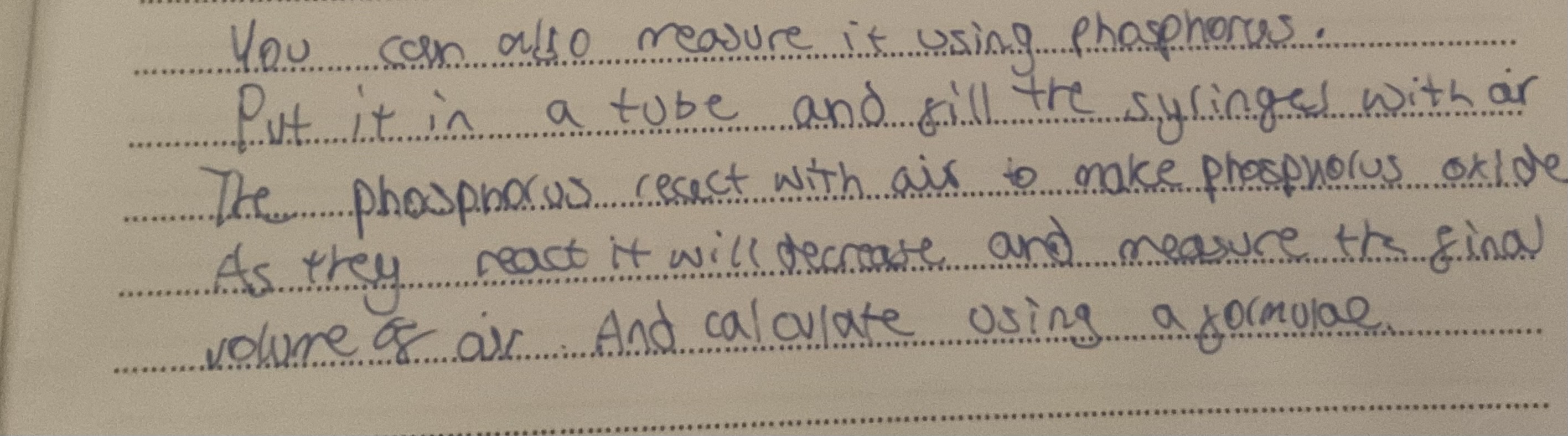
A substance such as iron or phosphorus reacts with the oxygen in the air.
When the oxygen reacts, it is removed from the air.
Give an example of the experiment from the previous question
100 cm³ of air → 79 cm³ after oxygen is removed
The decrease is:
100 − 79 = 21 cm³
So oxygen makes up approximately:
21% of air
What does combustion mean
It means burning in oxygen
What three examples of combustion do you need to know
Magnesium, hydrogen and sulfur
Magnesium reaction
2Mg + O₂ → 2MgO. Magnesium burns with a very bright white light and produces a white solid.
Hydrogen reaction
Hydrogen + oxygen → water
2H₂ + O₂ → 2H₂O
Hydrogen burns with a pale blue flame.
Sulfur reaction
Sulfur + oxygen → sulfur dioxide
S + O₂ → SO₂
Sulfur burns with a blue flame and produces sulfur dioxide.
What does thermal decomposition mean?
Thermal decomposition means using heat to break a compound into simpler substances.
Metal carbonates follow this pattern:
Metal carbonate → metal oxide + carbon dioxide
Give an example
Copper(II) carbonate → copper(II) oxide + carbon dioxide
CuCO₃ → CuO + CO₂
What colour is copper carbonate when heated and what does it produce
Copper(II) carbonate is green. When heated, it produces black copper(II) oxide and carbon dioxide gas.
How can carbon dioxide be teated
Carbon dioxide can be tested using limewater, which turns milky/cloudy.
What does green house gases help to do
It helps the earth from absorbing infrared radiation
What happens if the amount of CO2 increases?
If the amount of CO₂ in the atmosphere increases, it can cause more heat to be retained, contributing to climate change.
Remember:
More CO₂ → more heat retained → contributes to climate change
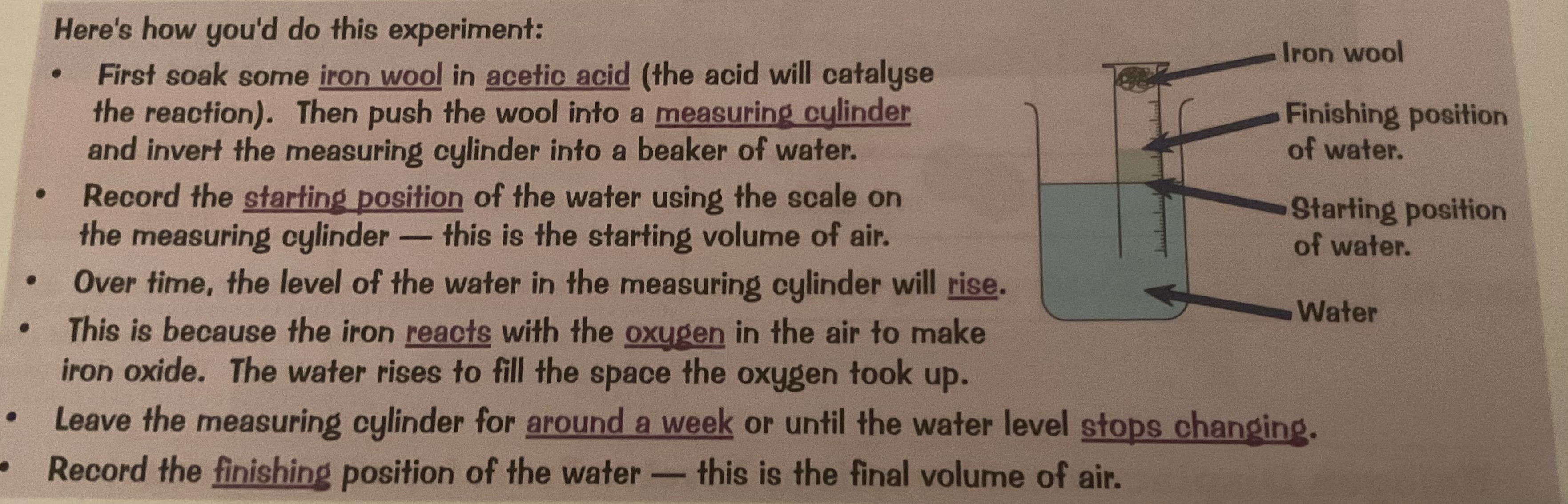
Design an experiment to find the amount of oxygen (iron)
Design an experiment to find the amount of oxygen (phosphorus)