M1 S4: Overcoming Host Immune Response
 Call Kai
 Learn
 Practice Test
 Spaced Repetition
 Match
 Flashcards
 Knowt Play
1/35

Earn XP
Description and Tags
In this section you reviewed: • How the production of a biofilm is a mechanism organisms use to overcome host immune responses. Biofilms are composed of EPS and the complex bacterial community is capable of communicating with one another through quorum sensing. • How capsules, thick polysaccharide layers that reside on the outside of cells, provide bacteria with protection against the host immune system. • How bacterial toxins (both endotoxins and exotoxins) function to arrest cellular functions. • How metabolic dormancy and the ability of wild-type S. aureus to phenotype switch into SCV can aid in the evasion the immune system.
36 Terms
In this section you reviewed:
How the production of a biofilm is a mechanism organisms use to overcome host immune responses. Biofilms are composed of EPS and the complex bacterial community is capable of communicating with one another through quorum sensing.
How capsules, thick polysaccharide layers that reside on the outside of cells, provide bacteria with protection against the host immune system.
How bacterial toxins (both endotoxins and exotoxins) function to arrest cellular functions.
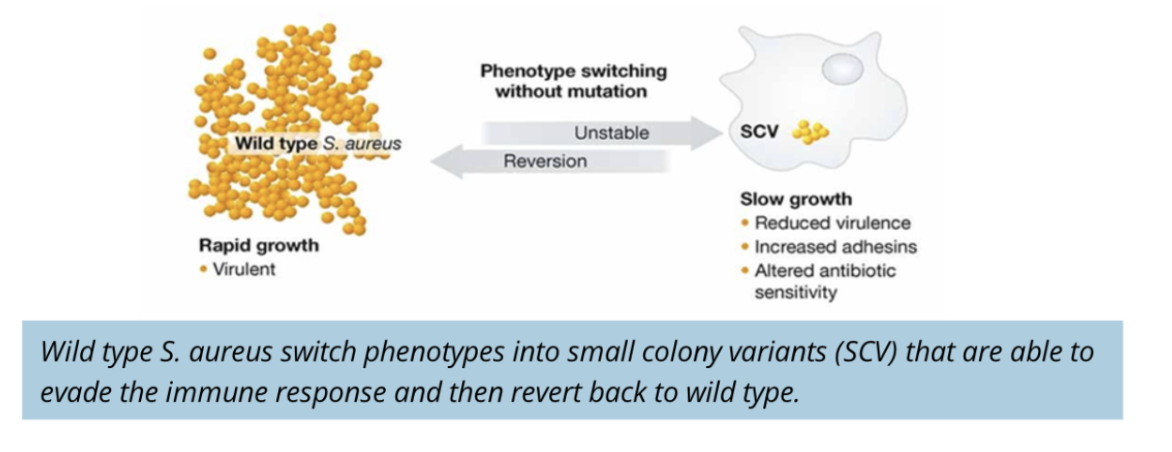
How metabolic dormancy and the ability of wild-type S. aureus to phenotype switch into SCV can aid in the evasion the immune system.
Infection caused by 4 stages: what are they
Entry
Invasion and colonization of tissue
Evasion of the host immune response
Infection
what is infection
vercoming of immune system caused usually by virulence factors
Molecules that are made by microo that increase their effectiveness and able them to infiltrate host
what are the 4 ways to evade immune system
Biofilm production
Capsules a way of avoiding phagocytosis
Toxin production
Metabolic Dormancy
why are biofiolms made?
Mechanism to overcome immune system and helps to stop penetration of antibiotics and other cellular function
what makes up a biofilm?
Made of different adhesive cells embedded in an extracellular matrix and extracellular polymeric substance
what are Extracellular polymeric substances (EPS)
Extracellular polymeric substances (EPS): EPS are natural polymers of high molecular weight secreted by microorganisms into their environment. EPSs are important for the structural integrity of biofilms and help determine the physiochemical properties of a biofilm.
where are biofilms found
Commonly found on prosthetic joints (knee and hip replacement = prosthetic joint infections (PJI)), tooth brushes, stainless steel, sink

T or F: biofilms are made of the same type of bacteria
F: Diverse and dynamic community
Mixed bacterial population
what is quorum sensing? why do bacteria do it?
Quorum sensing: The regulation of gene expression in response to fluctuations in cell-population density. Bacteria produce and release chemical signal molecules called autoinducers that increase in concentration as a function of cell density. Bacteria within the biofilm talk to each other to see when they need to move around.
T or F : Antimicrobial can not penetrate biofilms
T; = more difficult to treat
Why do they use quorum sensing? Why communicate?
Quorum sensing is the bacteria's mode of communication that allows them to convey information to other bacteria in the biofilm. Bacteria require constant communication to modulate the stages of the biofilm life-cycle. Bacteria communicate with each other to indicate the presence of nutrients or lack of nutrients in a particular location. If there are plenty nutrients than the biofilm will remain in that area to mature and if there is a lack of nutrients,
dispersal cells will be formed so the biofilm can relocate.
what happens if a biofilms breaks off
Represents a nidus of infection that can break off and be the source of infections at others sites
Steps of making a biofilm
Adhesion: the bacteria adheres to a new surface
Accumulation: other bacteria begins to accumulate on the already present bacteria
Maturation: the biofilm matures
Dispersion: when the biofilm requires more nutrients, bacteria will break off and re-locate
what is a Capsule
Capsule = a thick polysaccharide layer that resides outside of the cell
a Capsule is an example of what
Capsule production = virulence factor
T or F: Can see if capsule or not with capsule stain (fuzzy grey border = capsule )
T
How do capsulated bacteria interact with macrophages
Capsulated bacteria
Antiphagocytic shield: The outer capsule—usually made of thick polysaccharides or hyaluronic acid—hides the inner cell wall and masks vital targets from macrophage receptors. [1, 2]
Blocked opsonization: The slippery, often negatively charged or hyperviscous capsule prevents complement proteins and antibodies from working effectively, stopping opsonophagocytosis. [1, 2]
Immune evasion: Because macrophages cannot easily grab or swallow them, encapsulated bacteria survive longer in the host and cause severe disease. [1, 2, 3]
what are toxins made by bacteria and what is the target?
Toxins = small proteins or polysaccharides that are able to arrest cellular function or lyse host cells
Targets = plasma membrane or cytoskeleton
2 types of bacterial toxins
endotoxins and exotoxins

What are endotoxins?
Endotoxins are toxins that are not secreted, but are liberated when the bacteria lyse.
what is Lipopolysaccharide (LPS)?
LPS is a structural component within the outer membrane of Gram-negative bacteria. It is composed of the inner core, outer core, O antigen and Lipid A component.
The Lipid A component of LPS is a heat stable endotoxin that is a potent stimulant of the immune system even at small concentrations.
T or F you need a high concentration of Lipid A compinment of LPS to stimulant of the immune system
F: The Lipid A component of LPS is a heat stable endotoxin that is a potent stimulant of the immune system even at small concentrations.
Lipid A, when present in high concentrations in the body, may cause septic shock and death via an excessive immune response.
what is an exotoxin? what type of bacteria are they found with?
Exotoxins are defined as toxins secreted by bacterial cells. They are most commonly produced inside pathogenic Gram-positive bacteria.
T or F lipid A component is mainly found in gram positive bacteria
F: LPS is a structural component within the outer membrane of Gram-negative bacteria. It is composed of the inner core, outer core, O antigen and Lipid A component.
who (±) mainly makes exotoxins
gram postive
An example of a bacterial exotoxin is the macrophage cytotoxin produced by Salmonella spp. how does this work?
This bacterium can gain entry into host macrophages and produce toxins that impair the membrane ruffling and macropinocytic * activities of infected macrophages which can lead to cell death. These processes are essential for the macrophages to perform phagocytosis.
The macrophage cytotoxin produced by Salmonella spp. can ultimately lead to this bacteria evading the immune system through reducing the number and function of key innate immune cells.
Salmonella spp mainfests clinically as
Clinically, this bacterial infection manifests as food poisoning with the symptoms such as nausea, vomiting, and diarrhea however, these symptoms are related to an enterotoxin produced by the bacteria rather than the cytotoxic effects.
Enterotoxin (exotoxin) = effects gut
what are the 3 types of exotoxins?
Enterotoxins
neurotoxins
cytotoxins
what do Enterotoxins do
Enterotoxin = effects gut
Neurotoxin do what
Neurotoxin = effects nervous tissue
cytotoxins do what
Cytotoxin Toxic to cells. Cytotoxins damage, injure, or kill living cells. [1, 2, 3]
what does Metabolically quiescent mean
Some bacteria enter dormant state (metabolic activity and growth is stopped or slowed down)
how does Metabolic Dormancy evade the immune system
Impacts antibiotics to target cell (usually only target metabolically active) and reduced virlence goes unnoticed
give an example of a bacteria that uses Metabolic Dormancy to evade immune system
S. aureus
There are four main mechanisms through which bacteria evade the host immune system. Bacteria can use one or a combination of these defences. what are they and quickly explain them
A biofilm is formed when any group of microorganisms stick together to form a layer. Biofilms are impenetrable by antimicrobials and are therefore hard to treat. When a biofilm forms on a prosthetic joint, the only solution is to remove and replace the joint.
Capsules are a thick polysaccharide layer on the outside of a bacterium. It provides an extra layer of tough protection for the cell.
Bacterial toxins have the ability to damage or even kill host cells, removing their ability to eliminate the foreign invader.
Finally, some bacteria enter of state of metabolic dormancy, where the growth and activity is stopped or slowed, so these cells cannot be recognized by the host immune system.