ACC210 Chapter 5
 Call Kai
 Learn
 Practice Test
 Spaced Repetition
 Match
 Flashcards
 Knowt Play
1/46

There's no tags or description
Looks like no tags are added yet.
47 Terms
Pt 1. Recording a Credit Sale

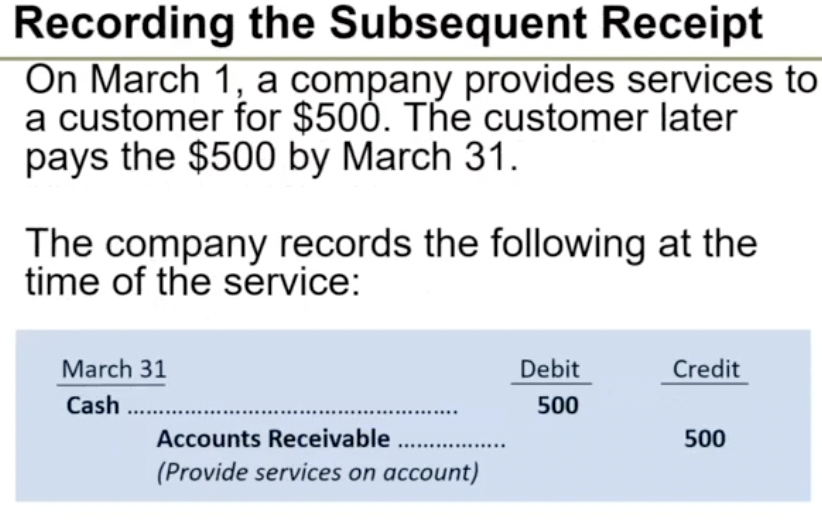
Pt 2. Recording the Subsequent Receipt
Sales Returns, Allowances, and Discounts are all examples of:
Contra-revenue accounts (Debits)
Net Sales
A company’s total sales less any discounts, returns, and allowances
Also referred to as net revenues
Net sales = sales - sales discounts - sales returns and allowances
Sales Returns and Allowances
Sales Returns
Seller issues a full refund
Customer returns the product
Sales allowances
Seller reduces the customer’s balance owed partially
Customer does not return the product
Sales Returns (Ex)

Sales Allowances

A sales return that we accept from a customer will…
decrease revenues
Why Use Separate Accounts?
It is helpful to use a separate account for returns and allowances to keep a separate record of the total revenue earned and reductions due to subsequent sales returns and allowances
If we have lots of sales returns and/or allowances we may be selling a poor quality product and this will become obvious quickly
Sales Discounts
Reduced from the amount owed by a credit customer
May be taken only if payment is made within a specified period of time (typically quickly)
Discount terms: 2/10, n/30 means a 2% discount is available if the balance is paid within ten days; the entire balance is due within 30 days
Collection during the discount period

Income statement reporting revenues net of sales returns, allowances, and discounts

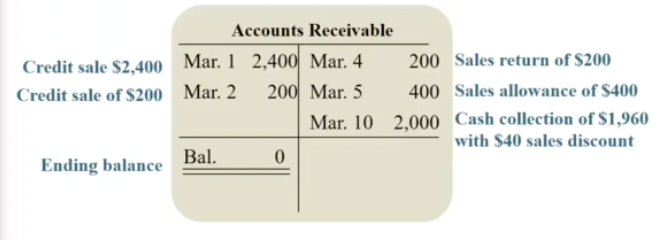
Balance of Accounts Receivable after credit sales, sales returns, sales allowances, and collections on account after sales discounts
End-of-period adjustment for contra revenues

Assume we recognize $120,000 of sales revenue and also have $5,000 in sales returns during the year. In addition, we estimate that we will see $1,000 of returns in January from product sales in December. Net revenues to report on our Income Statement would be:
$114,000
We must reduce sales revenue for both actual and estimated returns
Allowance method for A/R
Must acknowledge the likelihood that some accounts will be uncollectible
Companies are required to estimate future uncollectible accounts / record this estimate in the current year
Uncollectible accounts: customers’ accounts that are no longer considered collectible / Increases expenses (bad debt expense)
Estimating uncollectible accounts
Two accounts will be used:
Bad debt expense: recognized on the income statement as a cost (expense) of offering credit to customers
Allowance for uncollectible accounts: a contra-asset account representing the amount of accounts receivable that we do not expect to collect
The Allowance method for accounting for accounts receivable recognizes an expense based on:
Estimates of future uncollectible A/R
Estimating uncollectible accounts
Two normal approaches (both are acceptable and both are used in practice):
Percentage of receivables method
Based on the percentage of receivables expected to be uncollectible
Also, called the balance sheet approach because the focus is on the allowance for uncollectible accounts
Percentage-of-credit-sales method
Based on a percentage of credit sales made
Also called the income statement approach because the focus is on bad debt expense
Percentage-of-receivables method

Skywalker, Inc. estimates uncollectible accounts as a percentage of accounts receivable. What effect will recording the estimate of uncollectible accounts have on the fundamental accounting equation?
Decrease assets and decrease stockholders’ equity
Aging of accounts receivable (an alternative balance sheet approach)
Should be more accurate than using a single percentage (like 20% in the KMC example)
Consider the age of receivables:
Newer accounts have a lower probability of being uncollectible, while older accounts have an increasing likelihood of being bad debts
Percentages come from experience (or expensive consultants!)
Aging of accounts receivable schedule (ex)

Which Balance Sheet Approach to estimating the AFUA account balance is likely to produce a more accurate estimate?
Preparing an aging schedule based on current vs. past-due A/R balances
the aging process recognizes that older A/R have an increasing likelihood of being difficult to collect
Percentage of credit sales method
Estimates uncollectible accounts based on the percentage of credit sales made
Adjusts allowance for uncollectible accounts but ignores any existing balance in account
This method is known as an Income Statement approach since the focus is on Bad Debt Expense (not AFUA)
Examples of both methods
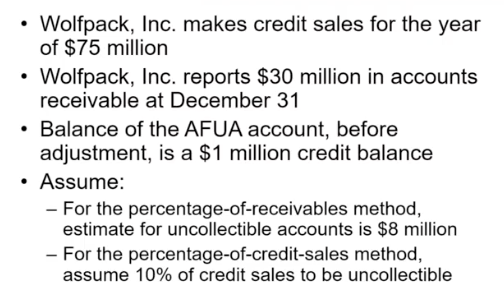
Adjusting for Estimates of Uncollectible Accounts (Balance Sheet Approach):
Balance Sheet Approach:

Adjusting for estimates of uncollectible accounts (Income statement approach):
Income statement approach:

On December 31, HeelCo reported accounts receivable of $300,000 and an allowance for uncollectible accounts of $500 (debit) before any adjustments. An analysis of accounts receivable suggests that the allowance for uncollectible accounts should be 3% of accounts receivable. The amount of the adjustment for uncollectible accounts would be:
9500
Writing Off Accounts Receivable
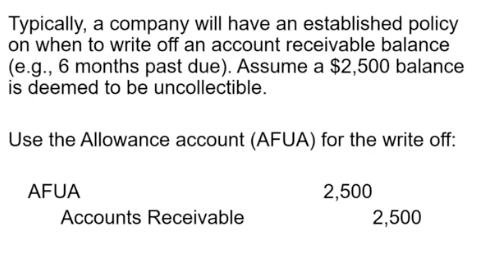
Writing Off Accounts Receivable to notice:

Collection of Accounts Previously Written Off

The current year's beginning and ending credit balances for Allowance for Uncollectible Accounts is $40,000 and $50,000, respectively. If the amount of Bad Debt Expense for the year is $45,000, what is the amount of actual accounts receivable that was written off as uncollectible during the year?
35000
The balance should have increased by $45000 due to recognizing Bad Debt expense of that amount. Since it only increased by $10000 we must have written off $35000 of A/R as uncollectible
Recording Notes Receivable
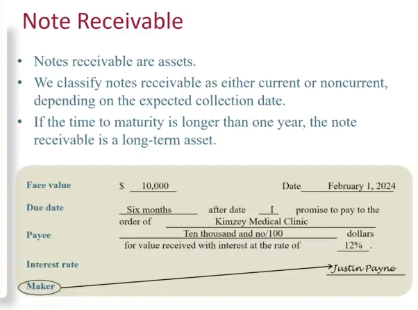
Kimzey provided $10,000 of services to Justin Payne, who is not able to pay immediately
Justin Payne signs a promissory note, offering to pay $10,000 plus 12% interest in six months

Note Receivable
Interest Calculation
Kimzey accepted a six-month, 12% promissory note
The terms of the six-month note mean that Kimzey will charge Justin Payne one-half year of interest, or 6%, on the face value
Interest on Kimzey’s note receivable is calculated as follows

A note receivable will always be classified:
Either as a current or long-term asset
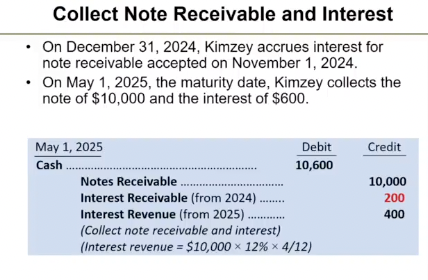
Collection of notes receivable

Calculating interest revenue over time for kimzey medical clinic
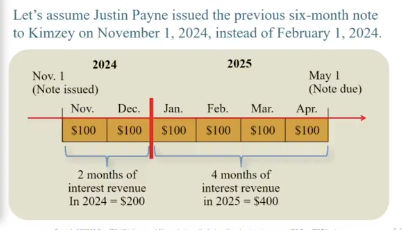
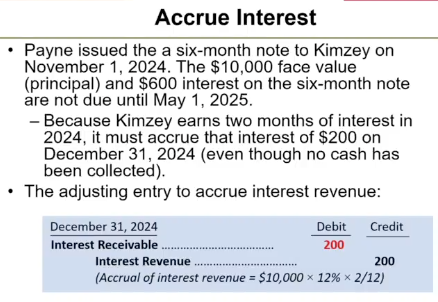
Accrue interest
Collect Note Receivable and Interest
The journal entry to record the 12/31 accrual of interest revenue for a 9-month N/R with a $250,000 principal balance, 8% interest rate, that was issued on 10/1 (principal and interest due on 7/1 next year) includes:
A debit to Interest Receivable for $5,000
The amount of interest earned is 5,000 (250,000x.08×3/12). This will be debited to interest receivable and credited to interest revenue
Managing and monitoring cash

The operating cycle is also sometimes referred to as the "cash-to-cash" cycle because
It measures how long it takes to convert inventory and receivables into cash
Receivables turnover ratio

Average collection period

Assume net credit sales revenue equals $400,000 and A/R at 1/1 and 12/31, respectively, equal $40,000 and $80,000. Receivables turnover is:
6.67
400,000/((40,000+80,000)/2) = 400,000/60,000 = 6.67