How to read plot for biochem exam 2 Study
 Call Kai
 Learn
Learn Practice Test
 Spaced Repetition
 Match
Match Flashcards
 Knowt Play
1/41

There's no tags or description
Looks like no tags are added yet.
Name | Mastery | Learn | Test | Matching | Spaced | Call with Kai | Chat |
|---|
No analytics yet
Send a link to your students to track their progress
42 Terms
What are the axes of a Michaelis–Menten plot?
x-axis = substrate concentration [S]; y-axis = initial velocity V₀.
![<p>x-axis = substrate concentration [S]; y-axis = initial velocity V₀.</p>](https://assets.knowt.com/user-attachments/b5de5070-107b-4c9b-8f42-b3cb64901ee1.png)
What is the shape of a Michaelis–Menten plot?
A hyperbola that approaches a maximum velocity.
What does the plateau of a Michaelis–Menten plot represent?
Vmax.
What does Km represent on a Michaelis–Menten plot?
The substrate concentration where V₀ equals ½Vmax.
What happens to V₀ as substrate concentration increases?
V₀ increases until the enzyme becomes saturated and approaches Vmax.
At very high substrate concentration, what happens to the reaction velocity?
It approaches Vmax and becomes nearly independent of substrate concentration.
What are the axes of a Lineweaver–Burk plot?
x-axis = 1/[S]; y-axis = 1/V₀.
What is the Lineweaver–Burk equation?
1/V₀ = (Km/Vmax)(1/[S]) + 1/Vmax.
What is the slope of a standard Lineweaver–Burk plot?
Km/Vmax.
What is the y-intercept of a Lineweaver–Burk plot?
1/Vmax.
What is the x-intercept of a Lineweaver–Burk plot?
−1/Km.
How do you calculate Vmax from a Lineweaver–Burk plot?
Take the reciprocal of the y-intercept.
How do you calculate Km from the x-intercept?
Take the reciprocal of the x-intercept and multiply by −1.
If the equation is y = mx + b, what does m represent on a Lineweaver–Burk plot?
Km/Vmax.
If the equation is y = mx + b, what does b represent on a Lineweaver–Burk plot?
1/Vmax.
For a normalized Lineweaver–Burk plot using V₀/[E]T, what is the y-intercept?
1/kcat.
For a normalized Lineweaver–Burk plot using V₀/[E]T, what is the slope?
Km/kcat.
How do you calculate kcat from a normalized Lineweaver–Burk plot?
kcat = 1 divided by the y-intercept.
How do you calculate Km from a normalized Lineweaver–Burk plot?
Km = slope × kcat.
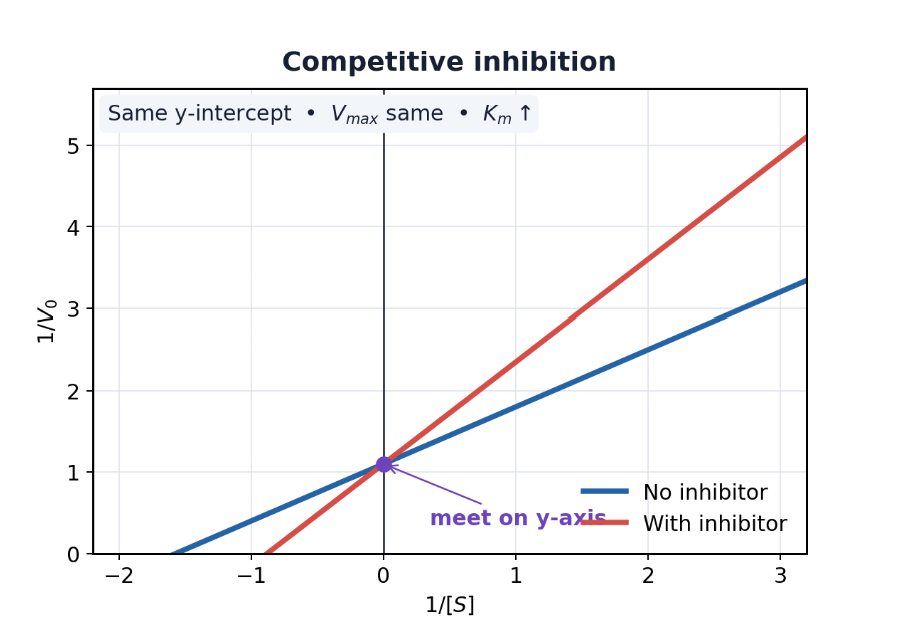
What Lineweaver–Burk pattern indicates competitive inhibition?
The lines intersect on the y-axis.
What happens to Vmax and Km during competitive inhibition?
Vmax stays the same and apparent Km increases.
Why does the y-intercept stay the same in competitive inhibition?
The y-intercept is 1/Vmax, and Vmax does not change.
What Lineweaver–Burk pattern indicates uncompetitive inhibition?
Parallel lines.

Where does an uncompetitive inhibitor bind?
It binds only to the enzyme–substrate complex.
What happens to Vmax and Km during uncompetitive inhibition?
Both Vmax and Km decrease by the same factor.
Why are uncompetitive inhibition lines parallel?
Km and Vmax decrease proportionally, so the slope Km/Vmax stays the same.
What happens to kcat, Km, and kcat/Km during uncompetitive inhibition?
kcat and Km decrease, but kcat/Km stays the same.
What Lineweaver–Burk pattern indicates mixed inhibition?
The lines intersect to the left of the y-axis.

Where does a mixed inhibitor bind?
It binds both the free enzyme and the enzyme–substrate complex, but with different affinities.
What happens to Vmax during mixed inhibition?
Vmax decreases.
What happens to Km during mixed inhibition?
Km may increase or decrease depending on which enzyme form the inhibitor favors.
What is the fastest way to recognize competitive inhibition?
Same y-intercept.
What is the fastest way to recognize uncompetitive inhibition?
Parallel lines.
What is the fastest way to recognize pure noncompetitive inhibition?
Same x-intercept.
What is the fastest way to recognize mixed inhibition?
Lines intersect to the left of the y-axis.
What plot pattern indicates a sequential Bi–Bi mechanism?
Intersecting lines.
What plot pattern indicates an ordered Bi–Bi reaction when the first substrate is varied?
Lines intersecting to the left of the y-axis.
What plot pattern indicates a random sequential Bi–Bi mechanism?
Intersecting lines.
What plot pattern indicates a ping-pong Bi–Bi mechanism?
Parallel lines.
Why do sequential Bi–Bi mechanisms produce intersecting lines?
Both substrates bind to the enzyme before a product is released.
Why does a ping-pong Bi–Bi mechanism produce parallel lines?
The first product is released before the second substrate binds.
What is the easiest memory phrase for the inhibitor plots?
Same y = competitive; parallel = uncompetitive; same x = noncompetitive; meet left = mixed.