AH3 CAD/ACS
 Call Kai
 Learn
Learn Practice Test
 Spaced Repetition
 Match
Match Flashcards
 Knowt Play
1/24

There's no tags or description
Looks like no tags are added yet.
Name | Mastery | Learn | Test | Matching | Spaced | Call with Kai | Chat |
|---|
No analytics yet
Send a link to your students to track their progress
25 Terms
CAD clinical manifestations: (3)
stable angina
unstable angina
prinzmetal’s angina
what distinguishes stable (3) from unstable angina (4)?
stable: (3)
CP with activity
linked to fixed plaque
relieved by meds and rest
unstable: (4)
CP at rest (and activity)
most concerning
marks the start of ACS
treated as emergency
what causes Prinsmetal’s angina?
when does it typically occur?
a variant of unstable angina caused by coronary spasms rather than plaque (but atherosclerotic changes are present)
→ occurs @ rest and in clusters b/w midnight and 8AM
What labs would you want to draw for CAD? (7)
total cholesterol
triglycerides
LDL
HDL
CK (creatinine kinase)
⬆= muscle damage
CK-MB (mostly in heart muscle)
⬆= HEART muscle damage
troponin
Whats the gold standard diagnostic test for CAD?
what does it help determine?
Coronary Angiography (left sided heart cath)
→ determines if PTCA/Stent placement is an option
(Percutaneous Transluminal Coronary Angioplasty aka Percutaneous Coronary Intervention)
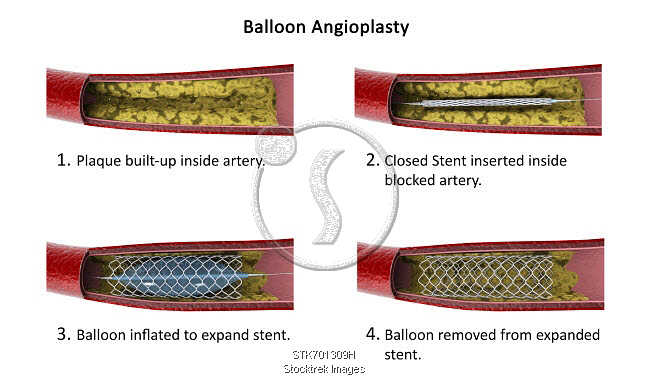
What happens during PTCA? (3)
catheter w/ small ballon on its tip advanced through femoral/radial artery to area with plaque
ballon inflated, then deflated to open lumen of artery
once opened, stent advances to location to hold artery open and maintain blood flow

What defines Coronary Artery Bypass Grafting (CABG):
arteries (chest/arms) or veins (legs) are grafted to bypass blocked coronary arteries while cardiopulmonary bypass (CBP) maintains perfusion
heart is stopped during this to provide bloodless field to work in

whats a complication of CAD?
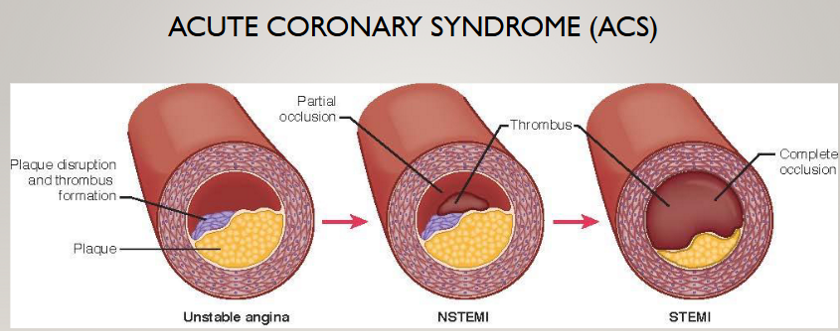
Acute coronary syndrome (ACS)
aka MI
STEMI vs NSTEMI
Key differences b/w STEMI and NSTEMI:
STEMI: (BAAAD)
infarction w/ complete obstruction of blood flow
NSTEMI:
ischemia w/ partial obstruction
Aside from classic chest pain, what other symptoms should nurse watch for in MI? (5)
epigastric discomfort
pain b/w shoulders and jawline
diaphoresis
syncope
SOB
What cardiac biomarkers specific to myocardium and stays elevated the longest?
Troponin I: NL: < 0.04 ng/mL (MI: > 0.04)
rises 3-6 hrs
peaks 14-20 hrs
stays elevated 1-2 weeks
Troponin T: NL: <0.01 ng/mL
rises: 3-4 hrs
peaks: 12-24 hrs
stays elevated 2-3 weeks
NSTEMI vs STEMI ECG changes:
NSTEMI:
ST depression
STEMI:
ST elevation

emergent treatment bundle for STEMI at presentation: (4)
aspirin
nitroglycerin
morphine
O2 if < 90%
Whys aspirin given 1st in ACS?
Whats the 2 doses?
Key note when taking aspirin?
Given first to disable platelet aggregation
initial dose: 325 mg CHEWED
2nd: 81 mg indefinitely
NOTE: dont take with other NSAIDS!!
What does nitro do?
What to monitor for?
Contraindications: (2)
Nitro is a vasoDILATOR
Monitor: hypotension, HA
Contraindicated: (2)
right ventricular MI
use of PDE-5 inhibitors aka Viagra
How is Nitro given?
Sublingual 0.4 mg q5mins x3

How is morphine dosed in ACS? (3)
used as adjunct to nitro (also vasodilator)
small doses!!!
1-2 mg IV q5-15 mins if CP not relived by Nitro
AVOID in right ventricular MI
whats the door-to balloon time goal for STEMI treated w/ PCI?
90 mins!!!
What are signs of a retroperitoneal bleed/Hematoma??? (RBH) (5)
catheter injures femoral artery → blood leaks into retroperitoneal space (behind abdominal organs)
hypotension
tachycardia (may be masked by beta blockers)
abdominal distention
back/groin pain (LATE)
flank ecchymosis (LATE)
how would u treat a retroperitoneal hematoma?
hold pressure
percutaneous intervention w/ balloon tamponade
blood transfusion

Indications (2) for fibrinolytic therapy and whats the biggest risk?
indications: (2)
pain < 6 hrs with STEMI
ST elevation > 1 mm in 2+ leads
risk: BLEEDING!!!
stop anticoags
monitor PT/INR
monitor fibrinogen, urine output, BUN/Cr
give cryoprecipitate and platelets
NO punctures, invasive devices
If unable to get to cath lab in time, what would u give for a STEMI? (2)
TNKase (tenecteplase)
5 sec bolus; no infusion or 2nd bolus
weight based dose, no more than 50 mg
rtPA (Activase)
bolus followed by infusion
Big 5 discharge meds after ACS? (5)
ASA—indefinitely
P2Y12 receptor blockers
at least 1 yr!!
BB—indefinitely
Statin—indefinitely
ACE-I (or ARB)
EF < 40% or anterior MI
How should P2Y12 inhibitor typically be continued after ACS, and why does this matter for teaching?
At least 1 year
continuing dual antiplatelet therapy for full yr is critical
stopping early = stent thrombosis
3 major complications of CAD:
MI (aka ACS)
HF
⬇CO
left ventricle cant function
Arrhythmias
can lead to asystole, bradycardia, heart blocks