CHEMMAT 121
 Call Kai
 Learn
Learn Practice Test
 Spaced Repetition
 Match
Match Flashcards
 Knowt Play
1/298

There's no tags or description
Looks like no tags are added yet.
Name | Mastery | Learn | Test | Matching | Spaced | Call with Kai | Chat |
|---|
No analytics yet
Send a link to your students to track their progress
299 Terms
Stress Formula
Force over cross sectional area perpendicular to F
Stress unit
Pascal (Pa)
Strain formula and conventional name
Stretch (epsilon) = Change in length over original length (L/Lo)
Strength definition
Amount of force a material can resist before failure
Tensometer results
Tensile strength of a material - Stress strain curve
1st key point on a stress strain curve
Yeild point - Marks the end of the elastic region where strain is recoverable
2nd key point on stress strain curve
Ultimate tensile stress (UTS). End of plastic deformation and start of necking
3rd point on stress strain curve
Fracture point (failure)
Plastic deformation - Concequence
Workhardening
Necking definition
Localised reduction in area
Plastic deformation definition
Uniform reduction in area
Elastic deformation definition
All strain is recovered when stress is removed
Fracture definition
1 Piece becomes multiple
Young’s modulus
Stiffness/Elasticity (E) = change in stress over change in strain. Unit of Pascals (Pa)
Strain unit
No unit, expressed as a percentage which is a ratio of change in the length over the original length
Fully annealed steel curve

Poisson’s ratio - Units
Nu (v)
Poisson’s ratio - equation
v = — x strain over z strain
0.2% Proof stress
Non-obvious yeild point
Safety factor assumptions
1) material is weaker than it actually is
2) applied force is larger than it actually is
Point at which materials are planned to resist up until
Yield point
True stress curve formula
True stress = Force over instantaneous area
Engineering stress curve formula
Same as standard stress calculation
Ductility definition
How much plastic deformation before fracture. Shown by strain axis
Brittle definition
No plastic deformation (or very little)
Elongation formula
Percentage of elongation = change in length over original length x 100 (same as strain)
Reduction in area formula
Percentage of reduction in area = change in area over original area x 100
Toughness definition
Energy required to fracture material
Toughness visual representation on curve
Area under the curve
Strength is mutually exclusive to
Toughness
Typical stress strain curves for different materials

Crystalline definition
Solid structures where the atoms arrange themselves in a regular repeating pattern
BCC
Body centered cubic
FCC
Face centered cubic
HCP
Hexagonal close-packed
BCC Model

Atoms per BCC cell
2
Coordination number definition
Number of nearest neighbour atoms for the BCC cell
BCC Coordination number
8
Unit cell dimension symbol
a
Unit cell dimension formula BCC
a = 4R over root(3)
R - term
Radius of atom
Atomic packing formula
Volume of atoms over volume of unit cell
BCC Atomic packing percentage (estimated)
68%
FCC Model

Atoms per FCC unit cell
4
FCC Coordination number
12
FCC Unit cell dimension formula
a = 4R over root(2)
FCC Atomic packing factor
74%
Hexagonal close packed model

Atoms per HCP cell
6
HCP Coordination number
12
HCP Atomic packing factor
74%
Polymorphism
Description for materials that can exist in more than 1 crystal structure.
Ceramic definition
Metal and non metal atoms joined together by ionic and covalent bonds arranged in a crystalline structure
Ceramic characteristics
Strong but brittle
2 Ceramic crystal structures
1) Rock salt structure
2) Silicate structure
Factors in determining ceramic crystal structures
1) Balancing charges to make final solid electrically neutral
2) Reliative size of ions (Anions and cations not touching)
Rock Salt structure model

Rock salt coordination number
6
Rock salt unit cell dimension formula
a = 2 x (Anion radius + cation radius)
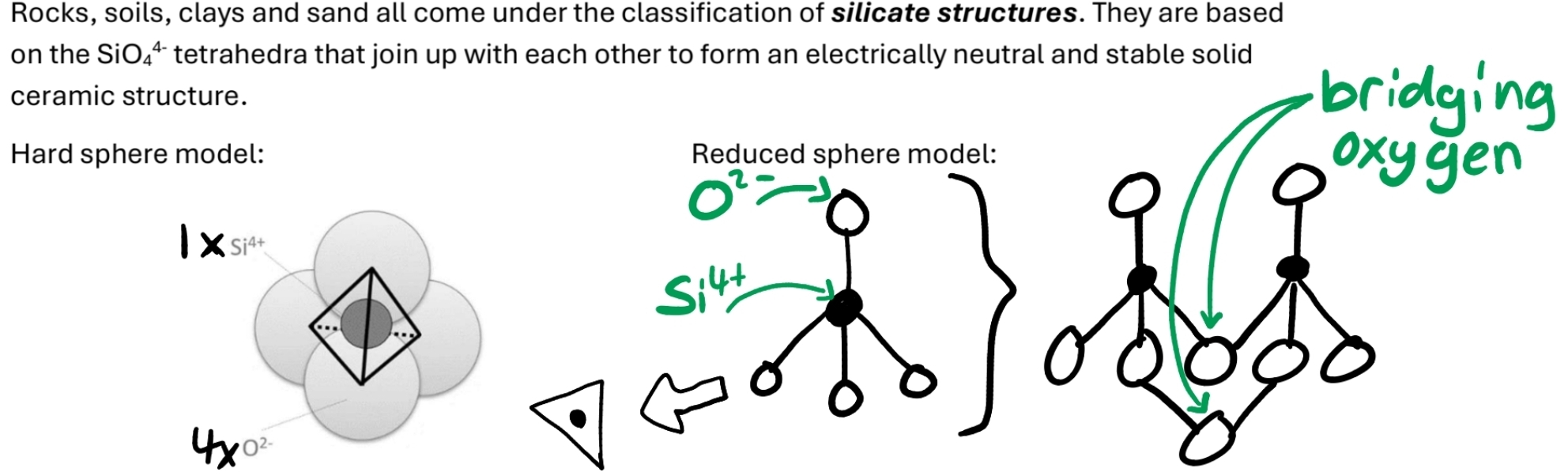
Silicate structure model - Not unit cell
Hard sphere model:
Glass structure classification
Amorphus
Silicate structure factor
Cooling rate from liquid state
1) Slow cooling - Crystalline ceramic → atoms can rearrange
2) Rapid cooling - Amorphous glass → Can’t rearrange
Crystallography definition
The study of the geometric crystal structures in crystalline solids. Refers to planes and directions within the structure
Crystal lattice directions
[u v w]
Steps to name directions in a crystal lattice
1) Draw the direction vector from a chosen origin.
2) Project the length onto all 3 unit cell axes. ie. [1u, 0v, 1/2c]
3) Put in terms of coefficients ie. [1 0 1/2]
4) Convert to whole integers ie. [2 0 1]
5) Put in square brackets.
Negative direction notation
Bar above a number.
Crystallographically equivalent definition (directions)
Atomic spacing along one direction is the same as another
ie. [0 1 0]
Direction family notation
< ‘1 0 0’ >
Planes in a crystal lattice (notation & name)
Round brackets: ( h k l )
Called millerindicies
Steps to name planes in a crystal lattice
1) Decide origin point - CANNOT be on plane being named & plane should act like a ‘roof’ to the point.
2) Work out intercepts of plane on unit cell (from origin)
→ A flat or vertical plane will only have 1 intercept ie. [ 2 ∞ ∞ ] (100)
→ A diagonal plane (ie. up and across in 1 direction) will have 2 intercepts ie. [ 2 1 ∞ ] (110)
→ A Diagonal plane in all directions will have 3 intercepts
ie. [ 2 1 1/2] (111)
3) Take reciprocals of intercepts ie. [ 1 ½ ∞ ] → [ 1 2 0 ]
4) Convert to integers (if needed)
5) Put in round brackets
Close packed directions definition
Directions where atoms are touching
( 1 0 0 ) Atomic arrangements

( 1 1 0 ) Atomic arrangements

( 1 1 1 ) Atomic arrangements

Crystallographically equivalent definition (planes)
Atomic spacing on two different planes are the same.
ie. ( 1 0 0 ) has same spacing as ( 0 1 0 ) for FCC and BCC cells
Plane family notation
{ 1 0 0 }
Close-packed family of planes (FCC)
{ 1 1 1 } in < 1 1 0 > directions
→ Direction refers to a plane which is perpendicular to direction the vector [ 1 1 0 ]
Close packed family of planes (BCC)
None.
One family is closer-packed than others: { 1 1 0 } in < 1 1 1 > directions
More accurate stress/deformation definition
Atomic bonds stretching
Stress formula in terms of elasticity and strain
Stress = elasticity (E) x strain (epsilon)
Permanent deformation definiton
Atomic bonds break and reform
Deformation process term
SLIP
Close packed plane slip properties
1) Atoms don’t move far to next equilibrium position
2) Weaker material
Non close packed plane slip properties
1) Atoms have to move further to next equilibrium position
2) Stronger material
Theoretical strength definition
The energy required to break and remake atomic bonds.
Shear strength definition
Actual strength of a material due to imperfections
Examples of point defects (1D imperfections)
1) Interstitial atom
2) Substitutional atom
3) Vacancy
Examples of planar defects (2D imperfections)
1) Edge dislocation
2) Screw dislocation
Slip cause
Yield strength is exceeded. Occurs easier in arrangements with dislocation.
Slip definition
Dislocation movement
Arrangements with highest likelihood of slip
Close packed planes in close packed directions
Slip comparison between FCC and BCC
1) BCC are generally stronger and less ductile than FCC
2) Slip occurs easier in FCC structures
HCP Slip & Characteristics
1) Close packed planes lined up in 1 orientation
2) Slip is very difficult
3) Thus HCP structures are strong and brittle
Plastic deformation in ceramics
Improbable. Like charges (ie, cation & cation) don’t form bonds
Ceramics characteristics
1) Stiff - Strong ionic/covalent bonds
2) Brittle - Like charges moved together repel, causing fracture
Ceramic imperfections (1)
Porosity
Glass characteristics
1) Strong
2) Brittle
Polycrystalline definition
Solidifying molten metals form many crystals.