Intro to Pain Management
 Call Kai
 Learn
 Practice Test
 Spaced Repetition
 Match
 Flashcards
 Knowt Play
1/34

There's no tags or description
Looks like no tags are added yet.
35 Terms
MCTF Pain Features
Type: nociceptive, neuropathic, nociplastic, mixed
Characteristics: mechanical [provokable] non mechanical [constant/at rest]
Sensitization: low-high
Biopsychosocial model factors
Bio: genes, physiology
Psyche: catastrophizing, self-efficacy, control, anxiety, anger
Social: SES, Social, skepticism
Goals of pain assessment
Find dominant mechanism
Contributing factors
Impact on physical fxn - body structures/fxn, activity limitations, participation restrictions
Impact on overall life
Goals (create plan to reach goals)
Increase standing tolerance, work mods
Prognosis
ICF Model for Pain
Condition contributes to
Body structures/fxns: tight mm, impingement, limited ROM
Activities: lift, bend, sit, stand, stairs, walk
Participation in work, return to sport
+Environmental +personal factors
PQRST
Provoking + easing factors
Quality: feel?
Region + radiation: spread? Along dermatome?
Severity/intensity: how much pain
Temporal factors: start, come and go? constant?
What does Provoking tell us?
Noxious stimuli or loading of 1 tissue?
Non-noxious stimuli → Sensitization
Makes worse/better?: positions, movements, touch,
how much to do before pain starts? how long does it take to settle?
What have you tried to make it better? Did it help?
Pain only when 1 tissue loaded?
What does Quality tell us?
Describing words tell us what mechanism
Neuropathic: burning, electrical, pins, needles
Inflammatory: aching
Does pain feel same everywhere or diff in diff places?
Record words, offer many options if have to list
Achy, throbby, sharp, burning, shooting, electric, tingling. pins + needles, numb
What does Region tell us?
Localized? = nociceptive
Spread?
Does it follow nerve or root or diffuse?
Where is pain? Can you point to it? 1+ painful areas?
What does Severity tell us?
Proportional to tissue damage or inflammation?
Ask about:
Timing: now, @ rest, w/ activity?, on average?
Set recall period: past 24 hrs, past week?
Use anchors: 10 is worst imaginable
Document it: write the question asked, recall period, and #. ASK THE SAME WAY!
Must have same questions, recall period + anchors to compare!
Measuring intensity which tells us severity
What does Timing tell us?
Evoked?
Resting pain or spontaneous?
Worse in am or pm?
Onset
Frequency of pain
Duration
24 hr pattern: am diff from pm, times of day when pain more present
Pain @ rest
Spontaneous pain
Average pain thru week, worst pain when aggrevate, least pain, right now
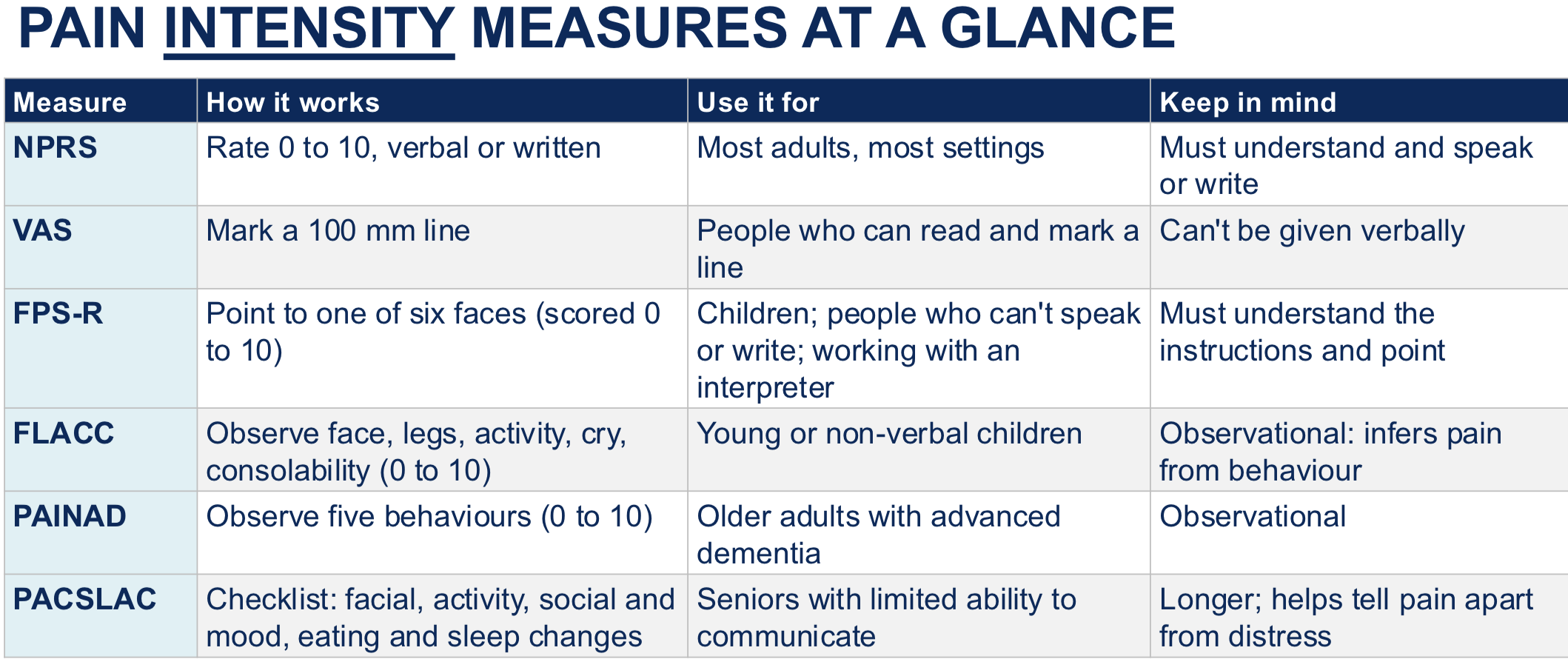
Ways to measure intensity
NPRS 0-10, verbal/written. Give anchors
Visual analogue scale: Good for nonverbal - draw line thru scale
Written or electronic
Faces pain Scale Revised: point to face scored 0-10. No read, write or speak.
Other ways to measure quality of pain
Short form McGill Pain Questionnaire
PROMIS Nociceptive + neuropathic pain quality
How to measure interference of pain
Brief pain inventory short form
Body map, worst, least, average and current pain
Relief from treatment
Interference w/ daily life
Which measure to use?
Language, culture
Ability to read, speak, write
Setting
Age
Not every tool is valid and reliable
Pain quality measures
PROMIS scale for nociceptive pain
PROMIS scale for neuropathic pain

Which tool measures the multi-dimensional factors of pain
McGill Pain Scale Short Form V2
Pain quality, intensity, affective, region, intensity, past treatment, pain interference
Components of building a hypothesis
History > PQRST > Physical exam > working hypothesis
Based on subjective and physical exam
Mechanical pain means what?
Provoked by physical stimulus - certain movements/posture
Response = stimulus
Non mechanical pain means?
Not related to physical stimulus
Constant or spontaneous pain
Response » stimulus
What is the pain mechanism if the pain only occurs when load injured tissues?
Normal nociceptive pain, NO sensitization
If light touch, constant pain, or gentle movement hurts, it is not normal nociceptive pain
Sensitiziation
Pain triggered by post, movement, load, palpation
Sensory stimuli: light touch, pressure, temp
Stress and distress
Local or widespread pain?
Typical for history + stage? What does it mean for rx?
Is pain clear cut?
NO! Based on individual’s perspective
Can have mixed pain
Fear + anxiety, stress heighten pain
PQRST in physical exam
Provocation done LAST in assessment
Location/sensory changes
Avoid asking pain intensity too many times
What to do if normal nociceptive pain
Tissue-specific tests to rule in/out
Stage, irritability and severity guide how far to push
Neuropathic Pain next steps
Screen dermatomes, myotomes, reflexes, neurodynamic tests
Map sensory loss/gain to nerve or root
Inflammatory nociceptive pain next step
Look for swelling, warmth, redness
Map sensory gain to swollen area
Screen for red flags + systemic disease
Nociplastic pain next steps
Map tenderness + sensory changes that don’t follow tissue/nerve
Sleep, mood, beliefs and stress
MCTF Yellow flags
MCTF Yellow flags
Cognitive factors: self-efficacy, attitudes + beliefs
Affective factors: depression, anxiety, stress, fear, worry
Social factors: SES, edu, relationship, health literacy, culture, health care
Psychosocial screening

3P Approach to Treat Pain
Physical: Ice, rest, comfort positioning, PT, OT
Pharmacological: Ibuprofen, opioids, NSAIDS
Psychological: distraction, watch TV, counselling
How to treat normal nociceptive pain
Targeted tissue exercise, manual therapy
How to treat inflammatory pain
RICE
EPAs
How to treat neuropathic pain
Graded exercise, desensitization, graded motor imagery to alter nociception
How to treat nociplastic pain
Graded exercise (i.e. gradually increase step count) to alter nociception
Common treatments suitable for any pain mechanism:
Heat, ice, TENS
Fxn: gait, stairs, gait aids, return to sport
Contributing factors: pain edu, self-management, goal setting, build self-efficacy
What types of questions to ask about pain?
Open
Standardized
Non leading