lecture 1 - overview of animal digestive systems
 Call Kai
 Learn
Learn Practice Test
 Spaced Repetition
 Match
Match Flashcards
 Knowt Play
1/57

There's no tags or description
Looks like no tags are added yet.
Name | Mastery | Learn | Test | Matching | Spaced | Call with Kai | Chat |
|---|
No analytics yet
Send a link to your students to track their progress
58 Terms
What do carnivores eat?
Animals
What do omnivores eat?
Plants and animals
What do herbivores eat?
Plants
What are simple carbohydrates?
Sugars and starches
What are complex carbohydrates?
FIbers
What are the main structural carbohydrates?
Pectin, hemicellulose, and cellulose
What is lignin?
A non-carbohydrate component of plant cell walls
Why can't mammals digest most plant fiber themselves?
Their enzymes cannot break down structural carbohydrates
How do herbivores digest fiber?
Microbes ferment it
What is sacculation?
Enlarged digestive areas that house microbes and slow passage
What does microbial fermentation produce from carbohydrates?
VFAs
What are the 3 main VFAs?
Acetate, propionate, and butyrate
What are VFAs used for?
A major energy source for herbivores
Where are VFAs absorbed?
Across the rumen or intestinal wall
What is microbial protein?
Microbial biomass that can provide protein to the animal
What are the 3 major digestive strategies?
Simple monogastric, hindgut fermentation, and foregut fermentation

What is a simple monogastric digestive system?
A system with little or no microbial fermentation
Where does most nutrient absorption occur in monogastrics?
Small intestine
What does the large intestine mainly absorb?
Water
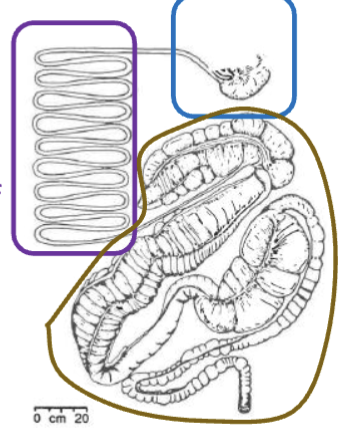
What is hindgut fermentation?
Fermentation occurring in the cecum and/or colon

What is foregut fermentation?
Fermentation occurring before the true stomach
What is the main difference between foregut and hindgut fermentation?
-Foregut occurs before the true stomach
-hindgut occurs after the small intestine
What are examples of hindgut fermenters?
Horses, elephants, pigs, and rabbits
What is a cecal fermenter?
An animal that primarily ferments feed in the cecum
What is a colonic fermenter?
An animal that primarily ferments feed in the colon
What is a ruminant?
An animal that uses foregut fermentation and rumination
What is the rumen's main function?
Microbial fermentation
What is the true stomach of a ruminant?
Abomasum
What are the 4 ruminant stomach compartments?
Rumen, reticulum, omasum, and abomasum
What is the function of the rumen?
Ferments feed using microbes
What is the function of the reticulum?
Sorts particles and helps with rumination
What is the function of the omasum?
Filters particles and absorbs water and VFAs
What is the function of the abomasum?
Digests feed and microbes using acid and enzymes
What is a true ruminant?
An animal with four stomach compartments
What is a pseudoruminant?
An animal with three stomach compartments
Why do ruminants regurgitate feed?
To rechew and reduce particle size
What is rumination?
Regurgitating, rechewing, and reswallowing feed
Why is rumination beneficial?
It reduces particle size and increases microbial access
Where are dietary and microbial amino acids absorbed in ruminants?
The small intestine
Where are most nutrients absorbed in the small intestine?
Across the intestinal wall into circulation
What happens to microbes in the ruminant digestive tract?
They pass to the abomasum and are digested
Why are microbes important as a protein source?
They provide microbial protein to the animal
What happens to microbes in hindgut fermenters?
They are mostly excreted
How can hindgut fermenters use microbial protein?
Through coprophagy
What is coprophagy?
Reingestion of feces to recover nutrients
Which digestive strategy has fermentation before the true stomach?
Ruminant/foregut fermentation
Which digestive strategy has fermentation after the small intestine?
Hindgut fermentation
Why did herbivores evolve complex digestive systems?
To obtain nutrients from fibrous plant material
What advantage does larger body size give herbivores?
Greater food intake and digestive capacity
What happens to ruminant intake when forage is difficult to digest?
Slow passage limits intake
Why can hindgut fermenters consume more low-quality forage?
Faster passage allows greater intake
What is a major advantage of ruminant fermentation?
Efficient fiber digestion and microbial protein production
What is a major disadvantage of ruminant fermentation?
Slow passage limits intake of poor-quality forage
What is a major advantage of hindgut fermentation?
Faster passage allows greater forage intake
What is a major disadvantage of hindgut fermentation?
Microbial protein is mostly unavailable without coprophagy
How does cellulose digestion compare among animals?
Ruminants digest the most; simple monogastrics digest the least
Where does microbial fermentation contribute most energy in ruminants?
In the rumen
What is the main energy source produced by herbivore fermentation?
VFAs