The Complement System
 Call Kai
 Learn
 Practice Test
 Spaced Repetition
 Match
 Flashcards
 Knowt Play
1/30

Earn XP
Description and Tags
Y2 Pathology - Immunology
31 Terms
Where are complement proteins found?
in the serum of animals, forming part of the innate immune system
What is the function of the complement system?
to recognise pathogen/danger signals and trigger responses which can:
directly lyse pathogens
opsonise pathogens
act as chemoattractants
trigger degranulation of mast cells
How is the first complement protein activated?
first complement enzyme/ protein binds to a cell surface which causes an activation trigger
this causes that protein to be split into 2
the larger part becomes an enzyme which is retained at the surface while the smaller part acts as a chemoattractant or cell activator
this complement enzyme can now interact with other complement proteins because it has been activated
Why is tight regulation of complement activation required?
the system is extremely potent and has a broad action
How is complement activation regulated?
direct inhibitors/ blockade
decay accelerator factors on WBC surfaces
CD59 inhibits the formation of the Membrane Attack Complex on host cell surfaces
What are the 3 pathways through which complement is activated?
classical - antigen-antibody complexes
MB-lectin - lectin binds specifically to soluble proteins on pathogen surfaces
alternative - complement proteins bind directly to pathogen surfaces
At which point do all complement activation pathways converge?
the activation of C3 protein
What 3 key things does C3 do once activated?
recruits inflammatory cells
opsonizes pathogens
kills pathogens
What is the key difference between the classical activation pathway and the MB-lectin and alternative pathways?
classical takes much longer due to the need for antibodies to be produced
How does the classical pathway activate the complement system?
inactive C1 binds to multiple Ag-Ab complexes until enough bonds have been formed to activate C1
active C1 binds to C4 which forms activated C4b
C4b binds to C2 to form C4b2 (C3 convertase)
C4b2 binds to C3 and converts it to activated C3b
C3b binds to C5 to form C3b5 which then forms the membrane attack complex

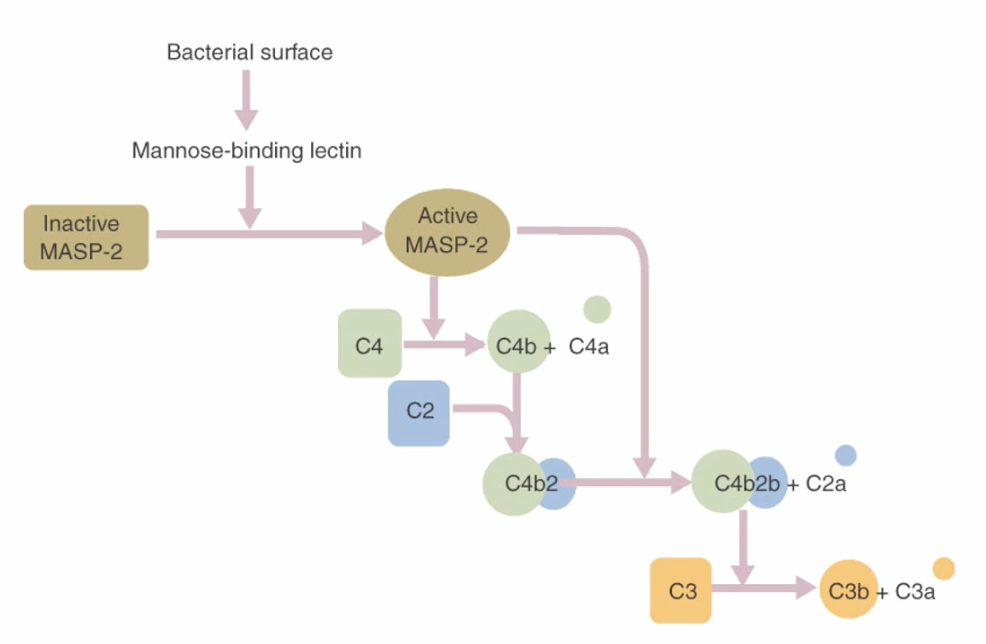
How does the MB-lectin pathway activate the complement system?
mannose-binding lectin binds to surface of a bacterial surface
activated mannose-binding lectin then binds to MASP-2 proteins and activates them
active MASP-2 binds to C4 and converts it to C4b
C4b binds to C2 to form C4b2 (C3 convertase)
C4b2 converts C3 to activated C3b which forms the membrane attack complex
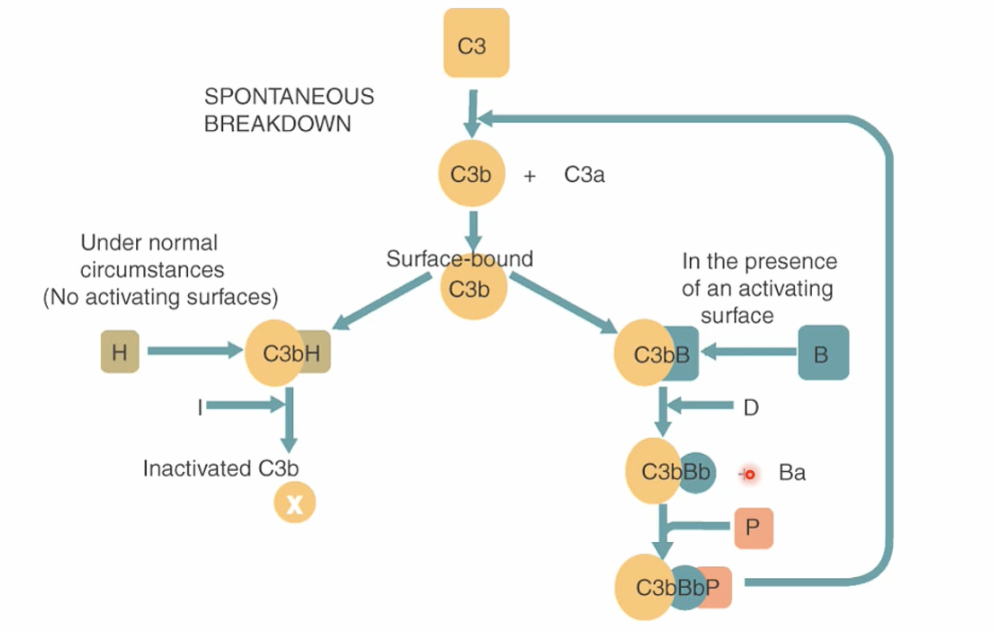
How does the alternative pathway activate the complement system?
C3 activates spontaneously by spontaneously breaking down to C3b
C3b binds to surface membranes and if it binds to an activating surface containing Bb, it activates C5 and forms the membrane attack complex
factor H binds to C3 to inactivate it and prevent it from building up on surfaces to act as a negative feedback mechanism
Which complement activation pathway is dominant in the body?
alternative
Where is C3 produced?
by macrophages in the liver
Which 2 things are formed when C3 is activated?
C3a and C3b
What are the roles of C3b?
to bind to pathogen surfaces via carbohydrates and opsonise them or remove immune complexes
to bind to factor H on host cells to be removed from circulation
What are the roles of C3a and C5a?
to act as an anaphylatoxin or a chemoattractant:
peptide mediators of inflammation
phagocyte recruitment
How does the complement system trigger phagocytosis?
lots of C3b and C4b molecules bound to a pathogen surface are recognised by phagocytes
opsonisation of pathogens via the system make phagocytosis more efficient
How do C3a, C4a and C5a trigger inflammation?
smooth muscle contraction
mast cell degranulation
increased vasodilation which causes local oedema, cell extravasation (WBCs moving into tissues), local influxes of antibodies and complement proteins
neutrophil activation
What are C3a, C4a and C5a?
anaphylatoxins
What is the Membrane Attack Complex (MAC)?
a central effector mechanism of the complement system and innate immune response which punches holes in membranes to destroy pathogens or infected cells
What is the effect of the MAC punching holes in cell membranes?
dramatic loss of cellular homeostasis
disrupts proton gradient which affects signalling
penetrates host lysozymes and other proteases
What is Canine C3 Deficiency?
a recessive genetic disorder in which affected dog’s immune sytems are unable to produce C3, causing severe immunodeficiency and a very poor prognosis
What is the effect of having no circulating C3?
reduced pathogen opsonisation due to reduced C3b
reduced inflammatory response due to less C3a and C5a
impaired antibody response due to less C3d signalling
What is Porcine Factor H deficiency?
an autosomal recessive genetic disorder in pigs which causes them to have no factor H, meaning that activation of C3 in the complement system is unregulated so C3 fragments accumulate in the kidneys and cause fatal renal failure
What are the 3 main diseases that affect the complement system?
canine C3 deficiency
porcine factor H deficiency
lupus
What is lupus?
an autoimmune disease in which immune complexes form and accumulate within tissues and then activate the complement system which causes inflammation and damage to these tissues
persistent complement activation can cause depletion of circulating C3 and C4 which suppresses the immune system
What are the 2 major forms of Lupus?
cutaneous lupus erythematosus (primarily affects skin)
systemic lupus erythematosus (affects multiple organs and tissues)
How does canine C3 deficiency affect the complement system?
lack of C3 affects all 3 activation pathways and causes infection due to no complement system activation
How does porcine factor H deficiency affect the complement system?
missing factor H mostly affects the alternative complement activation pathway by not regulating C3 activation which causes excessive consumption of C3 leading to tissue damage and an impaired immune response
How does lupus affect the complement system?
autoantibody production disrupts the classical complement activation pathway by triggering excessive activation and consumption of C3 leading to tissue damage and impaired immune response