AP Chemistry: Bonding (sec 1) and Gas Laws (sec 2)
 Call Kai
 Learn
 Practice Test
 Spaced Repetition
 Match
 Flashcards
 Knowt Play
1/59

Earn XP
Description and Tags
made w ai
60 Terms
What are the three primary types of chemical bonds, and what determines which type forms?
The three primary types are ionic, metallic, and covalent bonds. Differences in electronegativity between the bonded atoms determine the bond type.
How is an ionic bond formed, and between what types of elements does it typically occur?
An ionic bond involves the transfer of electrons between atoms so each achieves a noble gas electron configuration (full valence shell). It typically occurs between a metal and a nonmetal.
What is a formula unit in the context of ionic compounds?
A formula unit is the lowest whole-number ratio of ions in an ionic compound (e.g., NaCl or MgCl2).
State Coulomb's Law in the context of ionic bond strength and describe how charge magnitude and distance affect the electrostatic force.
F=r2kq1q2. The force of attraction is directly proportional to the magnitude of the charges (q1,q2) and inversely proportional to the square of the distance between them (r). Greater charges and smaller ionic radii produce stronger attraction.
What is lattice energy, and how do ion size and charge influence its magnitude?
Lattice energy is the energy change when separated gaseous ions pack together to form an ionic solid (or the energy needed to separate the ions). Greater ionic charges and smaller ionic sizes result in higher lattice energy and stronger bonds.
What physical properties characterize ionic compounds, and why are they brittle?
Ionic compounds have high melting and boiling points, form crystal lattices, dissolve in water with dissociation, and conduct electricity when molten or aqueous. They are brittle because an applied force shifts like-charged ions adjacent to one another, causing strong repulsive forces that shatter the crystal.
How does the 'sea of electrons' model explain metallic bonding and the properties of metals?
Metallic bonding is the attraction of free-floating valence electrons for positively charged metal cations. Because valence electrons are mobile and allow metal cations to slide past one another like grease, metals are malleable, ductile, and conductive.
What is an alloy?
An alloy is a mixture of two or more elements with at least one being a metal, formed by melting and cooling.
What are the seven homonuclear diatomic molecules listed in the lecture?
H2, N2, O2, F2, Cl2, Br2, and I2.
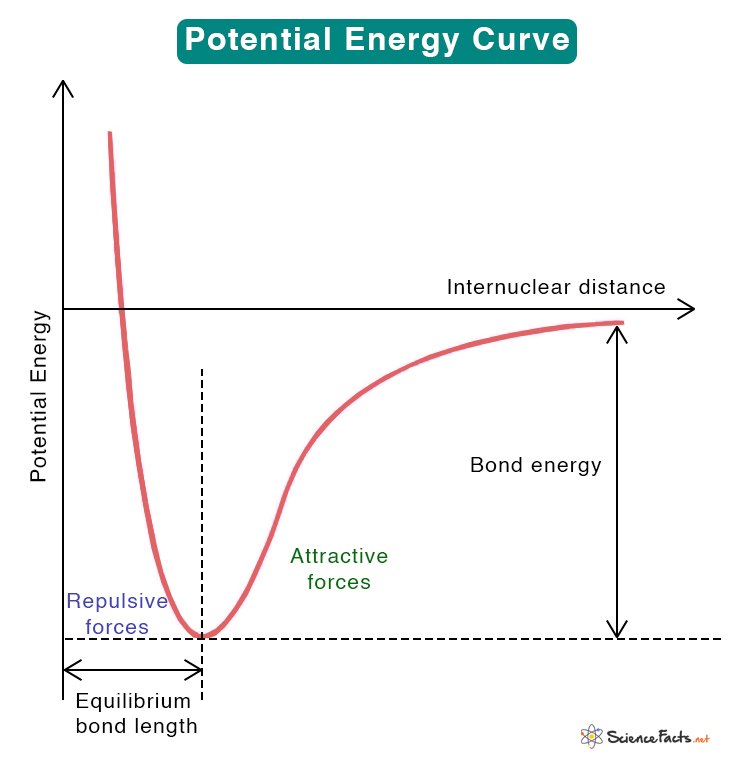
In a potential energy diagram of two approaching atoms, what does the minimum energy point represent?
The minimum energy point represents the bond length and bond energy, where attractive forces (protons to electrons) maximally offset repulsive forces (electron-electron and proton-proton repulsions).
How does increasing the number of shared electron pairs between two atoms affect bond length and bond strength?
As the number of shared electron pairs increases (single to double to triple), bond length decreases (bonds become shorter) and bond strength increases because more electrons between the nuclei decrease nuclear repulsion and increase nucleus-electron attraction.
What are network solids, and what are three examples cited in the notes?
Network solids are very stable structures in which all atoms are covalently bonded to each other in a continuous lattice, resulting in melting points of 1000∘C or higher. Examples include diamond, SiO2, and SiC.
What is the difference between dissolving and dissociation when comparing covalent and ionic compounds in water?
Ionic compounds dissociate into separate charged ions when dissolved in water, allowing them to conduct electricity. Covalent compounds (such as sucrose, C12H22O11) may dissolve as intact neutral molecules but do not dissociate into ions.
According to the 'HONC 1234' mnemonic, how many covalent bonds do Hydrogen, Oxygen, Nitrogen, and Carbon typically form?
Hydrogen typically forms 1 bond, Oxygen forms 2 bonds, Nitrogen forms 3 bonds, and Carbon forms 4 bonds.
Which elements are common exceptions to the octet rule that are satisfied with fewer than eight valence electrons?
H is satisfied with 2 electrons, Be is generally satisfied with 4 valence electrons, B is generally satisfied with 6 valence electrons, and N can be satisfied with 7 valence electrons.
Why can elements in Period 3 or higher expand their valence shell beyond eight electrons?
Elements in the third period or higher have accessible, empty d-orbitals in their valence shell that can accommodate additional electrons.
What are resonance structures, and what do experimental measurements reveal about their actual bond lengths and strengths?
Resonance structures occur when more than one valid Lewis dot structure can be drawn for a substance. Experiments show that molecules with resonance have identical, intermediate bond lengths and strengths rather than alternating distinct bonds.
How is the overall molecular bond order calculated for a molecule with resonance?
Total the number of individual bonds across all bonding positions and divide by the number of bonding groups (attached outer atoms).
What is the formula for formal charge on resonance structures?
(Number of valence electrons in that atom) — (number of nonbonding electrons) — (number of bonds)
What criteria determine the most favored Lewis structure using formal charges?
The structure with formal charges closest to zero (lowest sum of absolute values of FC).
Any negative formal charges should reside on the most electronegative atom(s).
What are the electronegativity difference ranges used to classify nonpolar covalent, polar covalent, and ionic bonds?
Nonpolar covalent: 0.0 to 0.4
Polar covalent: 0.5 to 2.0
Ionic: >2.0
Why is CO2 nonpolar while H2O is polar, despite both having polar covalent bonds?
CO2 is linear and symmetrical, causing the opposing bond dipoles to cancel each other out. H2O has a bent, asymmetrical geometry (with two lone pairs on oxygen), causing its bond dipoles to combine into a net dipole moment.
How is reaction enthalpy (ΔHrxn) estimated using average bond energies?
ΔHrxn=∑(energies of bonds broken)−∑(energies of bonds formed)
What is the fundamental premise of VSEPR theory, and how do lone pair repulsions compare to bonding pair repulsions?
Valence shell electron pairs repel one another and arrange themselves as far apart as possible in three-dimensional space. Lone pairs are held closer to the central nucleus and exert stronger repulsions than bonding pairs, compressing the bond angles.

Identify the molecular geometry, VSEPR notation, and bond angle of this molecule.
Trigonal pyramidal geometry, VSEPR type AB3E, with a bond angle of approximately 107.3∘.
What is the molecular geometry and bond angle for a central atom with 2 bonding pairs and 2 lone pairs (AB2E2)?
Bent (or angular), with a bond angle of approximately 104.5∘ (e.g., H2O).
What molecular geometries arise from a trigonal bipyramidal electron domain geometry (5 total electron pairs)?
0 lone pairs (AB5): Trigonal bipyramidal (90∘/120∘)
1 lone pair (AB4E): Seesaw (90∘/120∘/180∘)
2 lone pairs (AB3E2): T-shaped (90∘/180∘)
3 lone pairs (AB2E3): Linear (180∘)
What hybrid orbital set corresponds to each of the five electron domain geometries: linear, trigonal planar, tetrahedral, trigonal bipyramidal, and octahedral?
Linear (2 domains): sp
Trigonal planar (3 domains): sp2
Tetrahedral (4 domains): sp3
Trigonal bipyramidal (5 domains): sp3d
Octahedral (6 domains): sp3d2
How many sigma (σ) and pi (π) bonds are found in a single, a double, and a triple bond?
Single bond: 1σ bond
Double bond: 1σ bond and 1π bond
Triple bond: 1σ bond and 2π bonds
What are the four main assumptions of the Kinetic Molecular Theory (KMT) of gases?
Gas particles are in constant, random motion.
Collisions between particles are perfectly elastic and particles exert no attractive or repulsive forces on each other.
The volume of individual gas particles is negligible compared to the total volume.
The average kinetic energy of gas particles is directly proportional to the absolute temperature in Kelvin.
What device measures atmospheric pressure, and who invented it?
A barometer, invented by Evangelista Torricelli.

How do you calculate gas pressure (Pgas) using an open-ended manometer when the fluid level is (a) higher in the open arm or (b) higher in the gas arm?
When gas pressure is greater than atmospheric pressure: Pgas=Patm+h
When gas pressure is less than atmospheric pressure: Pgas=Patm−h
What are the standard conversion equivalents for 1atm of pressure across different units?
1atm=760mmHg=760torr=101.3kPa=101,325Pa
State Boyle's Law, give its mathematical formula, and state the required constant condition.
At constant temperature, the volume of a gas is inversely proportional to its pressure: P1V1=P2V2 (or PV=k).
State Charles' Law, give its formula, and specify why temperatures must be in Kelvin.
At constant pressure, gas volume is directly proportional to its absolute temperature: T1V1=T2V2. Temperature must be in Kelvin because Celsius temperatures could lead to a value of zero in the denominator or negative volumes.
State Gay-Lussac's Law and its formula, and explain why heating an aerosol can is hazardous.
At constant volume, the pressure of a gas is directly proportional to its Kelvin temperature: T1P1=T2P2. Heating an aerosol can increases the kinetic energy and collision force of the gas particles, dramatically increasing internal pressure until the can ruptures or explodes.
State Avogadro's Law and its mathematical relationship.
At constant temperature and pressure, the volume of a gas is directly proportional to the number of moles (n) of gas: n1V1=n2V2.
What is the Combined Gas Law equation?
n1T1P1V1=n2T2P2V2 (or T1P1V1=T2P2V2 if the number of moles n is held constant).
What is the Ideal Gas Law equation, and what value of R is used when pressure is in atmospheres?
PV=nRT, where R=0.082L⋅atm/(K⋅mol).
Under what specific conditions do real gases behave most like ideal gases, and why?
Real gases behave most ideally at low pressures and high temperatures. High temperatures provide sufficient kinetic energy to overcome intermolecular attractions, and low pressures mean the gas particles are spread far apart, making their individual molecular volumes negligible relative to the container.
What are the rearranged forms of the Ideal Gas Law used to find molar mass (MM) and gas density (d)?
Molar Mass: MM=PVgRT or MM=PdRT
Density: d=RTMM⋅P
How does the Van der Waals equation modify the Ideal Gas Law to correct for real gas behavior?
[P+a(Vn)2](V−nb)=nRT. The term a(Vn)2 adds pressure because intermolecular attractions reduce observed collision force with the walls. The term nb subtracts the actual physical volume occupied by the gas molecules from the container volume.
State Dalton's Law of Partial Pressures and the mole fraction relationship.
The total pressure of a gas mixture is the sum of the partial pressures of all component gases: PTotal=P1+P2+P3+⋯+Pn. The partial pressure of a gas is directly proportional to its mole fraction: PTotalP1=nTotaln1.
When collecting a gas over water (water displacement), how is the dry gas pressure (Pgas) determined?
Subtract the water vapor pressure at that temperature from the total barometric pressure: Pgas=PTotal−PH2O.
Distinguish between gas diffusion and effusion.
Diffusion is the gradual spreading of gas molecules through a space until they are evenly distributed. Effusion is the passage of gas molecules through a tiny pinhole or opening from a container into an evacuated space.
State Graham's Law of Effusion/Diffusion and its mathematical formula.
The rate of effusion or diffusion (r) of a gas is inversely proportional to the square root of its molar mass (MM): r2r1=MM1MM2 Gases with lower molar mass effuse faster.

How does molar mass influence the molecular speed distribution of gases at a constant temperature according to this Maxwell-Boltzmann distribution?
Lighter gases (lower molar mass, such as H2 and He) have higher average speeds and a broader, flatter speed distribution, whereas heavier gases (such as O2) have lower average speeds and a narrower, taller peak.

How does increasing temperature affect the distribution of molecular speeds for a given gas?
As temperature increases, the average speed shifts toward higher velocities, the peak flattens, and the distribution spreads over a wider range of speeds.
What is the relationship between temperature, average kinetic energy, and velocity for different gases at the same temperature?
Average kinetic energy depends solely on Kelvin temperature (KE=21mv2 directly proportional to T); thus, all gases at the same temperature have the identical average kinetic energy. However, lighter molecules must travel at higher velocities to have the same kinetic energy as heavier molecules. (*Note that AVERAGE kinetic energy = temp)
Standard Temperature and Pressure (STP)
A reference baseline defined as a temperature of 0∘C (273.15K) and a pressure of 1atm, under which one mole of any ideal gas occupies 22.4dm3.
Kinetic molecular explanation of Boyle's Law
Decreasing container volume crowds gas particles into less space, causing them to collide with container walls more frequently, which increases the measured pressure.
Kinetic molecular explanation of Charles's Law
Increasing temperature increases the average kinetic energy and velocity of gas particles, causing them to collide with container walls with greater force and frequency, expanding a flexible container to maintain constant pressure.
Kinetic molecular explanation of Gay-Lussac's Law
Increasing temperature raises particle speed and the force of impacts against rigid, fixed-volume container walls, directly increasing internal pressure.
Energetics of chemical bond breaking versus bond formation
Breaking chemical bonds is always endothermic (requires an input of energy), whereas forming chemical bonds is always exothermic (releases energy).
Root-mean-square speed of gas particles
A single representative value that quantifies the average velocity of gas particles in a sample, which increases with higher temperature and decreases with higher molar mass.
What is the difference between electronic domain geometry versus molecular geometry?
Electronic domain doesn’t distinguish between lone pairs and bonded electrons and focuses on “things attached.” Electronic domain only uses “linear, trigonal planar, tetrahedral, trigonal pyramidal, and octahedral.”
Orbital hybridization in methane (CH4)
The central carbon atom mixes one 2s orbital and three 2p orbitals to form four degenerate sp3 hybrid orbitals of equal shape and intermediate energy, allowing four identical covalent bonds.
General hybridization associated with single, double, and triple bonds on a carbon atom
A carbon atom with four single bonds exhibits sp3 hybridization; one with a double bond exhibits sp2 hybridization; one with a triple bond (or two double bonds) exhibits sp hybridization.
Guidelines for selecting the central atom when drawing molecular Lewis structures
Place carbon or nitrogen in the center if present; otherwise, select the least electronegative element (frequently the element with the lowest subscript in the formula), keeping hydrogen strictly terminal.
What is a physical reason why solid ionic compounds cannot conduct electricity?
Ions are held rigidly within fixed crystal lattice positions and cannot migrate to transport electric charge; electrical conductivity requires mobile charge carriers available only when molten or dissolved in aqueous solution.