15 Constant Allele Frequencies
 Call Kai
 Learn
 Practice Test
 Spaced Repetition
 Match
 Flashcards
 Knowt Play
1/30

Earn XP
Description and Tags
Vocabulary practice flashcards covering population genetics concepts, Hardy-Weinberg equilibrium equations, carrier frequencies, and DNA profiling techniques from Chapter 14.
31 Terms
genotype
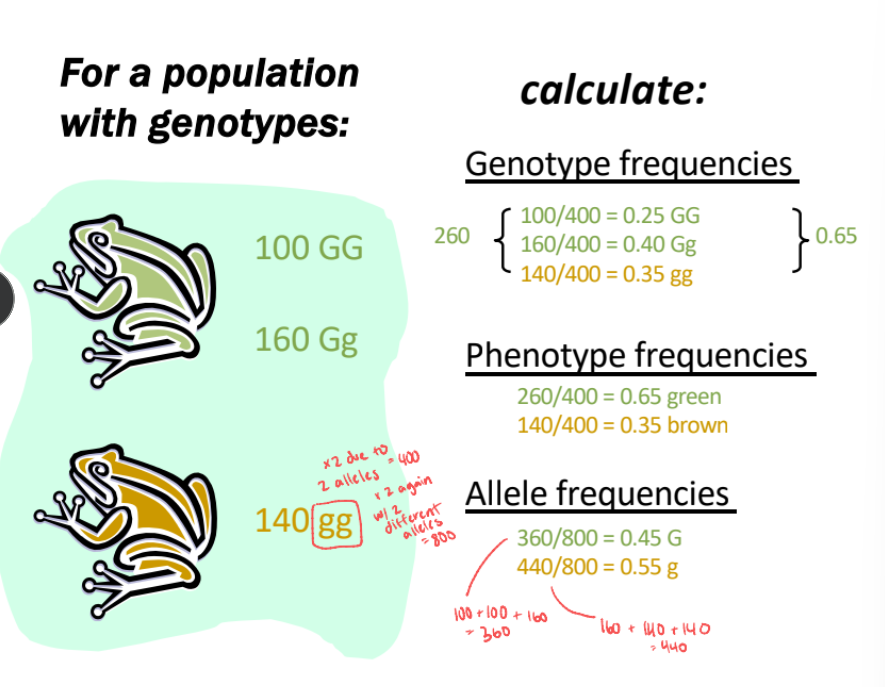
Population genetics is the study of genetic variation within populations, consist of the frequencies of the allele, ? , and phenotype.
Population
A group of organisms that belong to the same species, live in a defined geographical area, and potentially interbreed.
Gene pool
The total genetic information and alleles carried by the members of a population.
Mule
A sterile hybrid offspring resulting from a cross between a horse and a donkey that cannot produce viable offspring with other mules.
Allele frequency
is the frequency with which a particular allele of a gene is present in a population.
Genotype frequency
The proportion of each genotype present in a population.
Phenotype frequency
The number or proportion of individuals exhibiting a specific physical phenotype in a population.
Microevolution
Small genetic changes and variations within a group driven by changes in allele frequencies.
Macroevolution
Large-scale genetic changes occurring in a population over millions of years.
Five factors changing genotype frequencies
The five evolutionary mechanisms that alter genotype frequencies: non-random mating, migration, genetic drift, mutation, and natural selection.
Hardy-Weinberg law
A principle that uses algebra to explain how allele frequencies predict genotype and phenotype frequencies in diploid, sexually reproducing populations.
Hardy-Weinberg equilibrium
A state in which genetic variation remains constant because none of the five disruptive evolutionary factors are occurring in a population.
p
The variable in the Hardy-Weinberg equation that represents the frequency of the normal or dominant allele in a population.
q
The variable in the Hardy-Weinberg equation that represents the frequency of the recessive allele in a population.
p2
The term in the Hardy-Weinberg equation representing the genotype frequency or percentage of homozygous dominant individuals in a population.
q2
The term in the Hardy-Weinberg equation representing the genotype frequency or percentage of homozygous recessive individuals in a population.
2pq
The term in the Hardy-Weinberg equation representing the genotype frequency or percentage of heterozygous individuals in a population.
Heterozygous carrier
An individual with one dominant and one recessive allele who serves as a reservoir for a recessive allele without expressing the recessive phenotype.
X-linked traits in males
Inherited conditions on the X chromosome where a male's phenotype frequency directly equals the allele frequency (q=q2) because males possess only a single X chromosome.

DNA profiling
A method that examines unique patterns within an individual's DNA to identify them or compare forensic evidence to suspects.
Short tandem repeats (STRs)
Repeated segments of DNA ranging from 2 to 10 repeats in length that are distributed across the genome and treated as alleles for profiling.
Variable number of tandem repeats (VNTRs)
Segments of repeated DNA ranging from 10 to 80 repeats that are utilized in genetic profiling.
Non-coding regions
Regions of the human genome that do not code for genes or proteins, containing the majority of variations used in DNA profiling.
Electrophoresis
A laboratory procedure in which negatively charged DNA fragments migrate through a gel toward a positive charge, separating by size so that larger fragments move slower and remain near the top.
Combined DNA Index System (CODIS)
An FBI DNA database launched in October 1988 connecting all 50 states that utilizes 13 short tandem repeat loci to identify suspects and link crimes.
Mitochondrial DNA
A type of DNA used in forensic identification when biological evidence samples are extremely damaged and nuclear DNA is insufficient.
phenotype
evolutionary
allele frequency can change throughout generations and cause changes in ? frequency and ? change

Necessary Conditions for Hardy-Weinberg Equilibrium
– No new mutations
– No migration in or out of population
– No natural selection
– Random Mating
– Very large population
t/f: the number of copies of repeats in DNA profiling is an allele and could for heterozygous or homozygous
t

slower
faster
more copies of repeats are larger and have ? migration speeds on a gel; less copies are smaller and have ? migration speeds on a gel.
