exam 2
 Call Kai
 Learn
 Practice Test
 Spaced Repetition
 Match
 Flashcards
 Knowt Play
1/75

There's no tags or description
Looks like no tags are added yet.
76 Terms
minimum and maximum for bacterial growth
the lowest or highest temperature at which a microbe can grow
psychrophiles
like to grow in cold lower than 15c
mesophiles
like to grow in warm 20-45c
thermophiles
like to grow in hot temp 45-80c
hyperthermophiles
very hot temp more than 80c
acidophile
low ph
neutrophile
mid pH 5-8
alkaliphile
high pH
halophile
salty (ex ocean)
extreme halophile
very salty
Vibrio cholerae
Halophile that prefers to grow at [NaCl] = 1-3%
NQR couples the redox reaction to
generation of a sodium (Na+) motive
force rather than a proton motive force
The sodium motive force powers the
flagellum and amino acid transporters,
which are necessary for V. cholera
pathogenesis
where does fermentation occur?
redox reactions occur in the CYTOPLASM not membrane
where does ATP generation occur in fermentation
cytoplasm via substrate phosphorylation - not via ATP synthase activity
is there a terminal electron acceptor in fermentation
NO - the cell must use one of its metabolites as an electron acceptor and then excrete it as a waste product
linear structure fermentation
1 substrate and 1 product
1 reaction turning NAD+ to NADH, 1 reaction turning NADH to NAD+
branched structure fermentation
1 substrate , 2 different products
sometimes making NAD+ to NADH and sometimes making NADH to NAD+
Y and Z are waste products
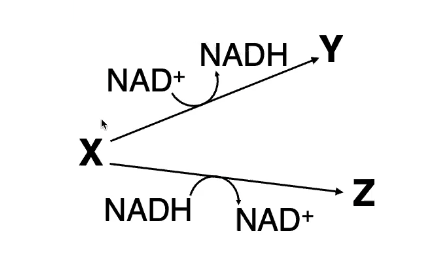
two substrate structure fermentation
2 substrate , 2 products

ex of linear fermentation
lactic acid fermentation (yogurt)
start with glucose (carbon source)
glycolysis (2NADH and 2ATP)
results in pyruvate
pyruvate gets reduced puts 2 NADH (NADH turns into NAD+)
generates 2 lactate (lactate gets excreted)
ethanol fermentation (beer)
only difference is adding 2 acetaldehyde to convert NADH to NAD+
branched fermentation example
lactic acid fermentation (pickling)
glucose - pentose phosphate pathway
glucose gets converted to xylose-5-P (this process consumes ATP)
xylose-5-p gets split into glyceralhyde-3-p and acetyl-p
one side makes ATP, one side regenerates NAD+

two substrate fermentation example
stickland amino acid fermentation
commonly used for clostridia
start with alanine convert to pyruvate oxidize pyruvate to acetyl-coA convert acetyl-CoA to acetyl-P and gets converted to acetate to make ATP
2 glycine reduce to 2 acetyl-p by adding 2 NADH
2 acetyl-P to 2 acetate (2ADP —> 2 ATP)
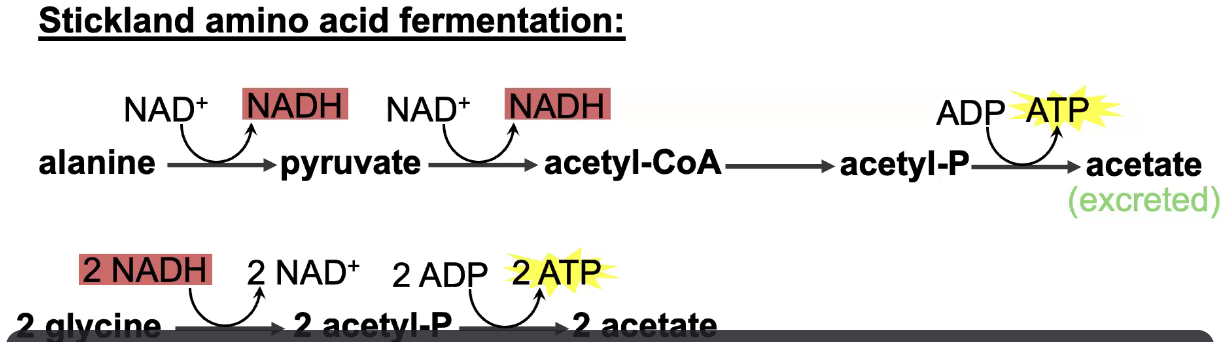
what are the electron acceptors for fermenters
organic compounds (can alter the environment)
what can excreting high concentrations of organic compound affect
local environment, affecting nearby microbes and host cells
what does fermenters are typically specialist means?
fermenters typically perform a limited number of fermentation pathways
ex “never going to convince lactobacillus to make ethanol / beer”
speed of fermentation
fermentation is a fast metabolism meaning they can alter their environment quickly
fermentation in the gut
SHORT CHAIN FATTY ACID
fatty acid - carboxylic acid with a hydrocarbon chain
ex- butyrate
linear pathway
substrate level phosphorylation
what molecule being oxidized in fermentation
something that is generating NADH
production of NADH - molecule before that is being oxidized
what molecule is being reduced in fermentation
anytime a molecule is consuming NADH, the molecule before that is being reduced
benefits of butyrate
the butyrate made by bacteria in out gut accounts for 5-15% of the total calories that our bodies use
butyrate is the preferred carbon sourced used by the cells that line the colon
butyrate is though to play other important roles in modulating appetite/weight and reducing inflammation
what happens to the gut environment if the coloncytes run out of butyrate?
inflammation in the gut/fermentation metabolism stops switches over to aerobic respiration
low butyrate —> low rates of respiration by colonocytes —> O2 levels increase in the gut (when it usually has low levels when healthy) —> O2 availability allows facultative anaerobes to outcompete fermenters —> facultative anaerobes promote inflammation in the gut
what one way to avoid unhealthy, inflamed gut
eating fiber, fiber supports the growth of the fermenters that generate butyrate
lactate in the mouth fermentation
lactate accumulation will acidify the environment
lactate accumulation in the mouth is thought to contribute to cavities (the acid that can demineralize tooth enamel)
more lactate, lower PH
lactate in the vagina fermentation
host epithelial cells secrete glycogen (complex glucose polymer)
this helps to select for lactobacillus which use a glycogen-degrading enzyme (PulA) to release glucose and ferment the glucose to form lactate
drops the PH
acidic environment helps inhibit the growth of bad microbes
are different fermentation pathways considered good or bad
No they aren’t considered good or bad. the same pathway conducted in different parts of the body can be either beneficial or detrimental to human health
how is fermentation making PMF
use ATP synthase enzyme in reverse
-hydrolyze atp (break it down)
using the energy from breaking down ATP to move protons outside the cell
obligate aerobe
tolerate O2
grows via aerobic respiration
does NOT grown in the absence of O2
facultative anaerobe
tolerate O2
grows via aerobic respiration
grows in the absence of O2
grows by aerobic respiration, anaerobic respiration and fermentation
aerotolerent aerobe
tolerates O2
does NOT grow via aerobic respiration
grows in the absence of O2
grows anaerobic respiration of fermentation
obligate anaerobe
an organism whose growth is inhibited or killed by O2
does NOT tolerate O2
does NOT grow via aerobic respiration
grows in absence of O2
anaerobic respiration or fermentation
ETC terminology energy by light
photo
ETC terminology energy by chemicals (organic or inorganic)
hetero
ETC terminology electron donor by inorganic compounds (H2,H2S, FE2+, NH4+ etc)
litho
ETC terminology electron donor by organic compounds (glucose, amino acids, fatty acids etc)
organo
ETC terminology carbon source by CO2 (inorganic)
auto
ETC terminology electron donor by organic (glucose, amino acids, fatty acids
organo
How H₂ oxidation works
H₂ is oxidized by hydrogenase
Electrons reduce quinone to quinol (QH₂)
QH₂ transfers electrons to a terminal reductase
Electron transfer contributes to PMF and energy conservation
reverse electron flow purpose
Produce NAD(P)H for biosynthesis.
Electrons leave the reaction center and ultimately reduce NAD(P)⁺.
The key difference is that the electrons do not return to the reaction center.
where does the reaction center get replacement electrons?
An external electron donor, such as H₂ or H₂S.
Purple phototrophs
Feature | Purple phototrophs | |
|---|---|---|
Reaction center | P870 | |
Carrier in electron flow | Quinone | |
Cyclic flow | Generates PMF via bc₁ | |
Noncyclic flow | Uses reverse electron flow to generate NADH | |
Need replacement electron donor? | Yes, during noncyclic flow | |
Produces O₂? | No |
Green phototrophs
Feature | Green phototrophs | |
|---|---|---|
Reaction center | P840 | |
Carrier in electron flow | Ferredoxin, then quinone for cyclic flow | |
Cyclic flow | Generates PMF via bc₁ | |
Noncyclic flow | Can reduce NAD(P)⁺ through ferredoxin and NAD(P)⁺ oxidoreductase | |
Need replacement electron donor? | Yes, during noncyclic flow | |
Produces O₂? | No |
difference between purple and green phototrophs
Purple phototrophs need reverse electron flow to make NADH in the pathway . Green phototrophs can use electrons from reduced ferredoxin to make NAD(P)H without reverse electron flow.
Oxygenic phototrophy
the process of using light as an energy source to convert CO2 and water to sugar, releasing O2 as a byproduct
anoxygenic photrophy
the process by using light as an energy source, where o2 is not generated as a by product
ex purple and green phototrophs
the reaction center purple bacteria
ETC proteins binds bacteriochlorophyll a and numerous other cofactors
chlorophylls help collect light energy and the other cofactors are all involved in redox reactions as usual
purple bacteria cyclic electron flow
light shines on the reaction center
this excites electron to a high energy state
the reaction center gives electrons to quinone
reduced quinone gives election to a cytochrome via bc1 complex, the bc1 complex generates PMF during this reaction
reduced cytochrome returns the electrons to the reaction center to complete the cycle
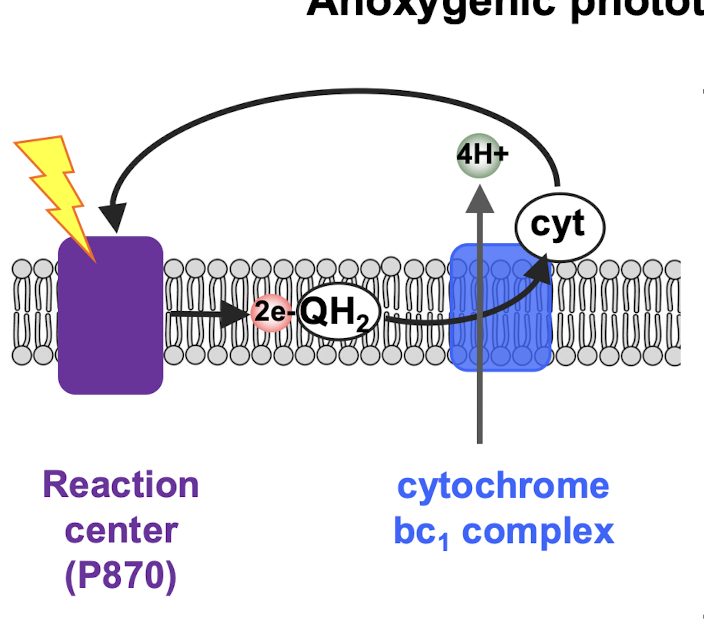
purple bacteria non cyclic electron flow
electrons from the light excited reaction center are passed to quinone
quinone carries electrons to NADH dehydrogenase to make NADH (via reverse electron flow) for anabolism
an electron donor (ex H2) then reduced the reaction center

green bacteria cyclic electron flow
light shines on the reaction center which excites electrons to a high energy state
reaction center gives electrons to ferredoxin (Fd) which is an Fe-S cluster containing protein that searches as an electron carrier
reduced Fd gives electrons to quinone
reduced quinone gives electrons to cytochrome via the bc1 complex
the bc1 complex generates PMF during this reaction
reduced cytochrome return electrons to the reaction center to complete the cycle
green bacteria non-cyclic electron flow
ferredoxin can pass electrons directly to NAD+ or NADP+ via the enzyme NAD(P)+ oxidoreductase.
this is an energetically favorable redox reaction
green phototrophs do NOT need to use reverse electron flow to make NADH
similar to purple phototrophs, green phototrophs require an electron donor (H2, H2S) to give electrons to the reaction center whenever the cell does not make non-cyclic electron flow for making NADH
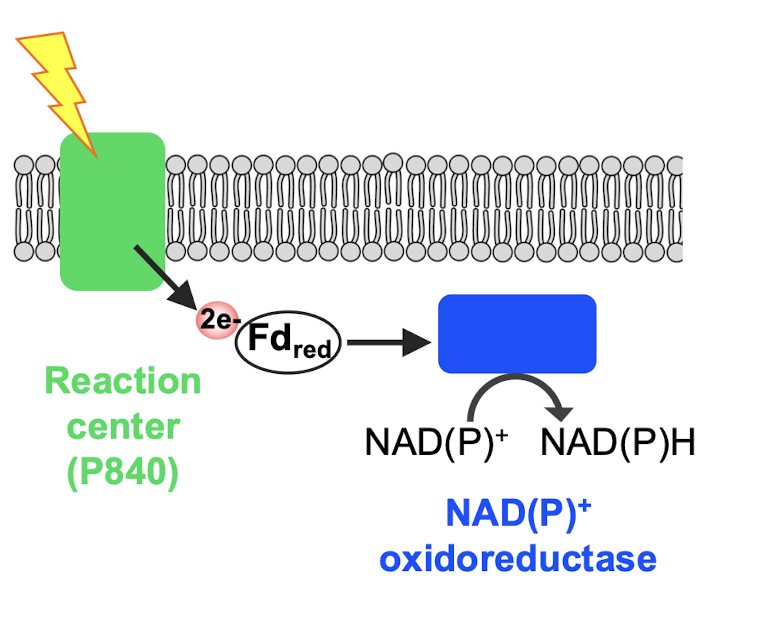
oxygenic phototrophy mechanism
combining machinery of green and purple phototrophs
starts with non-cyclic electron transfer in green phototrophs
reduced cytochrome will carry electrons to green reaction center
cyclic electron transfer in purple phototrophs
purple reaction center evolves to use water as an electron donor which generates O2

what commonly supplies energy for reverse electron flow
PMF
all ATP is generated via substrate level phosphorylation
fermentation
PMF drives ATP synthesis
respiration
ethanol excretion inhibits the growth of other microbes
fermentation
PMF is generated via ATP hydrolysis
fermentation
redox balence is achieved when a membrane-bound oxidase donates electrons to a terminal electron acceptor
respiration
R. spheroids was grown under shaking toxic conditions in the dark with glucose supplied in the growth medium
chemo-organ-heterotroph
r.sphaeroides was grown under anaerobic conditions in from of a light source, sealed in a canister with a gas pack that generates CO2 and H2
photo-litho-autotroph
rhodobactor sphaeroides is used to generate biofuels. to do so, it is won in front of a light source in a medium hydrolyzed corn husks, which is rich in sugars and amino acids
photo-organo-hetrotroph
Stickland fermentation
Stickland fermentation is a type of fermentation where bacteria use two amino acids: one gets oxidized, and the other gets reduced.
The main purpose is to produce energy (ATP) while maintaining redox balance.
Step 1: Alanine gets oxidized
Alanine loses electrons, which can be transferred to NAD⁺.
Step 2: Glycine gets reduced
The bacterium needs to get rid of the excess electrons stored in NADH.
Glycine acts as an electron acceptor.
NAD⁺ is regenerated so metabolism can continue.
Oxygenic phototroph example bacteria
cyanobacteria, use water as their electron donor and release O₂.
main issue with green sulfur bacteria during cyclic electron flow
they can produce ATP, but they don't produce net NADPH or reduced ferredoxin for biosynthesis.
solution - Noncyclic flow with an external donor