FOR3445 Pt. 2
 Call Kai
 Learn
 Practice Test
 Spaced Repetition
 Match
 Flashcards
 Knowt Play
1/36

There's no tags or description
Looks like no tags are added yet.
37 Terms
Define dispersal.
Movement of organisms away from natal place. Often confined to a particular life history stage (post juvenile) NOT RETURNING (that would be migration)
Don’t confuse with dispersion, which refers to the position of individual organisms with respect to others in the population.
To expand its range through dispersal, an organism must be able to do what?
1. Survive potentially harsh conditions during dispersal
2. Reach the new area
3. Survive and reproduce in the new area to the extent that a new population is established
What are the 3 types of dispersal events?
1. Jump dispersal
colonization of new areas over long distance
2. Diffusion
gradual spread of individuals outward from the margins of a species range
involves not just individuals, but populations
3. Secular migration
occurs much more slowly, so slow that organisms can evolve during the process
Give some examples of range expansion.
purple loosestrife in NA (invasive tend to diffuse faster than non invasives)
oaks in scotland (diffusion)
Africanized killer honey bee (brazil to central america)
armadillos (slowly expanded into carolinas)
red foxes (quickly)
fire ant (within 100 years it diffused a pretty great distance)
What is vagility? Pagility?
The terms vagility and pagility refer to the ability of organisms to disperse actively or passively.
Vagility - can disperse under it own willpower
Pagility - can only disperse passively
jump and diffusion - active or passive
secular - only passive
What is aerial plankton?
insects, spiders, and mites who disperse through the atmosphere
diaspora - big group of individuals moved from their original homeland
spiders do ballooning to get higher (like a parachute)
zones where insects are no longer capable of free flight?
What is phoresy?
organisms that employ other organisms for long distance transport. hitching a ride on something else
What are the three kinds of dispersal routes that affect biotic interchange?
1. Corridors
dispersal routes that allow movement between regions. They do not selectively discriminate against one form, but rather allow a balanced assemblage of plants and animals to cross them.
areas at either ends of a corridor should contain fairly similar organisms
2. Filters
dispersal route that exercises some selection over the types of organisms that can pass through it.
Thus, the colonists are a biased subsets of those that could pass.
3. Sweepstakes routes
The crossing of barriers by rare, chance events.
Such events, while highly unlikely in the short term, are likely, even probable, over the long term.
The got lucky/won the “sweepstakes”
Nonvolant
Non flying organisms (typically absent from island populations)
physiological barriers
created by environmental conditions which organisms (or their propagules) are unable to survive long enough for dispersal. Ex: such barriers can be presented by salt (or fresh) water or unfavorable temperatures
Diploendozoochory
when a seed consumer is eaten by a carnivore, which them deposits seed
more seedling success
resilience to climate change
movement across poor habitats
Why do birds go polewards to breed?
Birds migrate towards the poles to take advantage of favourable breeding conditions during the warmer months. There are four main reasons:
Pulse of food: There is a seasonal increase in food availability, particularly insects and budding plants.
Nesting sites: Northern regions provide suitable locations for building nests and raising young.
Lower predation risk: There may be fewer predators in northern breeding areas.
Raise more Young: Migratory birds can raise more offspring, approximately 4–6 young, compared with 2–3 for tropical resident birds.
What are some types of migration?
Short-distance migration: Birds move relatively short distances between breeding and non-breeding areas. Example: Lucy's Warbler, which moves between the southern United States and Mexico.
Altitudinal migration: Birds move to different elevations, often moving higher to breed. Example: American Dipper, which may move 2–17 km.
Long-distance migration: Birds travel very long distances between breeding and non-breeding grounds. Example: Bar-tailed Godwit, which can travel 11,690 km in nine days.
Differential migration: Different groups within a species follow different migration routes or patterns. Example: Sharp-tailed Sandpiper, where adults and juveniles have different migration routes.
What is the difference between staging and stopover sites?
Both are places where birds stop during migration to rest and refuel.
Staging site: A location where birds stop between significant flights, often building up energy reserves before continuing a long journey. (capital?)
Stopover site: A location along the migration route where birds temporarily stop to rest and replenish their fuel stores before moving towards their destination. (income)
The key distinction is that staging sites are particularly associated with preparing for major flights, whereas stopovers are temporary resting and refuelling locations along the route.
What are the three main maximized features of optimal migration?
Energy: Birds must have adequate fuel reserves to complete their migration. They may also change their body composition, including their flight muscles and digestive organs, to meet changing energy demands. (phenotypic organ flexibility)
Safety: Birds must minimize the dangers associated with migration, such as the risks encountered while travelling long distances.
Timing: Birds must decide when to depart and arrive so that they reach their breeding grounds when conditions are most favourable for reproduction.
What are the risks of arriving too early or too late?
Arriving too early: Birds may encounter snow, cold temperatures, and insufficient food, making survival and successful breeding more difficult.
Arriving too late: Birds may miss the peak availability of food and the most favourable breeding conditions, resulting in reduced reproductive success.
The ideal arrival time is when environmental conditions, food availability, and breeding opportunities are most favourable.
Describe the Mismatch Hypothesis.
The Mismatch Hypothesis proposes that the timing of migration and breeding may no longer align with the timing of favourable environmental conditions. (as a result of climate change)
For example, birds may migrate to their breeding grounds based on seasonal cues, such as day length, but climate change may cause spring temperatures and insect emergence to occur earlier. If birds arrive after the peak availability of insects, there may be insufficient food to feed their chicks, reducing reproductive success.
In simple terms: Birds arrive at the wrong time relative to the conditions they need to survive and reproduce successfully.
The key idea is that a mismatch between migration timing and environmental conditions can reduce breeding success.
What is migration?
Seasonal movements between one region and another Usually implies movements between breeding grounds and non-breeding grounds
Describe an ideal-free distribution
when animals distribute themselves among available habitats based on habitat quality.
assumptions made:
Ideal: Each animal selects the habitat best suited for its survival and reproduction.
Free: Animals can move freely between habitats and have equal access, without being restricted by territorial residents.
As high-quality habitats become crowded, their benefits decrease, encouraging other individuals to settle in lower-quality habitats. (marginal value theorem (MVT) = indicates the reward of settling in an unoccupied lower quality patch is greater than the high quality crowded patch )
Eventually, an equilibrium is reached where individuals have similar fitness across occupied habitats. WE MAY HAVE TO DRAW IT
What are the four orders of habitat selection?
REGION - First-order selection: Selection of a geographic range or general area in which a species lives.
PATCH MOSAIC - Second-order selection: Selection of a home range within that geographic area.
HABITAT PATCH - Third-order selection: Selection of specific habitat components or patches within an individual's home range.
RESOURCE PATCH - Fourth-order selection: Selection of specific resources, such as food items or feeding sites, within a habitat.
What are some types of information cues used in habitat selection?
Inadvertent Social Information…
—- Location cues: Information provided by the presence or location of other individuals. For example, seeing other birds occupying a particular habitat may encourage another bird to settle there. (SHORT LIVED, NON COLONIAL, SYNCHRONUS (all one life stage so you cant know reproductive success))
—- Public information (PI): Information about the reproductive success of other individuals at a particular location. (how well are they doing at that place?) For example, birds may choose a nesting site where other birds have successfully reproduced. (DELAYED, COLONIAL, ASYNCHRONOUS (different stages of life))

When do most birds prospect for territories?
Many birds prospect for territories during the post-breeding season, after the breeding period has ended.
They explore potential territories and gather information about habitat quality and territory ownership before the next breeding season.
Why do birds prosect for territories after breeding season then?
Birds prospect during the post-breeding season because it allows them to gather information about potential breeding sites before they need to establish a territory.
IF THEY DID IT DURING THE SEASON THEN THEY’RE WASTING THEIR TIME MESSING AROUND
This is particularly useful because:
They can identify potentially high-quality habitats.
They can observe territory ownership and occupancy.
They can gather information that helps them choose where to settle during the next breeding season.
Essentially, prospecting ahead of time helps birds make better habitat-selection decisions when it is time to breed.
What is an information cascade?
An information cascade occurs when individuals use the behaviour or decisions of other individuals as information when making their own decisions.
For example, if several birds settle in a particular habitat, other birds may interpret their presence as a sign that the habitat is suitable and decide to settle there too.
This can result in individuals following the choices of others rather than independently evaluating habitat quality. (BAD/MALADAPTIVE)
EX. BOBOLINKS GOING TO DUMMY, AND CROSSING THE STREET JUST BECAUSE ANOTHER GUY WENT
Knowledge of habitat selection allows us to…
1. Understand evolutionary processes
2. Implement efficient conservation strategies
What is a habitat? selection?
space where an organism attempts to meet the necessities of life, or an area that helps them reach such a space
selection - act of choosing (you cannot have selection without options)

Conceptual Restraint
you dont know what is there if you can’t see it
What is "game theory"?
Game theory is a branch of mathematics that studies strategies in which individuals (players) attempt to maximize their individual returns or fitness.
In behavioral ecology, it examines how individuals choose behavioral strategies to maximize their fitness when interacting or competing with other individuals.
ex. individuals may adopt an aggressive (hawk) or non-aggressive (dove) strategy when competing for limited resources.
Can hawks invade a population of doves?
Yes.
Hawks can invade a population of doves because hawks are aggressive and will always fight for and win the contested resource when encountering a dove.
Hawks receive the entire resource (R).
Doves retreat and receive nothing (0).
Hawks do not suffer injury costs when fighting doves.
Therefore, hawks have a higher fitness than doves when the population consists primarily of doves, allowing hawks to increase in frequency.
Can doves invade a population of hawks?
es.
Doves can invade a population of hawks because encounters between hawks result in fighting, which creates the possibility of injury.
Hawks fighting other hawks win only half the time.
Losing hawks suffer an injury cost (C).
Doves avoid fighting and therefore avoid injury costs.
When hawks are common, the costs of fighting other hawks can reduce their fitness. Doves can benefit from avoiding these costs, allowing them to invade when their frequency is sufficiently low.
Is there an optimal behavioural strategy in acquiring prey?
No, there is not necessarily one universally optimal strategy.
The success of a behavioural strategy depends on the frequency of other strategies within the population.
When doves are common, hawks have an advantage because they can take resources without fighting.
When hawks are common, doves can benefit because they avoid the costs of fighting other hawks.
This is an example of negative frequency-dependent selection, where a strategy becomes more advantageous when it is less common.
As a result, hawks and doves can coexist at certain frequencies because neither strategy has a permanent advantage.
What is frequency-dependent selection? How can it be positive? Negative?
Frequency-dependent selection occurs when an individual's fitness depends on the relative frequency of different phenotypes or behaviours within a population.
Positive frequency-dependent selection (majority advantage):
A phenotype becomes more successful as it becomes more common.
The majority phenotype has a fitness advantage.
This can cause one phenotype to become increasingly dominant.
Negative frequency-dependent selection (minority advantage):
A phenotype becomes more successful as it becomes less common.
The minority phenotype has a fitness advantage.
This promotes genetic and behavioural diversity because less common strategies can have higher fitness
How does frequency modify payoff?
Frequency modifies payoff because the fitness an individual receives depends on how frequently it encounters individuals using the same or a different strategy.
For example:
When hawks are common, hawks frequently encounter other hawks, increasing the likelihood of fighting and injury.
When doves are common, hawks frequently encounter doves, allowing hawks to take resources without fighting.
When hawks are rare, they have a greater advantage because most of their encounters are with doves.
Therefore, the payoff of each strategy changes as the proportion of hawks and doves in the population changes.
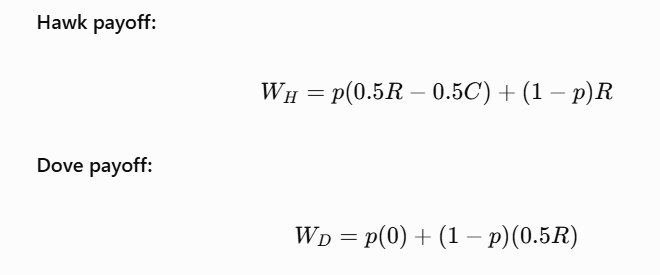
Calculate the payoff for hawks and doves using the equations.
Where:
p= relative frequency of hawks.
1-p = relative frequency of doves.
R = value of the resource.
C = cost of injury.
Breaking down the equations:
For hawks:
p(0.5R-0.5C): The probability of encountering another hawk multiplied by the average payoff of fighting another hawk.
(1-p)R: The probability of encountering a dove multiplied by the full resource payoff.
For doves:
p(0): The probability of encountering a hawk multiplied by zero, since doves retreat.
(1-p)(0.5R): The probability of encountering another dove multiplied by the average resource payoff.
Evolutionary Stable Strategy (ESS)
“a strategy that is resistant to invasion and most likely to be maintained by natural selection”
