SPA 127 chapter 3
 Call Kai
 Learn
 Practice Test
 Spaced Repetition
 Match
 Flashcards
 Knowt Play
1/86

There's no tags or description
Looks like no tags are added yet.
87 Terms
Anatomy
study of body structures and their relationships
Phsiology
Study of how organisms and body structure function
True or False: Abnormalities or diseases can interfere with eating, drinking, swallowing or talking
True
Three Physiological Subsystems of Speech
Respiratory System
Laryngeal System
Upper airway system
Respiratory System
-Moves air in/out
-Supports gas exchange, coughing, swallowing, coordination
-Provides driving force for speech production
Laryngeal System
Airway protecting valve that protects the lower airways and is a sound generator for speech
Upper airway System
Includes the pharynx (throat), velopharynx, oral cavity, and nasal cavities
Supports feeding, swallowing, resonance, and articulation
Primary Function of the respiratory system
Supply oxygen to the blood
remove excess carbon dioxide
Secondary Function of the respiratory system
Speech production
Pulmonary apparatus
consists of pulmonary airways and lungs
True or False: Pulmonary apparatus and chest wall are not linked toghether
False
Lungs
Organs of breathing: a pair of cone-shaped spongy structures that are highly elastic and can change in size and shape to allow us to breathe
Trachea
A tube composed of 16-20 horseshoe-shaped cartilages that extend from the larynx through the neck into the torso
-divides into left and right main-stem bronchi
-Successive branches terminate at alveoli(tiny air sacs were gas exchange occurs)
Ribcage wall
bone and cartilage that surround the lungs (12 pairs of ribs)
Diaphragm
Dome-shaped muscle of inspiration
Composed of a nonelastic central tendon and a rim of muscle fibers
Contracts during inspiration, pulls downward and forward, and flattens, enlarging the thorax vertically
Pulls air in due to negative pressure
Abdominal wall
Vertebral column at the back that extends from the bottom of the ribcage wall to the coccyx and pelvic girdle
Inspiratory muscles
generally above the diaphragm
takes air in
Expiratory muscles
Generally below the diaphragm
Pushes air out
External Intercostals
Muscles in the spaces between the outer portions of the ribs
Elevate the ribcage when they contract; increase size of the thorax
Internal Intercostals
muscles in the internal portions of the rib interspaces
pull downward on the ribcage when they contract, decreasing the size of the thorax which creates positive pressure and pushes air out
Abdominal muscles
Assist the diaphragm movement back to its relaxed position
Tidal Breathing
Occurs most of the time
Inspiration
Motor commands from the respiratory brainstem centers activate the diaphragm.
Diaphragm contracts, chest wall expands, lungs expand, alveolar pressure decreases.
Causes air to rush in and equalize with atmospheric pressure.
Expiration
Decrease in the size of the rib cage wall, compression of the lungs, increase in pressure in the lungs, air rushes out to achieve equilibrium with atmospheric pressure.
Expiration during quiet breathing is relatively passive.
What happens to the diaphragm during speech breathing?
The diaphragm contracts, leading to rapid, forceful inspirations.
How does the length of inspiration compare to expiration during speech breathing?
Inspirations are much shorter than expirations.
What is the difference between quiet breathing and speech breathing?
Quiet breathing has a more regular inspiration-expiration pattern, while speech breathing involves quick inspirations and longer, controlled expirations.
What is the primary biological function of the larynx?
To prevent foreign objects from entering the trachea and lungs.
What prevents substances from entering the lower airways during swallowing?
Active closure of the laryngeal valve.
How does the larynx help protect the airway from foreign objects?
It can build up air pressure for forceful expulsion of foreign objects through coughing.
What is the larynx?
An air valve located in the front of the neck, composed of cartilages, muscles, and other tissues.
What is the primary role of the larynx in speech production?
It is the primary sound generator for voice and speech production.
Where is the larynx located?
Between the trachea and pharynx.
Where are the vocal folds located?
Inside the larynx.
Where are the vocal folds attached?
To the thyroid cartilage at the front and the arytenoid cartilages at the back.
What are the vocal folds primarily made of?
Muscle and a vocal ligament.
What does abduction of the vocal folds mean?
The vocal folds move apart.
When do the vocal folds abduct? What does adduction of the vocal folds mean?
During respiration (breathing). The vocal folds come together.
Glottis
Space between vocal folds
Where is the larynx located in newborns?
: It is small and high in the neck.
At what age does the larynx reach its final position?
Between 10 and 20 years of age.
Why do adult males generally have lower-pitched voices?
Their vocal folds are typically longer and more massive.
What happens to men's vocal pitch with advanced age?
Pitch tends to increase, likely due to muscle loss.
What happens to women's vocal pitch with advanced age?
Pitch tends to decrease, likely due to edema and hormonal changes.
What three cavities make up the upper airway system?
Oral cavity, nasal cavities, and pharyngeal cavity.
What do the structures of the upper airway system form?
The vocal tract.
What is the vocal tract?
A resonant acoustic tube that shapes sound energy produced by the respiratory and laryngeal systems into speech sounds.
What is the function of the vocal tract during speech production?
To shape and modify sound into recognizable speech sounds.
What is the tongue important for?
: Swallowing and speech production.
What are the five parts of the tongue?
Tip, blade, body, dorsum/back, and root.
What is the tip of the tongue?
The frontmost part of the tongue.
What is the blade of the tongue?
The area immediately behind the tongue tip.
What is the body of the tongue?
The main central portion of the tongue.
What is the pharynx?
A muscular tube extending from the base of the skull toward the larynx.
What structures connect with the pharynx?
The nasal cavities, oral cavity, and entrance to the larynx.
What are the three cavities of the pharynx?
Nasopharynx, oropharynx, and laryngopharynx.
What is the nasopharynx?
The upper portion of the pharynx behind the nasal cavity.
. What happens to the velum during swallowing and certain speech sounds?
It elevates and closes off the nasal cavity from the pharyngeal cavity.
What is velopharyngeal closure?
The closure between the soft palate and pharyngeal walls that separates the nasal and oral passages.
Why is velopharyngeal closure important?
It helps prevent food or liquid from entering the nasal cavity during swallowing and controls nasal airflow during speech.
What does the speech production process begin with according to the slides?
Phonation.
What is phonation?
The production of voice through vocal fold vibration.
What is subglottal pressure?
Air pressure that builds up beneath the adducted vocal folds.
What happens when subglottal air pressure builds beneath the vocal folds?
The pressure pushes the vocal folds apart, allowing air to pass through.
Rectus abdnomis. inspiration or expiration
expiration
External intercostals. inspiration or expiration
inspiration
Diaphragm inspiration or experation
inspiration
Internal Intercostals inspiration or experation
experation
Air flows from areas of ______preasure to areas of ________low pressure
high, low
What are the two primary Functions of the larynx
-Primary sound generator for voice and speech production
-Prevents foreign objects from entering the trachea and lungs
What does the diaphragm do during inspiration and experation?
contracts-Inspiration
Relaxes-experation
Epiglottis
leaf-like structure that folds over the larynx
Thyroid
protective cartilage/adams apple
Glottis
Space between vocal folds
Arytenoids
Pyramid- like structures that adjust the shape of the vocal folds
Pharynx
throat
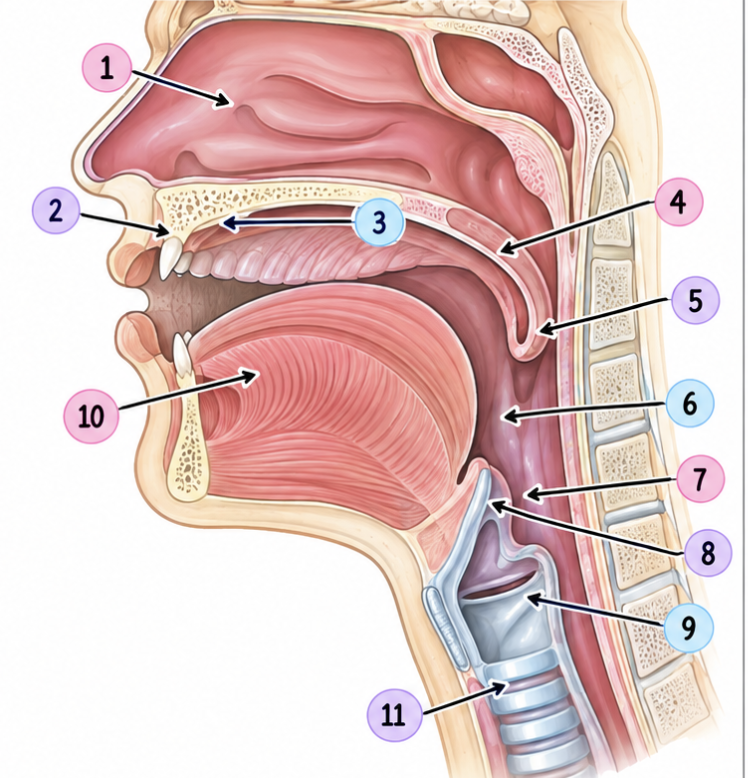
1
Nasal cavity

2
Alveolar Ridge

3
Hard Pallete

4
velum

5
uvula

6
Pharynx
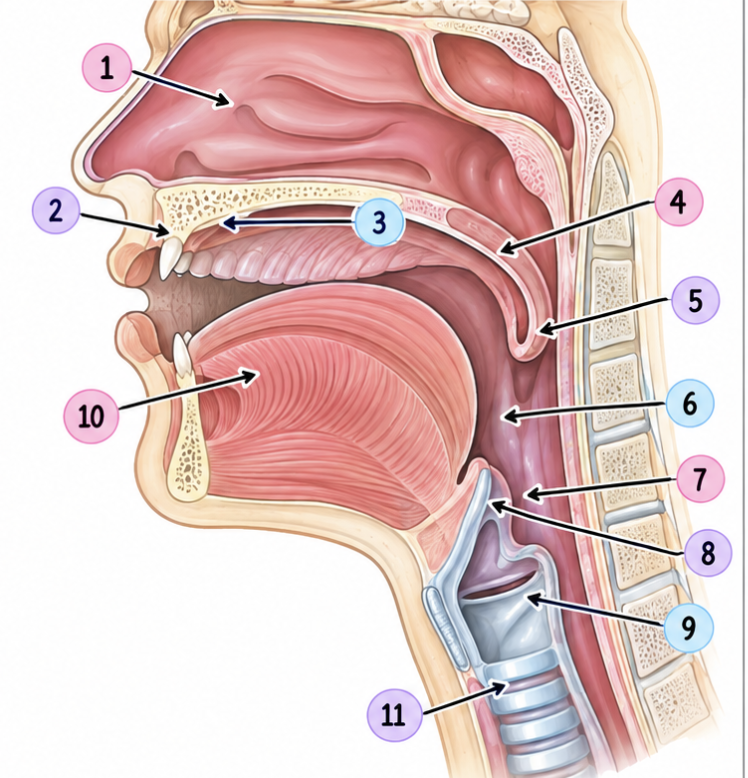
7
Larynopharynx

8
Epiglottis

9
Larynx

10
tongue

11
Trachea