Pattern & Physical Evidence
 Call Kai
 Learn
 Practice Test
 Spaced Repetition
 Match
 Flashcards
 Knowt Play
1/96

There's no tags or description
Looks like no tags are added yet.
97 Terms
Forensic Science
application of science to criminal and civil laws; umbrella term encompassing a myriad of professions that use their skills to help law enforcement officials conduct their investigation
Matthieu Orfila (1787-1853)
father of forensic toxicology
Francis Galton (1822-1911)
conducted first definitive study of fingerprints and their classification
Locard’s Exchange Principle
when a criminal comes in contact with an object or person, a cross-transfer of evidence occurs
developed by Edmond Locard (1877-1966) who incorporated Gross’ principles within a workable crime lab
Hans Gross (1847-1915)
wrote first treatise describing the application of scientific principles to the field of criminal investigation
Sherlock Holmes
novel (Study in Scarlet, 1887) created by Sir Arthur Conan Doyle
Gilbert “Gil” Grissom (2000-2009, Season 1-9)
forensic entomologist and night shift supervisor of Clark County, Nevada CSI team
unrealistic TV show, but triggered CSI Effect
CSI Effect
every crime scene will yield forensic evidence
a prosecutor’s case should always be bolstered and supported by forensic evidence
Criminalistics
use of scientific technologies to solve crimes (mostly in law enforcement agencies in the criminal justice system)
August Vollmer
former Police Chief of Berkely, CA → accepted the appt as LAPD chief of police
completely reorganized the department, improving working conditions, establishing new standards of being prof, laying the groundwork for what eventually became the Scientific Investigation Division (SID) and more recently the Forensic Science Division
believes scientific analysis of evidence had a place in police work so he ordered formation of first crime lab in USA
Which crime lab is the largest?
FBI has largest and most comprehensive crime labs
Which was the world’s first crime lab?
1910 in Lyon, France by Locard
AAFS Categories
Criminalistics
Engineering Sciences
General
Jurisprudence
Odontology
Pathology/Biology
Physical Anthropology
Psychiatry/Behavioral Science
Questioned Documents
Toxicology
Digital Multimedia Sciences
Forensic Nursing Science
What should the initial responding officer prioritize?
Life safety and emergency care
Scene safety and hazard control
Scene security and access control
What do SOPs promote?
Consistency, Accountability, Repeatability, Documentation
General Processing of Physical Evidence
Observation
Recognition
Collection
Preservation
Individualization
Interpretation
AAFS
American Academy of Forensic Sciences
several sections that correspond to aspects of forensic science
ANSI
American National Standards Institute
AAFS Academy Standards Board (ASB)
an ANSI-accredited standards development organization
JonBenet Ramsey Case Mistakes
Allowing friends of parents come into house (crime scene) = contamination
24 hours is a crucial time window = need as much evidence as possible
Didn’t try to open the door a second time
Read the ransom note and formed an immediate opinion (kidnapping and homicide case)
Didn’t interview possible witnesses/neighbors
No searches
No experienced crime scene analyst at the scene
Not about the amount of evidence, it’s about the timing, collection of crime scene, and interpretation of that evidence
Crime Scene Objectives
Document the information provided
Ensure officer safety
Provide emergency care
Secure and Control the scene and all those in it
Release the scene to the appropriate authority
Primary Focal Point
always obvious to observant officers → may include:
body or large blood pools
areas ransacked or disturbed
areas where evidence is
Natural Entry & Exit Points
natural avenues of entry or exit to these primary focal points
avenues of these often hold significant evidence (fingerprints, shoe marks, etc) or may suggest possible secondary scenes
Secondary Scenes
areas of interest that aren’t obvious
they may be staging areas where the criminal waited before or fled to after the crime
located often on periphery of crime scene and may be overlooked
critical observation will help identify these areas
Crime Scene Entry Control Log Identifies…
Who entered the scene
When they entered the scene and when they left
Why they entered
IAI
International Association of Identification
Evidence
something legally submitted to a competent tribunal as a means of ascertaining the truth of any alleged matter of fact under investigation before it
Testimonial Evidence
under oath
Real/Physical Evidence
size, shape, dimension
can prove a crime was committed or establish key elements of a crime
can place suspect in contact with victim/scene
can establish identity
can exonerate the innocent
can corroborate the victim’s testimony
can make a suspect confess
can be made reliable from eyewitnesses
Class Characteristics
evidence associated only with a group is said to have class characteristics
Individual Characteristics
evidence that can be associated to a common source with an extremely high degree of probability is said to possess individual characteristics
Mechanical Fit
an individualization by fitting 2+ pieces of something together
ex) paint flakes, broken reflector lens, broken metal, matches/match books
4 Key Elements in Crime Scene Documentation
Notes
Photos
Sketches
Reports
Type of Crime Scene Photos
Overall Photographs
Evidence Establishing Photographs
Evidence Close-Up Photographs
Evidence Establishing Photographs
typically exposed with a 50mm lens
function = frame evidence items with an easily recognized landmark
visually establishes the position of the evidence in the scene
Evidence Close-Up Photographs
exposed with a “macro” lens (50mm, 55mm, or 105mm)
function is to allow the viewer to see all evident detail on the item of evidence
you have to get close to fill the frame with evidence itself
they are taken with and without a scale
Sketching
act of drawing a 2D view of the scene and important artifiacts
Mapping
measuring and recording associated locations of these elements in the scene
one can sketch without mapping, but you can’t map without sketching
Typical Sketch Drawing
easily demonstrates items in horizontal plane (floors, beds, etc)
birds eye view

Elevation Sketch Drawing
drawn in a “side” view
demonstrates items on vertical planes (ex. walls)

Cross Projection Sketch
combines both the “birds-eye” and elevation sketch
simply lay down the walls
shows the relationship of both vertical and horizontal planes

ALS Operation
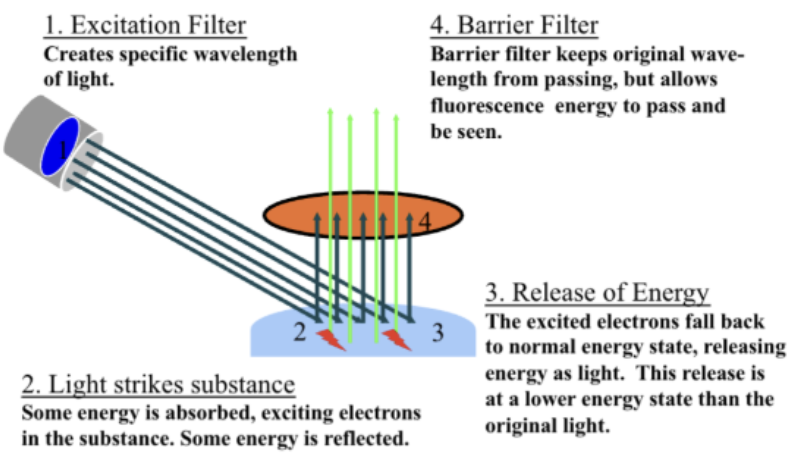
ALS Fluoresence

Small Particle Reagent (SPR)
liquid with molybdenum disulfide suspended in it
sprayed on the surface
molybdenum disulfide reacts and attaches to the latent print
dried it can be lifted with lifting tape
Porous Conditions
paper, cardboard, untreated wood
Non-Porous Smooth Condition
painted, plastic, or glass surfaces
Non-Porous Rough Condition
vinyl, leather, textured countertops
Special Condition
skin, adhesive tape, blood
Rubber Casting
used for tool marks on nearly any surface
special silicone materials to capture microscopic details
if possible, recover the actual tool mark as well
Electro Static Lifting Devices (ESLD)
captures dust prints of shoes and tires
used on almost any dry surface
impression is transferred by electrostatic charge to a mylar film
oblique lighting used
Plaster and Dental Stone
used for 3D impressions
always photograph impressions beforehand
dental stone mixed on scene, then poured into impression
Gelatin and Other Adhesive Lifts
used for 2D impressions
always photograph beforehand
adhesive lifter applied like fingerprint lifting tape
clear covers applied over the lift after recovery
What are the 3 different certifications CSIs can get?
Certified Crime Scene Investigator (CCSI)
Certified Crime Scene Analyst (CCSA)
Certified Senior Crime Scene Analyst (CSCSA)
Reconstruction Patterns
best use in crime investigation and make up basis of most crime scene reconstruction
CSI (crime scenes)
Individualizing Patterns
contain both class and individual characteristics for comparison
pattern experts (crime labs)
Predictable Effects
regular changes one would expect to see at the scene or in evidence
ex) insect activity at a homicide case
Unpredictable Effects
unexpected changes one would not expect to see at a crime scene; especially diasasterous to an investigation because it lead to misinterpretation of the scene
ex) altering crime scene by crime scene personnel
Transitory Effects
fleeting changes within a crime scene
ex) smoke from burning cig
Relational Details
details that help establish relationship among items at the scene and rely on the ability of personnel to properly place items within a crime scene
ex) recognition of a void pattern on a wall with blood spatter
Functional Details
the operating condition of items found at the scene
ex) a nonfunctional wristwatch found on a victim
Transient Evidence
odors, temp, temporary markings, biological/physical phenomena
Conditional Evidence
lighting condition, condition of victim’s body, precise location of specific pieces of evidence
Pattern Evidence
blood spatter, stain patterns, glass fracture patterns, fire burn pattern, furniture position patterns, trajectory patterns, track-trail pattern, clothing or article patterns, tire or skid mark patterns, modus operandi patterns, powder or residue patterns
Transfer Evidence
impression + material
trace evidence produced by physical contact of persons, objects, or between persons/objects
Associative Evidence
evidence that can associate a victim, suspect, object with a particular scene to each other (fingerprint, DNA, ID card, etc) found at the crime scene
Reconstruction Patterns
used to reconstruct past events or associate several events
Bloodstain patterns
Glass fracture patterns
Fire burning patterns
Furniture or clothes disarrangement patterns
Projectile-trajectory patterns
Footprints and fingerprint patterns
Tire track patterns
Tool mark patterns
Skid marks patterns
Gunshot residue patterns
Body gesture patterns
Wound patterns
Impact or damage patterns
Modus Operandi (M.O.) patterns
Individualization Patterns
those which have the potential to be associated with an item or person responsible for it
ex) fingerprints, palm prints, footprints, handwriting, toolmarks
Blood Stain Pattern Analysis
studying the location, distribution, and appearance of bloodstains and spatters may be useful for interpreting and reconstructing the events that produced the bleeding
surface texture and the stain’s shape, size, and location must be considered when determining the direction, dropping distance, and angle of impact of bloodstain
Herbert Leon MacDonnel
1971 = scientific research & practical application of bloodstain theory (had a grant to recreate and duplicate bloodstain patterns at crime scenes
1973 = established training program for basic pattern interpretation
1982: bloodstain pattern interpretation published
What does the 40 hr BPA training entail?
Volume of a typical drop of blood
Vertical spatter as a function of distance fallen and target surface impacted
Effect of target surface on extent of spatter
Spot shape vs. Impact angle
Effect of horizontal motion on bloodstain appearance
Splashed blood vs distance fallen
Projected blood vs distance fallen
Cast-off bloodstains
Medium velocity bloodspatter
High velocity bloodspatter
Spot size vs horizontal projection
Transfer of patterns in human blood
Blood volume vs bloodspatter area
Low-Velocity impact blood spatter
impact force (velocity) = up to 5 ft/sec
stain size = 4 mm (diameter) or greater
Medium-Velocity Impact Blood Spatter
blood is subjected to a force: 5-25 ft/sec
stain size: 1-3 mm (diameter)
beatings, stabbings
High-Velocity Impact Blood Spatter
impact force (velocity): greater than 100 ft/sec
stain size: predominately less than 1 mm
Passive/Gravity Bloodstain Pattern
created without significant outside force
ex) transfer, drop, flow, large volume

Spatter Bloodstain Pattern
associated with external force
ex) impact mechanism, secondary mechanism, projection mechanism

Altered Bloodstain Pattern
physical or physiologic alteration
ex) clotted, diluted, diffused, insects, sequenced, voids
Bloodstain
not all evidence examples of this type are actually stains, thus use of the term bloodstain is inaccurate
should be “blood traces” or “blood deposits”
Pattern
the word “pattern” is not as general as the term configuration
configuration is a better term for blood deposits or tracs in 3D space
Angles of Impact (AOI)
can be determined by dividing width of bloodstain pattern by length of pattern = value of division is the sine of the angle of impact
arcsine is the value in degrees that corresponds to the sin
AOI = sin^-1(w/l)
dependent upon the accuracy of measurement (literature indicates an error rate of ± 10%)
ACE-V Method
refers to the four steps used in analysis/comparison of a latent print with a known
Analysis
Comparison
Evaluation
Verification
Analysis in ACE-V
“latent print” = questioned friction ridge impression
“known print” = exemplars of friction ridge skin
analysis of latent prints to determine if its of value or not for comparison
Comparison in ACE-V
a legible copy of the known prints used for individualization of a latent print shall be retained in the case record → need to have the following documented:
unique identifier of exemplar (name, DOB, assigned ID number, reference to specific exemplars like date of arrest/recording)
anatomical sources represented (fingerprints/palmprints/toeprints)
when known, need to document the medium (ink, livescan) & origin (printed from archive, direct submission)
Evaluation in ACE-V
individualization documentation includes = specific latent friction ridge impression, identifer of exemplars used to reach conclusion, anatomical source, initials/signiture, date conclusion reached
exclusion documentation includes = specific latent friction ridge impression examined, unique identifier of exemplar(s) used to reach conclusion, initials/signiture of examiner, date conclusion reached
inconclusive documentation shall include = specific latent friction ridge impression, unique identifier of exemplar, specific anatomical source, reason, initirals/signiture, date conclusion reached
What are some reasons for inconclusive results for fingerprint ID?
better exemplars needed
specific anatomical sources needed
insufficient friction ridge detail in agreement
Verification in ACE-V
specific latent friction ridge impression examined
unique identifier of the exemplar(s) used to reach conclusion
anatomical source
conclusion of verifying examiner
initials, signiture, or equivalent (unique identifer, electronic signiture) of examiner
date conclusion reached
Level I Examination
detail = overall pattern & ridge flow
arches, loops, & whorls
each pattern has subcategories & loop/whorl patterns have definable features (core & delta)
determine anatomical source & orientation
cannot be used to individualize
can exclude some

Level II Examination
detail = comparison of minutiae
used with level I to individualize and exclude
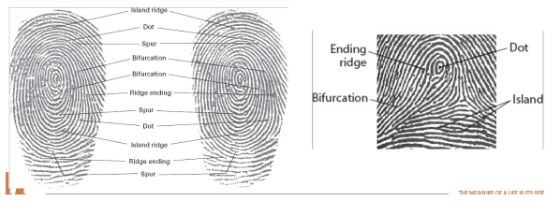
Level III Examination
detail = pore numbers, locations, shape & size of ridge features
structure of individual ridges = shape of ridge & relative pore position
secondary creases: co-inear breaks across a sequence of adjacent ridges, ridge breaks, etc
used to individualize and exclude with levels I and II

Fingerprint Identification
made if every feature on crime scene print is consistent with the known
no requirements for US, some require 10-14 pts
Fingerprint Exclusion
there are unexplained differences with known
Fingerprint Inconclusive
there are not enough features for a definite conclusion
Fingerprint Consultations
shall be documented & include = specific friction ridge reviewed, nature and result of consultation, initirals/signiture of examiners, date of conclusion
if examiners have significant interaction on a particular print, the consulted examiner shall not be used as the verifier for that particular point
IAI = International Association for Identification)
primary peer-standard-setting group in the ID sciences, with a cert program for latent print examiners
SWGFAST = Scientific Working Group on Friction Ridge Analysis, Stusy, and Technology
started in 1995 with purpose of establishing consensus standards for the profession
Cognitive Bias
influences that may affect reliability and validity of one’s observations and conclusions
Confirmation Bias
tendency to search for data or interpret information in a manner that supports one’s preconceptions
when ppl observe more, give extra emphasis to, or intentionally look for evidence that would validate their existing beliefs/expectations and likely to exuse or completely ignore evidence which could reject their beliefs
Contextual Bias
tendency to allow info or outside influences to interfere with evaluation/interpretation of data