Cell Anatamy
 Call Kai
 Learn
Learn Practice Test
 Spaced Repetition
 Match
Match Flashcards
 Knowt Play
1/68

There's no tags or description
Looks like no tags are added yet.
Name | Mastery | Learn | Test | Matching | Spaced | Call with Kai | Chat |
|---|
No analytics yet
Send a link to your students to track their progress
69 Terms
What are the 3 parts of cell theory?
Cells are the smallest living unit; all organisms contain cells; cells come from exiting cells
Prokaryotic cells
Most primitive, simplest of cells - BACTERIA (DNA is in a region called Nucleoid)
Eukaryotic cells
More complex , various sizes & shapes - EVERYTHING ELSE (DNA is enclosed in the Nucleus)
Please Don’t Crush Ribs
Plasma membrane
DNA
Cytoplasm
Ribosomes
Plasma membrane
cell’s outer boundary; Selective boundary
Separates the cell from its surrounding environment
Regulates substances moving into and out of the cell
allows the proper environment for cellular metabolism
DNA
Genetic material
Nucleoid
region, no membrane around it
Nucleus
membrane-bound structure
Ribosome
Makes protein / protein synthesis
Bi
Two
Bilayer
Two layers of phospholipids
Hydrophilic head
Attracted to water
hydrophobic tails
avoid water
Hydrophobic region location
in the interior core of cell membranes
hydrophilic region location
on the outer and inner surfaces of the membrane, facing the watery fluid both inside and outside the cell
Nucleus
Stores most of the cell’s DNA and helps control cell activity
Nuclear envelope (membrane)
Membrane surrounding the nucleus
Nuclear pores
Little openings that regulate what enters/leaves the nucleus
Nucleolus
makes ribosomal components
Chromatin
loose/uncoiled DNA + proteins
Chromosomes
Tightly condensed chromatin, especially during cell division
Cytosol
Liquid
Cytoplasm
liquid + stuff
Organelle
A specialized cell structure that performs a specific job
Ribosomes ‘
Makes proteins
Cytoskeleton
Shape, internal organization, movement
Centrioles
helps organize structures involved in cell division
Mitochondira
ATP production/cellular energy
Rough endoplasmic reticulum has:
Ribosomes attached
Rough = Ribosomes = proteins
Smooth ER
NO ribosomes. Lipids + detox
Golgi apparatus
It modifies, sorts, and packages proteins/lipids into vesicles
lysosomes
Contains digestive enzymes / Cell garbage disposal / recycling center
Vesicles
Transport
secretion
storage
Peroxisome
Detox + oxidative breakdown
Cilia
Short and numerous; can move material across a cell surface
Flagellum
longer, usually fewer; can move the entire cell
Cholesterol
Sits between the phospholipids / helps keep the membrane stable but flexible
Integral proteins
IN the membrane
channels or carriers as transport
Receptors
enzymes
Peripheral proteins
sit on the inner or outer surface of the membrane rather than passing deeply through it
Cell support
signaling
enzyme activity
Carbohydrate side chains
Stick out from the outside surface of the cell
Help with cell recognition and communication
microvilli
Tiny finger-like extensions of the plasma membrane
Increases surface area
Fluid
The phospholipids and many membrane components can move sideways within the membrane so the membrane isn’t rigid
What does Mosaic mean?
The membrane is not a uniform sheet; instead, it is a "sea" of lipids embedded with a scattered, diverse mix of proteins, cholesterol, and carbohydrates.
What does phospholipid bilayer mean?
a double layer of lipid molecules that forms the fundamental structure of every cell membrane.
why is the plasma membrane described as a mosaic ?
composed of a patchwork of diverse, embedded molecules—such as [proteins, cholesterol, and carbohydrates]—that are scattered throughout a phospholipid bilayer
Red blood cell
Shape: flattened/biconcave disc
A lot of surface area for exchanging gases and helps the cell squeeze through tiny blood vessels
Sperm cell
Has:
a head
lots of mitochondria in the midpiece
long flagellum
Fluellin provides movement, while mitochondria supply ATP for that movement.
Neuron
Their long extension allow them to send and receive signals across distances
Simple squamous epithelial cell
Very thin and flat
Cell shape supports cell function
External boundary; regulates flow in/out
Plasma membrane
Contains digestive enzymes
Lysosome
Scattered throughout cell: Major ATP
Mitochondria
Slender membrane extension increasing surface area
Microvilli
Flattened sacs + vesicles; packages proteins for export
Golgi apparatus
Control center; necessary for cell division/life
Nucleus
Two rod-shaped bodies near nucleus; basis of cilia
centrioles
Dense dark nuclear body; ribosome packaging/production site
nucleolus
Membranous system with rough and smooth varieties
endoplasmic reticulum
attached to membranes or free in cytoplasm; makes protein
ribosomes
Thread like material in nucleus containing DNA
Chromatin
Site of detoxification of harmful chemicals
Smooth ER

1.
Phospholipid bilay

2.
hydrophilic head
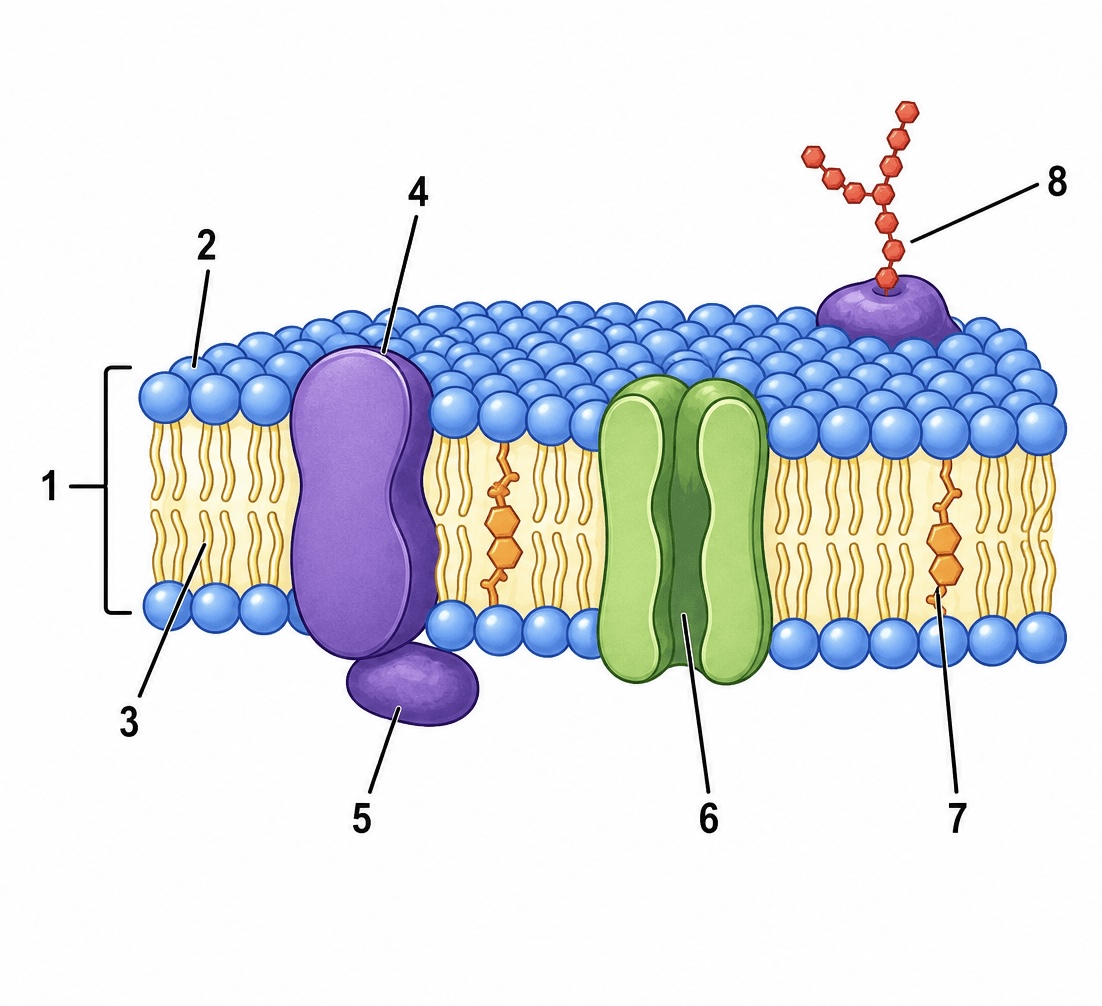
3.
Hydrophobic tail

4.
integral protein

5.
Peripheral protein

6.
channel protein

7.
cholesterol

8.
Glycoprotein