crim process
 Call Kai
 Learn
 Practice Test
 Spaced Repetition
 Match
 Flashcards
 Knowt Play
1/92

There's no tags or description
Looks like no tags are added yet.
Name | Mastery | Learn | Test | Matching | Spaced | Call with Kai | Chat |
|---|
No analytics yet
Send a link to your students to track their progress
93 Terms
NZBORA s 22
‘Everyone has the right not ot be arbitrarily arrested or detained’
Arrest =
restraint or apprehension (typically by a police office - physical or not) for principal purpose of bringing person before Court. Person is no longer free to go as they please and must remain in the presence of or subject to direction by the arrester.
Crimes Act 1961, s 39
Arrester able to use force necessary to overcome resistance (police + citizens)
Most common statutory power for arrest without warrant is s 315 Crimes Act 1961
finds someone disturbing the peace or committing an offence punishable by imprisonment.
Good cause to suspect of having committed a breach of the peace or an offence punishable by imprisonment.
(NOTE: suspect = more than mere speculation. Good cause = objective test
Rights upon arrest ss 21-27 NZBORA + what other place are these laid out
21- right to be free from unreasonable search and seizure
22 - Not to be arbitrarily arrested
23 - lays out rights at arrest e.g. informed for the reason, can get a lawyer without delay, be treated with humanity, charged promptly etc.
24 - rights of those charged - may be released on bail unless there is a good reason not to, lawyer, told what charge and it’s details, adequate time to form a defence
s25 - minimum standards of procedure - fair hearing, presumed innocent until proven guilty etc.
s 26 - no retroactive penalties (if it wasn’t an offence when you did it then you can’t be charged) - can’t be repunished for an offence you’ve already been acquitted or sentenced for.
s 27 - natural justice rights
Practice Note on Police questioning
what rationales do there rights upon arrest engage
supportive of burden of proof, presumption of innocence, other procedural rights, and generally the fair treatment of the defendant by the state.
Promotes reliability of admissions (miscarriages caused by past improper police questioning e.g. Teina Pora)
Practice note on police questioning in relation to questioning and charging people
1. A member of the police investigating an offence may ask questions of any person from whom it is thought that useful information may be obtained, whether or not that person is a suspect, but must not suggest that it is compulsory for the person questioned to answer.
2. Whenever a member of the police has sufficient
evidence to charge a person with an offence or
whenever a member of the police seeks to question a
person in custody, the person must be cautioned
before being invited to make a statement or answer
questions.
What caution should be given during questioning or on arrest?
The caution to be given is:
(a) that the person has the right to refrain from making any statement and to remain silent
(b) that the person has the right to consult and instruct a lawyer without delay and in private before deciding whether to answer questions and that such right may be exercised without charge under the Police Detention Legal Assistance Scheme. (so that people don’t say no because they can’t pay for it)
(c) that anything said by the person will be recorded and may be given in evidence
issues surround/with rights upon arrest (4)
Criminal procedural rights have faced challenge in NZ and overseas in relation to the investigation and prevention of terrorism (in particular, rights such as continued detention without charge)
Targeting of particular groups (gang member, sex
offenders etc
The admissibility of confession evidence where improper questioning occurred dealt with under three different headings in Evidence Act 2006.
Section 28 (reliability), s 29 (oppression) and s 30 (improperly obtained evidence)
Charging procedure
Initial decision to charge made by Police
Then reviewed by prosecutor (see test on other FC)
P’s should only commence a prosecution if BOTH tests are met
Test for prosecution
1) Evidential test - is there enough evidence to prove the charge beyond reasonable doubt
2) Public interest test - does the public interest require a prosecution to be brough
(MUST meet BOTH )
Why such a detailed test for deciding when to prosecute?
Because there's significant prosecution discretion which then has risks;
May be used unfairly, don’t want the ones in Invercargill for driving whilst suspended but people in south Auckland to not charge that. Make more equality before the law.
The onerous nature of the criminal process ‘process is the punishment’ and therefore the importance that only those cases where it is really appropriate be engaged in the criminal justice process.
Evidential test:
Sufficient evidence to prove the charge “beyond reasonable doubt”. Includes consideration of both “elements of offence” but also likely “defences”.When considering whether evidence meets that test need to
consider:
Availability
Admissibility
Credibility
Reliability
• Not for prosecutor to usurp the function of the fact-finder (Judge or jury)
Prosecutor should not attempt to predict the outcome of a trial. In particular, prosecutors should not allow the prospect of illegitimate reasoning by the fact-finder to factor into their assessment of evidential sufficiency. This is particularly likely to be an issue in cases involving sexual violence or family violence, where a victim may be perceived to have behaved in a counter-intuitive way.
Public interest test - key factors,
not all offences satisfying the evidential test must be prosecuted.
should be satisfied that public interest requires a prosecution to be brought
broader considerations of justice, fairness, and consideration beyond the case at hand/
Key factors include:
Nature of the offence (seriousness, level of culpability of suspect, likely sentence if convicted).
The suspect (age, disability, prior history, risk posed, other background factors, existing consequences eg employment, remorse and making amends, assistance to authorities)
The victim (ongoing safety concerns, impact of prosecution on them, or of decision not to prosecute, impact on ability to claim reparation)
Types of charge
Most cases evidence will support charges for more than one offence (some that have various levels of seriousness eg assault, assault with intent to injure etc - or a combined one assault and kidnapping)
P should proceed with the charge that accurately and adequately reflects the seriousness and extent of the offending (to give leeway for an appropriate sentence)
Provides the court with an appropriate basis for sentencing in light of the facts
Plea arrangement/Plea bargaining
Most common form of plea arrangement is that a prosecutor will agree to reduce a charge to a lesser offence or withdraw some charges if the defendant agrees to plead guilty to an offence.
• Benefits include avoiding a trial and time and
cost savings.
• However, arrangement must be justified in
interests of justice and resulting guilty plea must
still adequately reflect the criminality of the
conduct.
• Guidelines are clear that prosecutor should
never inflate the number or seriousness of
charges to use as a bargaining tool.
and P should not agree to support a particular sentence because sentencing = judges decision . But should give advance notice of their likely sentence but not apart of plea arrangement
P should engage with defence-counsel not typically with defendants themselves
not where it will distort facts or create an artificial basis for sentencing
seek victims views on the proposed plea arrangement before it is agreed (ultimately P’s decision)
should be as consistent as possible in plea discussions with all defendants
should follow arrangement unless Crown solicitor or senior manager personally approves the repudation of a plea deal in the interests of justice
p shouldnt mislead the court
• Impact of mandatory sentences? Shift of power
from Judge to prosecutor? ( Problems have arisen where there are severe mandatory punishments
May feel forced to plea guilty.
When should prosecution decide what charge to charge?
Before test for Prosecution because:
needs to know for evidential test
seriousness = public interest
benefits of plea arrangements
provides a level of certainty of an outcome without the need for a trial
time (quicker)
savings.
Time can be used on other cases
victims that may have had to give evidence that is traumatic may not have to now
Decisions to take no action
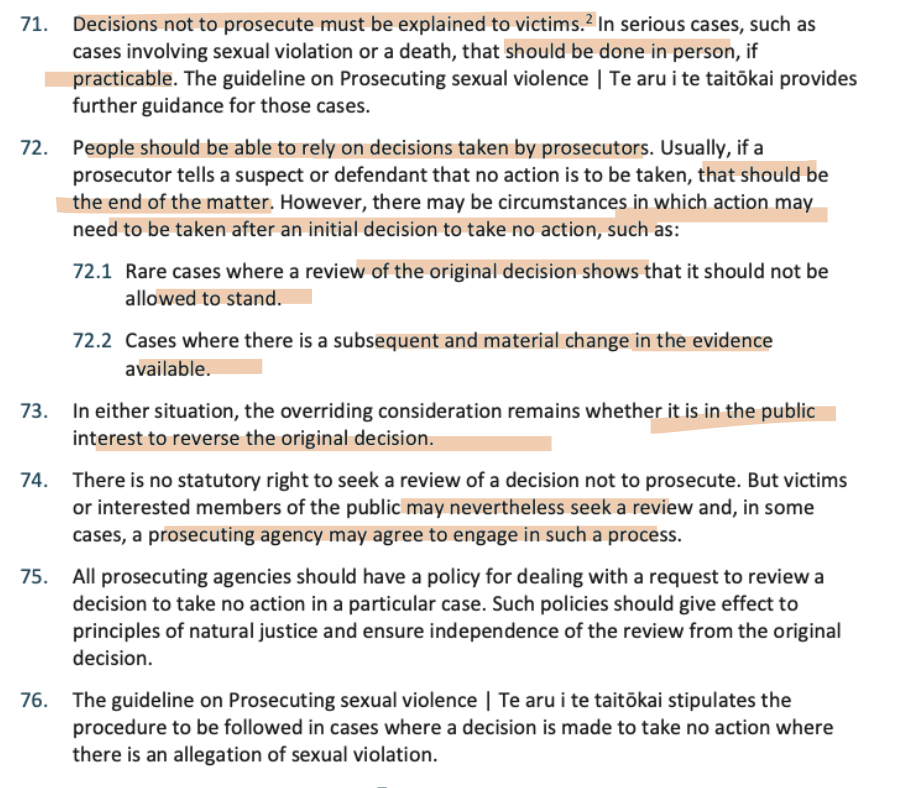
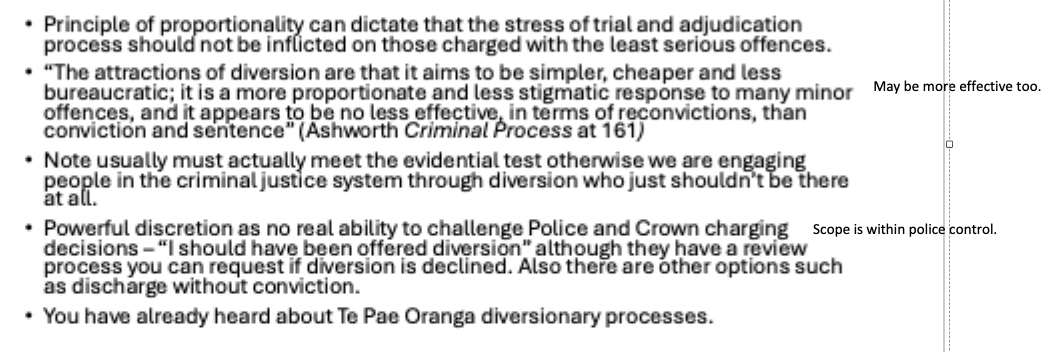
Warnings and diversion
principle of proportionality = stress of trial shouldn’t be inflicted on those charged with minor offences
see photo
Sentencing Act 2002 - where does the tension lie
Discretion conferred in ss 7-9 and increasingly prescriptive provisions being added to the Act
s 7 purposes of sentencing in Sentencing Act 2002
Hold offender accountable for harm done and promote a sense of responsibility
Provide for interests of victim (incl reparation)
denounce and deter
protect the communuty
assist in offenders rehabilitation and reintegration
s 8 principles of sentencing
gravity of offending and degree of culpability of the offender
seriousness of the offence in comparison to other types of offences (indicated by max penalities)
If super serious case of its type they should impose maximum penalty prescribed
desirability of consistency of sentencing in respect of similar offenders committing similar offences in similar circumstances
impact on victim
impose the least restrictive outcome appropriate in the circumstances
offenders personal circumstances
the outcomes of any restorative justice processes
s 9, aggravating features which require sterner response
actual or threatened violence or use of weapon
involving unlawful entry into a dwellinghouse
offence is committed on bail or still subject to a sentence
extent of loss, damage or harm
Particular cruelty, abuse of trust or vulnerability of victim
hate crime
premeditation of offence
number, seriousness and relevance of previous convictions
s 9 Mitigating features
Age of offender (old and youth [age 25= brain development + more likely to be rehabbed]
whether they pleaded guilty - taking accountability faster process
conduct of victim [very aggravating or extraordinary]
diminished intellectual capacity at time of offence
remorse
previous good character
time spent on electronically monitored bail - - not full discount but some recognition as you have more freedom. Time remanded in custody gets taken off any sentence automatically.
hirearchy of sentences and orders from least restrictive to most restrictive s 10A
[te pae Oraka etc come before hand]
Convict and discharge or order to come up for sentence if called upon [on record']
sentences of a fine and reparation
community work and supervision (up to 400 hours)
intensive supervision and community detention (up to 12 months)
Home detention (no longer than 12 months)
Imprisonment
s 106 - discharge without conviction is different, not a sentence but a deemed acquittal.
Sentencing methodology - court developed
1) chose a starting point of imprisonment by reference to - how serous was the offending
maximum penalty
aggravating and mitigating features of the offending
guideline decision if any
starting points adopted in other similar situations
2) Factor in the offender (sentence can go up at this point)
aggravating and mitigating features personal to the offender - discounts made from starting point - incl guilty please = max discount of 25%
see whether the sentence is a just one in all circumstances (Moses v R)
End sentence must not be out of all proportion to the gravity of the overall offending (totality consideration)
restrictions on court discretion in sentencing
when end sentence = > 2 years only available option is sentence of imprisonment
2 years or under you can consider home detention and those options lower down the sentencing hirearchy - still a discretionary decision can be sentenced to a short term of imprisonment under 2 yrs rather than those options.
not supposed to artificially lower the sentence to get to the 2 year mark
Parole Eligibility
sentence to short term of imprisonment (less than 2 years) you are released having served 50% of your sentence
more than 2 years eligible to go before the parole board after serving 1/3 of your sentence.
Well established restrictions on sentencing discretion
exception for murder - mandatory life sentence with minimum non parole period of 10 years (subject to recall whenever) - sometimes that period can be 17 years if aggravating features
s 86 - can apply for a minimum period of imprisonment in certain cases where the standard parole eligibility is not sufficient for any or all of the following;
holding offender accountable for harm done to victim and community
denouncing conduct in which offender was involved
deterring the offender or other persons from committing the same or similar offence
protecting the community from the offender
Recently introduced restrictions of discretion
3 strikes regime (Increasing penalties (w/ carve outs for manifest injustice) for strike offences)
40% cap on discounts
restrictions on repeat discounts for youth and remorse
serious youth offender designation and boot camps.
policies stated as having a significant deterrent effect but there is real doubt as to the effectiveness of this
concern it will impact māori more given their over-representation in prison,
other reforms
Youth court regime
Te kōti rangatahi
new beginnings court
pilot court for sexual violence
increased use of restorative justice
Issue: not had as much investment in rehabilitation as we have on tough on crime approaches.
What is a criminal justice system:
Method which the state applies the criminal law to it’s citizens
Values in our criminal justice system which compete
Fairness in criminal proceedings -> balancing powers of the state to ensure privacy and dignity
Balance of community safety + reintegration of prisoners
Punishment vs reintegration.
Lawyers role
Public interest -> lawyers have important role in upholding rights in NZBORA [public want a quick outcome for what is obviously 'just']
Trends; in our criminal justice system
Increasingly punitive -> from 70's increasing seriousness and punishment in criminal justice systems. Political issue often they are seeking to outdo each other and being tougher on crime.
Enhanced focus on victims rights -> victims having a say in the process -> apart of this push is bringing in punitive parts.
Increasing managerialism and administrative focus, eg getting people through the system as fast as possible
Types of investigative steps:
Questioning possible witnesses / suspects
Eyewitness identification procedures
Search of addresses
Analysis of phone data (call logs, texts, phone location)
Forensic examination of scene and items seized (samples)
Pathology of deceased (medical experts determining cause of death)
CCTV in vicinity
Covert investigation techniques (undercover policing)/ being under surveillance.
Identification Evidence:
person saying I saw x person on the scene, works when the witness knows the person and their name)
if person does not know the name then they get shown about 8 people who are similar looking including the suspect and they have to pick the person out.
What happens if an eye witness doesn’t know the person they have to identify - risk in justice + ways it goes wrong
Can be the source of a significant miscarriage of justice
Evidence that strangers being identified by a witness from short glances in stressful situations is bad/typically wrong -> but jury places significance on it.
ways it goes wrong;
Investigation + collection -> stress of being asked by police and them say yeah must be him
Bad memory -> some people may be good but science shows that there's large unreliability.
It’s not uncommon for someone to be exonerated by DNA testing after being convicted by faulty eye witness identification (examples R v Edmonds) (Fukofuka v R))
Evidence Act 2006 s 4 (Visual identification evidence) -definiton
assertion by a person, based wholly or partly on what that person saw, to the effect that a defendant was present at or near a place where an act constituting direct or circumstantial evidence of the commission of an offence was done at, or about the time the act was done.
s 45 Evidence act 2006 Admissibility (use in proceedings against someone) of identification evidence
(1) if formal procedure is followed in obtaining VIE of a person alleged to have committed an offence or there was a goods reason not for following a formal procedure. Evidence = admissible in criminal proceeding. UNLESS D proves on balance of probabilities evidence is unreliable.
2) if proper formal procedure is not followed with no good reason not to evidence = inadmissible. UNLESS the prosecution proves beyond reasonable doubt that the circumstances in which the identification was made have produced a reliable identification.
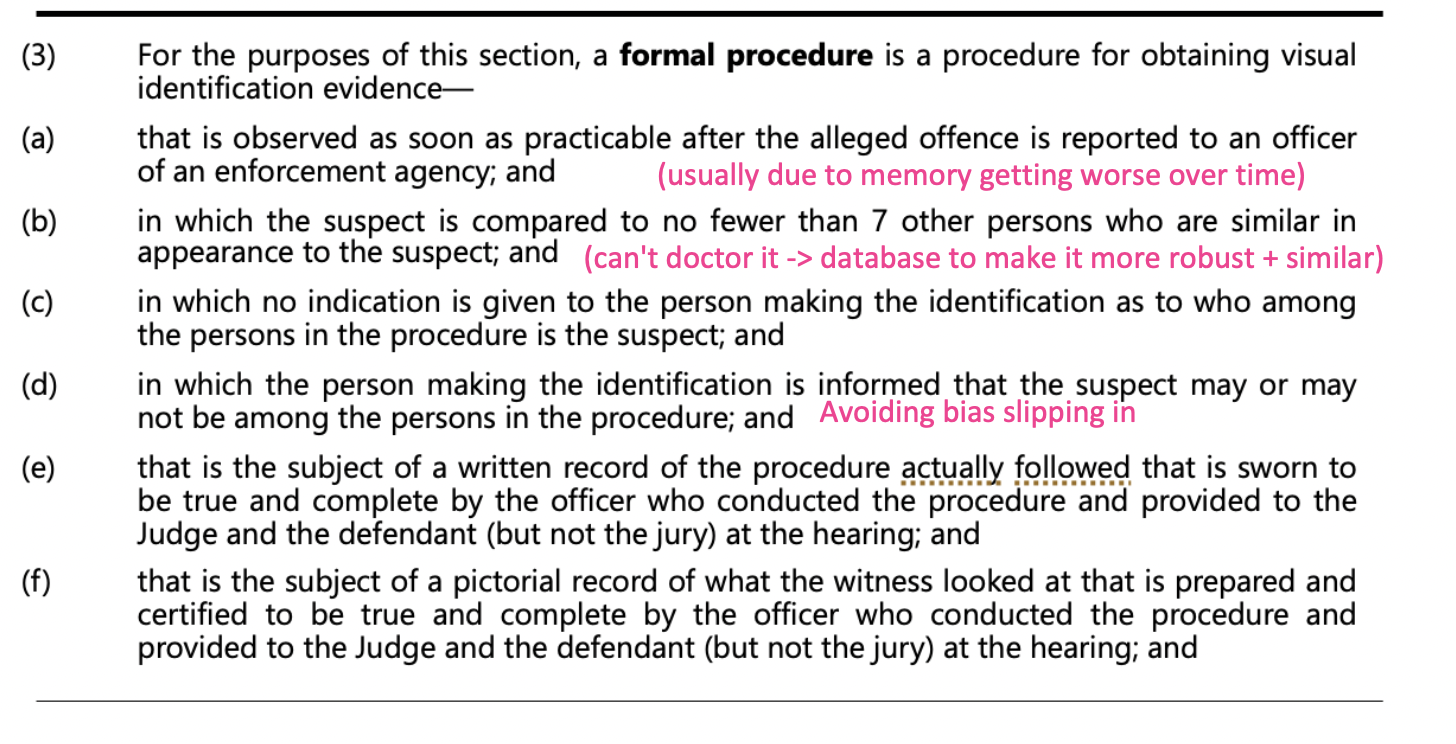
Formal procedure for obtaining visual identification evidence = (under s 45(3) a-f)
a) should be done ASAP after the offence is reported to police
b) suspect must be compared to no fewer than 7 other people who are similar in appearance.
c) no indication should be given to person making the identification on who is the suspect.
d) identifier should be informed the suspect may or may not be among the persons in the procedure.
e) a written record of the procedure actually followed, that is sworn to be true and complete by the officer who conducted the procedure and provided to the Judge and defendant (not jury) at the hearing.
f) pictorial record of what the witness looked at is prepared and certified to be true and complete by the officer who conducted the procedure and provided to Judge and defendant at hearing.
Good reasons not to follow formal procedure (VIE) s 45(4) (a)-(f)
a) refusal of the suspect to take part in the procedure (refusing to take part in parade, not permit photos or videos where agency doesn’t already have a photo showing true likeness)
b) singular appearance of the suspect (that can’t be disguised so that the person is similar in appearance to those with whom the person is to be compared) e.g. face tattoo
c) substantial change in the appearance of suspect after the alleged offence occurred and before it was practical to hold formal procedure
d) no officer involved in investigation or prosecution could reasonably anticipate that identification would be an issue at the trial. (e.g. being caught on scene)
e) an identification of a person alleged to have commited an offence has been made to an officer of a enforcement agency soon after the offence occurred and in the course of that officers initial investigation
f) identification of a person alleged to have committed an offence has been made to an officer of an enforcement agency after a chance meeting between the person who made the identification and the person alleged to have committed the offence.
Aims of the rules around admissibility
reduce the risk of wrongly convicting people.
Aim to make sure that the evidence is accurate
Judicial direction on Visual identification evidence s 126
1) In a criminal proceeding tried with a jury in which the
case against the defendant depends wholly or substantially on the correctness of 1 or more visual or voice identifications of the defendant or any other person, the Judge must warn the jury of the special need for caution before finding the defendant guilty in reliance on the correctness of any such identification.
(2) The warning need not be in any particular words but must
(a) warn the jury that a mistaken identification can result in a
serious miscarriage of justice; and
(b) alert the jury to the possibility that a mistaken witness may be convincing; and
(c) where there is more than 1 identification witness, refer to the possibility that all of them may be mistake
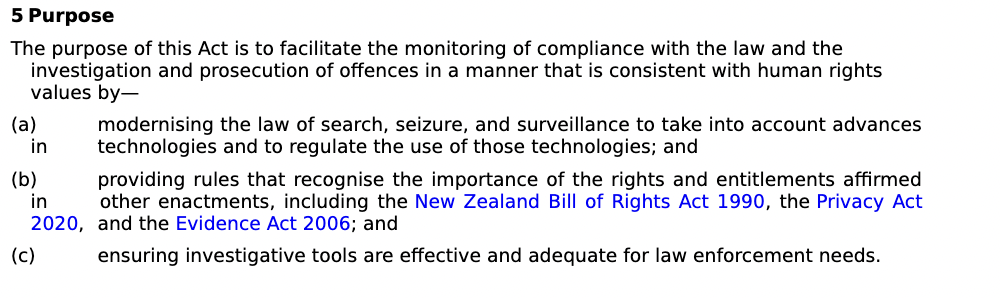
Search and seizure; Search and surveillance Act 2012; purpose s 5
monitoring of compliance with law and the investigation and prosecution of offences in manner that is consistent with HR values
see photo
NZBORA 1990 s 21 unreasonable search and seizure (Search and seizure)
right to be secure against unreasonable search or seizure (person, property or correspondence or otherwise)
search not defined in NZBORA and SSA.
Police have same rights as ordinary citizens - at some point investigatory conduct carried out by police = search.
current test for whether it’s a search
expands on Entick v Carrington
Hamed v R; if the police activity invades a reasonable expectation of privacy.
An expectation of privacy will be reasonable if:
first, the person complaining of the breach of s 21 did subjectively have such an expectation at the time of the police activity and, secondly, that expectation was one that society is prepared to recognise as reasonable
Statutory powers of search
Warrant preference rule;
can apply
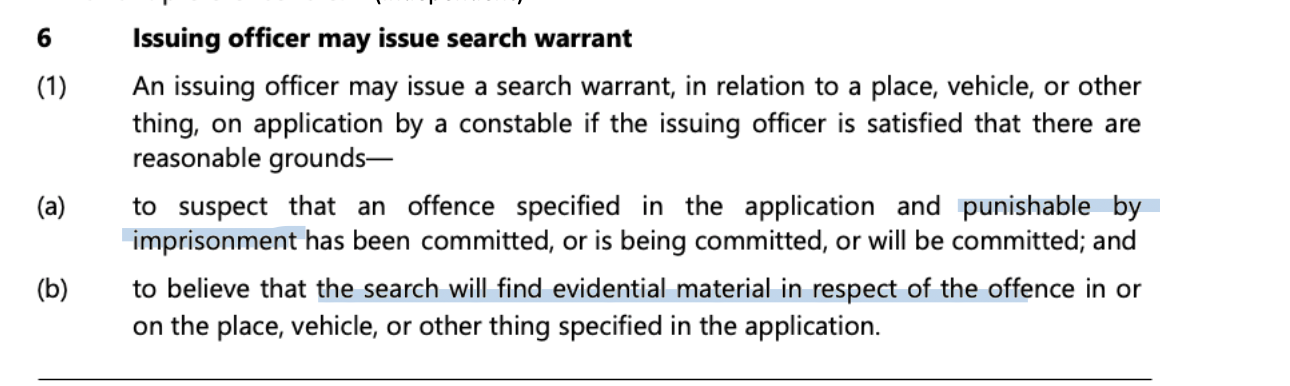
warrant may be issued if issuing officer is satisfied that there a reasonable grounds
to suspect (mere speculation or concern is not enough must be possible or likely) that an offence punishable by imprisonment (committed, being committed or will be committed) AND
believe (higher standard, objective credible basis) that the search will find evidential material in respect of the offence
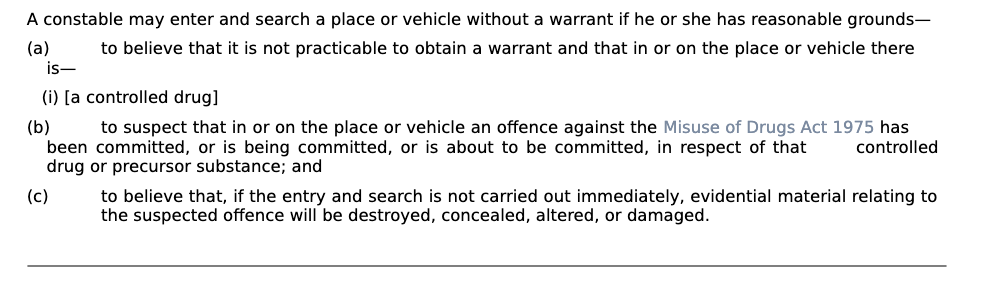
warrantless search s 20 Warrantless search of places and vehicles in relation to some Misuse of Drugs Act 1975
offences
not practicable to obtain a warrant where there is a controlled drug
offence against Misuse of drugs act is committed, (future, past, now) and
If entry and search is not carried out immediately evidential material relating to the suspected offence will be destroyed etc.
Other examples of warrantless search power
Consent (but must be advised able to refuse)
• Pursuant to lawful arrest (difficult issues arise around searching contents of phone found on person,
unless Police have “reasonable grounds to believe evidential material will be located on it”.
• Items in plain view when exercising otherwise lawful power.
• To prevent offence or respond to risk of life
• Arms and drug offences when certain conditions present
search and seizure other info - penalty for breach and phones
Penalty for breach? Possible exclusion of evidence.
• Requirement to report to Police Commissioner when warrantless power exercised.
• Law Commission recommendation In relation to phones -> need to have clearer guidelines.
what is a trial?
Mechanism by which a criminal charge is proved or not, if the conduct is not accepted by the defendant.
Attempt to sort the guilty from the innocent
process is constrained by the burden of proof being on the Crown and the high standard of proof to protect the innocent from wrongful conviction.
Can be communicative and incorporate other community values, rather than solely a focus on fact-finding.
Modes of trial (2)
NZ adversarial system:
judge neutral participant
questioning of witness by prosecution and defence and making of submissions for either side is considered the best method for finding the truth
prosecution = on behalf of state - victim historically has no decision-making power, although may be key witness for prosecution.
Other inquisitorial system:
different approach taken in some other jurisdictions
judge more involved in fact finding, more extensive pre-trial role of Judge
Victim often represented by a lawyer during trial
judge alone trials and when it can be elected
mostly for criminal offences w/ max penalty under 2 years imprisonment
determines questions of law and is the fact-finder
full reasons for decision released in written judgement
offences > 2 yrs imprisonment defendant can elect Judge-alone or jury trial - however for most serious offences (such as murder and manslaughter) they are tried by a jury
Prosecution can apply for judge alone trial in cases likely to be long and complex (if max penalty is under 14 years) and in cases where there is real risk of juror intimidation.
Jury trials
heard before judge and jury of 12 members of the public
judge = questions of law and provides direction to jury
jury = determines questions of facts - question trail provided by judge to assist
no reasons or explanations given for verdicts (jury secrecy)
all 12 or a majority verdict of 11/12 if certain conditions are met
benefits of jury trials
Jurors are well placed to apply standards of our criminal law e.g. reasonableness
juries = more diverse than judiciary [although not diverse enough] and can bring that collective life experience to their decision making
provide legitimacy to the criminal justice system trough public participation (don’t get blasted in media as often)
Check on arbitrary laws and government (where they think it’s not fair and say not guilty - jury nullification)
Possible downsides of jury trials
Risk of prejudice and bias from community impacting decisions.
Some concepts jury’s have to apply are complex - judges may be better placed to make these decision
time + resource intensive. could result in a hung jury
lack of transparency in lack of reasons being provided.
Burden of proof
NZBORA s 25(c ) - right to be presumed innocent until proven guilty according to law
therefore vast majority of offences the burden is on the prosecution to prove the elements of the charged
D doesn’t have to give or call evidence
limited exceptions where onus is reversed e.g. Strawbridge?
Standard of proof
beyond reasonable doubt - have it because of error preference - often described as ‘you must be sure.
Role of the victim
prosecution brought on behalf of the state not victim
V has very limited role in decision making
key witness often
some changes in recent years to stop the process being super dehumanising and traumatising for victims.
increased requirements to obtain and place v’s views before court so it can form part of discretionary decision making
sometimes can give evidence behind a screen or via video link depending on offence they were a victim to.
increase in limits on kinds of questions they can be asked to avoid unfair and irrelevant character blackening that used to be a feature of trials
other reforms include - counter-intuitive evidence [SO and Family violence to stop misconceptions- development of the sexual violence pilot courts.
Opening addresses
judge gives opening address - including court room procedure
The crown - Crown counsel is not an advocate for their case.
Crown and defence will give opening addresses
Crown opening content
What the Crown says happened (do not over-promise)
the burden and standard of proof and the elements of the charges
way in which evidence will be presented [e.g. videos, witnesses etc]
Not really the opportunity for persuasion - that comes in the closing addresss at the end of the trial.
defence opening statement
Criminal Procedure Act 2011, s 107
defendant may make an opening statement for the purposes of identifying the issue or issues at the trial
opportunity to give a fuller opening address if there is a defence case following the prosecution case
Examination in chief
questioning of your own witness
formal written statements and briefing your witness
use open questions
purpose = draw all relevant information from witness in an engaging and credible way.
be aware of admissibility issues (relevance, hearsay, prejudicial material)
Be careful of leading questions on contentious matters (discuss with counsel for the other side)
Cross-examination
test the veracity of a witness and the accuracy and completeness of a story
cross examine only for duty, advantage or effect - when in doubt don’t cross examine.
Advantage;
elicit favourable evidence (have the witness agree with facts supporting your case)
to discredit unfavourable evidence and/or the witness who gave it (changing story, evidence that they hate your client etc)
Duty:
if you are going to ask the fact-finder to disbelieve an opposing witness you must ‘put the case’. Ensure that the evidence is properly tested for the fact-finder.
Duties in cross-examination
Conduct and client care rules 13.10.2 - must not put any proposition to a witness that is either not supported by reasonable instructions or that lacks foundation by reference to credible information in the lawyer’s possession.
Prosecution rule 13.12
must act fairly and impartially at all times and in doing this must
b) present the prosecution case fully and fairly with professional detachment; and
avoid unduly emotive language and inflaming bias or prejudice against an accused person
etc
cross examination ‘key rules’
prepare well- know evidence use exhibits
ask leadings questions
don’t ask questions to which you don’t know the answer
don’t have the witness repeat their evidence in chief
put facts do not invite conclusions
Do not argue with the witness
wait out silences (they can be impactful)
Know when to stop.
re-examination
evidence act 2006 s 97
witness may be questioned about matters arising out of evidence given by the witness in cross-examination incl any qualification in cross-examination of evidence given by the witness in examination in chief but
may not be questioned about any other matter except with the permission of the judge
Conventional wisdom is not to do it [looks defensive or can highlight bad evidence]- if you can object at the time.
Closing address
chance for persuasion
crown 1st defence has final word
Confront your arguments weak points directly
base your submissions on the evidence and use examp,es
judges summing up and question trails
before jury retire judge sums up the case and gives key directions
burden + standard of proof, inferences, credibility/reliability, submissions of counsel aren’t evidence, demeanour, propensity direction if admitted.
Appeals
limited right of appeal against jury verdicts - must be unreasonable having regard to the evidence or miscarriage of justice
miscarriage of justice = criminal procedure act 2011 s 232 = error, irregularity or occurence in or relation to or affecting the trial that - a) has created a real risk that the outcome of the trial was affected or b) has resulted in an unfair trial or a trial that was a nullity.
Criminal cases review commission aimed at remedying miscarriages of justice
often issues that come up are new scientific evidence and changing standards of trial practice and fairness.
compensation regime for wrongful conviction - discretionary
decisions on bail (rationale)
NZBORA s 24(b) ‘everyone who is charged with an offence shall be released on reasonable terms and conditions unless there is a just cause for continued detention’
why is a decison on bail significant?
it has significant consequences. Staying on remand = possible loss of employment, time with family, if there is a significant delay to trial could be lengthy remand in custody.
Severity of conditions matters too if granted bail, level of restriction (on rights) and surveillance.
conflicts with bail
individuals right to liberty vs interests of public security
why should there be a right to bail?

Bail Act 2000
mirrors s 24(b) NZBORA
Section 7(5) for those not “bailable as of right” the general position is that as set out in s 24(b) NZBORA, they must be released on reasonable terms and conditions unless the Court is satisfied there is just cause for continued detention
‘bailable as of right’
Bail Act 2000, s 7 a defendant is bailable as of right who:
• is charged with an offence not punishable by imprisonment; or
• is charged with an offence for which the maximum punishment is less than 3 years’ imprisonment (except for male assaults female, assault on a child and assault person family relationship)
what is just cause for continued detention? s 8 Bail Act 2000
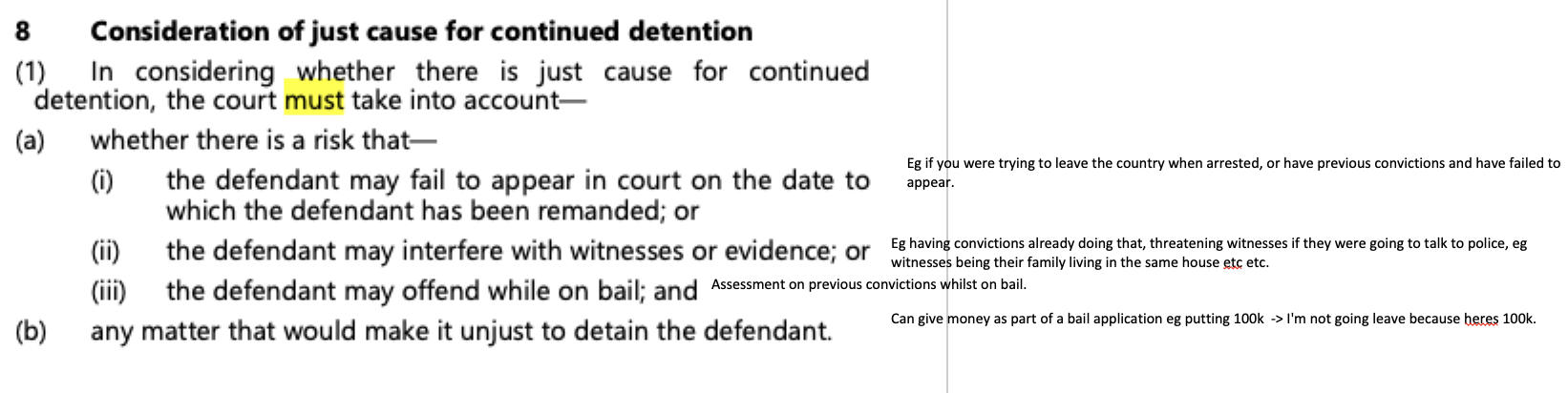
Court may take into account the following under s 8(2) when deciding if there is a just cause for continued detention.
nature of the offence (serious or not)
strength of evidence and probability of conviction
seriousness of punishment (severity of punishment)
charcter and past conduct (criminal behaviour) of the D
if D has a history of offending on bail, breaching court orders and including orders imposing bail conditions
likely length of time before the hearing/trial
possibility of prejudice to the defence in the preparation of the defence if defendant remains in custody
any special matter relevant in the particular circumstances
Additional considerations for bail
to protect victims of alleged family violence and those protected by a protection order. (s 8)
certain types of offences.
reverse onus provision s 10 for people charged with specified offence but who have a previous conviction for a specified offence AND
s 12 relating to further alleged serious offending carried out on bail for those who have previously received 14 or more sentences of imprisonment (onus shifted onto them to prove why they should be bailed)
Additional issues with bail
restrictive conditions, surveillance society (electronically monitored bail)
disruption to family (No rehabilitation stuff)
inequities caused by need for suitable address ( bad policies with Housing NZ saying wont house people on bail (even if the person living there would take them))
disclosure
Mostly refers to the provision of relevant evidence from the prosecution to the defence.
Some limited obligations of the defence in relation to alibi and expert witnesses.
Includes the obtaining of some information from third parties by defence (for example counselling, medical or Oranga Tamariki records).
Why is disclosure of evidence to the defence-counsel important (pros and cons)
efficiency (trials run smoothly when each side has notice of the evidence and the arguments that the opposing side will present at trial.
arguments for Cons:
non-disclosure of prosecution evidence = common factor in miscarriage of justice cases and comparable concerns remain not least given increase in communications and digital data.
NZBORA protections for disclosure
NZBORA, s 25(a) right to a fair trial. Equality of arms and fair warning important.
NZBORA, s 24(d) right to adequate time and facilities to prepare a defence.
NZBORA, s 25(f) right to examine witnesses for the prosecution.
These rights are given effect in part through the Criminal Disclosure Act 2008
what must the prosecutor disclose?
• In essence the prosecution must disclose all “relevant information”.
• Relevant is defined in s 8 as ”information or an exhibit that tends to support or rebut, or has a material bearing on, the case against the defendant”. ( It’s managed by prosecution (yk they may be biased and don't know what helps the defence), sometimes defence may have to ask for info based on x argument)
• There are some specific reasons relevant information can be withheld, but it is a high
standard and defence must be given the opportunity to challenge it.
• For example “likely to prejudice the maintenance of the law, including the prevention and
investigation of offences”, ”likely to endanger the safety of any person” or could identify
undercover police officers or informer.
risk of miscarriage of justice and consequences of not disclosing.
real risk;
Alan Hall case - Hall spent 10-20 years in prison for murder, found near a scene where someone was killed. Police deleted sentence that said alleged was of a darker complexion whereas Hall was pakeha.
risk of expense and delay - Bublitz case - Found out 2,000 docs hadn't been disclosed and had to restart. (lots of time and money wasted)
risk of serious breach of privacy or endangering lives by over-disclosure is also present.
Evidence Act 2006 s 7 (general principle for admissibility)
relevant evidence = admissible
relevant = ‘has the tendency to prove or disprove anything that is of consequence to the determination of the proceeding’ = has some probative value (even if very small)
BUT is subject to s 8 exclusionary rules
s 8 Evidence Act exclusionary rules
Judge must exclude evidence if its probative value is outweighed by the risk that the evidence will
Have an unfairly prejudicial effect on the proceeding
Needlessly prolong the proceeding
Propensity evidence (subject to different provisions)
‘evidence of a person’s propensity to act in a particular way or have a particular state of mind’ - s 40 - e.g. previous convictions for similar acts
Only admissible against D if ‘probative value outweighs the risk of unfairly prejudicial effect’ on the D.
Probative value largely rests on concept of ‘linkage and coincidence’ - what are the chances especially if found near where x has happened and they have previous convictions for something similar
other examples of targeted admissibility provisions
visual identification
voice identification evidence
propensity
hearsay - Statement made by someone other than a witness - extra rules due to reliability
admissibility of improperly obtained evidence e.g. unreasonable or unlawful search or in breach of rights
evidence is improperly obtained if
obtained in consequence of a breach of enactment or rule of law by a person to who s 3 NZBORA applies; or
unfairly
in deciding whether it is obtained unfairly judge must take into account guidelines set out in practice notes on that subject.
process Evidence Act s 30(2)(b) → judge finds evidence is or is not properly obtained + determines wether exclusion of evidence is proprtionate to the impropriety by means of balancing process that gives appropriate weight to the impropriety [and] takes proper account of the need for an effective and credible system of justice → s 30(4) EA judge must exclude any improperly obtained evidence if in accordance with sub-s 2 they determine its exclusion is proportionate to the impropriety
how do we decide when exclusion is proportionate to the impropriety s 30(3)
Judge must have regard to the following:
a) importance of any right breached by the impropriety and the seriousness of the intrusion on it
b) nature of the impropriety, in particular, whether it was deliberate, reckless or done in bad faith,
c) the nature and quality of the improperly obtained evidence
d) the seriousness of the offence with which the defendant is charged
e) any other investigatory techniques not involving any breach of rights that were known to be available but weren’t used
f) alternative remedies to exclusion of the evidence which can adequately provide redress to the defendant
g) whether the impropriety was necessary to avoid apprehended physical danger to the police or others
h) whether there was any urgency in obtaining the improperly obtained evidence