bisc 102 final megaset
 Call Kai
 Learn
 Practice Test
 Spaced Repetition
 Match
 Flashcards
 Knowt Play
1/159

There's no tags or description
Looks like no tags are added yet.
160 Terms
What is Ecology
The study of interactions between organisms and their environment
biotic environment
the living things an organism interacts with
abiotic environment
all the nonliving factors in an ecosystem
organismal ecology
The branch of ecology concerned with the morphological, physiological, and behavioral ways in which individual organisms meet the challenges posed by their biotic and abiotic environments.
population ecology
The study of populations in relation to the environment, including environmental influences on population density and distribution, age structure, and variations in population size.
community ecology
The study of how interactions between species affect community structure and organization
ecosystem ecology
The study of energy flow and the cycling of chemicals among the various biotic and abiotic components in an ecosystem.
landscape ecology
focuses on the factors controlling exchanges of energy, materials, and organisms across multiple ecosystems
global ecology
The study of the functioning and distribution of organisms across the biosphere and how the regional exchange of energy and materials affects them. (global scale)
ecological niche
The range of conditions a species can tolerate and the range of resources it can use. Sum total of a species' use of the biotic and abiotic resources.
Biomes
a broad, regional type of ecosystem characterized by distinctive climate and soil conditions and a distinctive kind of biological community adapted to those conditions. Usually classified by whether dominant vegetation is shrubs, herbaceous species, or trees.
Dominant life forms & their C allocation: Herbaceous species
Grasses, forbs, lilles, strawberry plants, etc. Allocates less C to support tissues and more to support photosynthesis.
Dominant life forms & their C allocation: Shrubs
Intermediate allocation to support photosynthesis
Dominant life forms & their C allocation: Trees
Allocate the most support, wood, which has maintenance costs. Less C to photosynthesis. As abiotic conditions become adverse for photosynthesis, trees decline in size and density until they no longer persist. WOODY = TRADEOFF
decidous trees
Trees that lose their leaves; leaves only live in one growing season. Winter deciduous or drought deciduous.
evergreen trees
trees that retain their leaves throughout the winter. year-round growth
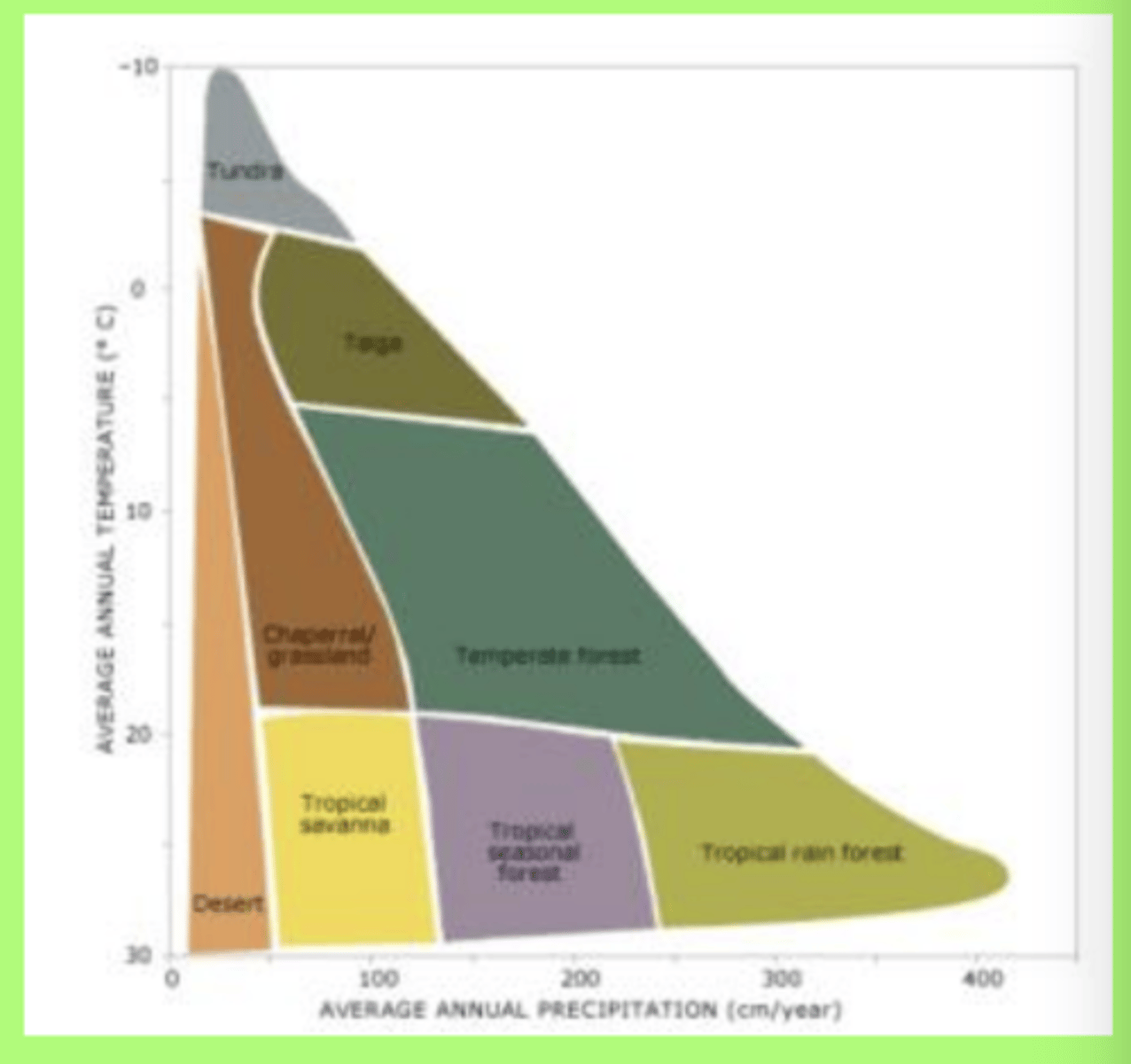
Biomes can be plotted by: _____ and ______
precipitation and temperature
Global factors that influence climate (3)
1. Solar radiation: the equator gets more solar energy than poles, therefore warmer avg temps
2. Air circulation: Warm wet air rising from the equator drives high ppt in the tropics vs subtropical deserts
3. Seasonality: Different hemispheres are tilted towards the sun at different times of year, giving different seasons.
Rainforests
near the equator have higher solar radiation (warm), are wetter, and less seasonal
Deserts
tend to be at 20ºC (North and South) and are drier but still (mostly) warm
Temperate Forests
more seasonal, often deciduous, ppt is highly influenced by topography
Major Biomes (graphic)
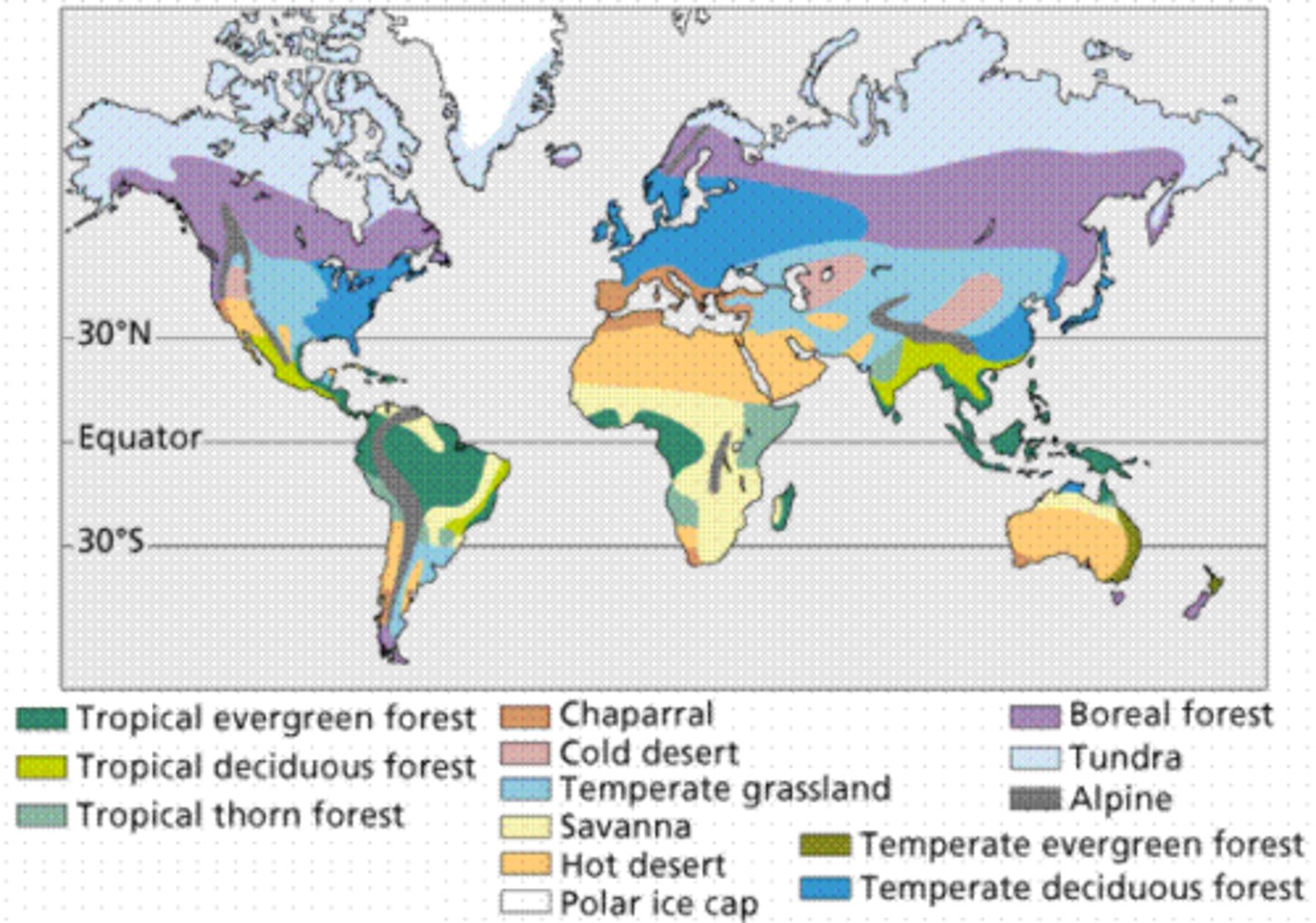
By latitude, (top to bottom) trends
tundra
↓
deciduous
↓
desert
↓
tropical
Regional factors to biomes (2)
1. Mountain Rain Shadows: rain on one side of mountain shadows other side of mountain, preventing lush flora and fauna growth. (Ex. rainforest on one side, prairies on other)
2. Ocean Currents: Gyre formations circle warm and cold water. controls the distribution of heat, nutrients, and marine life.
Longitudinal trends (left to right)
Wetter environments (rainforests) tend to be on the west side of continents due to the jet stream and the rainshadow effect
rainforest ---> temperate forest --> desert --> temperate grassland --> deciduous forest
temperature vs ppt (graph)
Importance of ocean currents (2 examples)
- cool water & air flows south from arctic = SoCal is dry shrubland
- warm water & air flows north from equator = floria is rainforest
**BIG IMPACT ON AIR FLOW
Arctic Tundra biome
Cold temperatures, low precipitation, long, dark winters. Permafrost (frozen soil) present and no trees, only lichen and low plants. Largely located south of the arctic ice cap, low productivity and biodiversity.
temperate coniferous forest biome
Found in temperate regions with warm summers, mild winters, and enough rainfall to support forests. Located in costal areas, many conifers, understory of shrubs and ferns.
Productivity
a high rate of Net Primary Productivity (NPP), which is the speed at which photosynthetic organisms (like plants and algae) produce organic matter (biomass) after accounting for their own respiration needs. In simpler terms, it is the rapid accumulation of new living plant material, providing a large energetic base to support high biodiversity, complex food webs, and ecosystem resilience
Desert and dry shrubland biome
30º latitude north and south, extreme temperatures, low/no ppt, very low productivity, cacti-predominant, , very hot.
Aquatic Biomes are characterized by what four things?
1. Salinity: rivers meet ocean to form brackish (saltyish) water
2. Depth: freshwater marshes are shallow (all water recieves sun), Bethnic zone of ocean recieves no light
3, Water flow: lakes have little movement, ocean tides and waves move nutrients and air flow.
4. Nutrients: streams nutrient poor at origin and rich at endpoints. Coastal runoff and ocean upwelling can move nutrients
bethnic zone
bottom of the ocean, no light
limnetic zone
In a lake, the well-lit, open surface waters farther from shore, photosynthesis of aquatic plants occurs.
Freshwater Wetlands biome
Areas where the soil is saturated or covered with freshwater for at least part of the year (marshes, swamps, and bogs). Very shallow; usually enough to support emergent vegetation (plants rooted in soil but poking out of the water). High sun availability. Very slow to stagnant water. Extremely high nutrients; wetlands are among the most productive ecosystems on Earth and act as natural filters.
Organisms: Hydrophytes (water-loving plants like cypress trees or peat moss), dragonflies, herons, alligators, and many amphibians.
Estuaries Biome
Description: A partially enclosed coastal area where freshwater from rivers meets and mixes with saltwater from the ocean (brackish water).
Water Depth: Relatively shallow, often featuring salt marshes or mangrove forests.
Sunlight: High; shallow depths allow sunlight to reach the bottom, fueling massive plant growth.
Water Flow: Highly dynamic; influenced by both river discharge and daily tidal cycles.
Nutrients: Very high; "the nursery of the sea" due to the constant influx of nutrients from the river and ocean.
Organisms: Mangroves, sea grasses, crabs, shrimp, oysters, and many juvenile fish species.
Oceans Biome
Description: The largest marine biome, covering about 70% of Earth's surface and containing high salinity.
Water Depth: Average depth is about 3,700 meters, reaching nearly 11,000 meters in trenches (Challenger Deep).
Sunlight: Only the top 200m (euphotic zone) receives enough light for photosynthesis; the vast majority is in total darkness.
Water Flow: Driven by global currents, tides, and upwelling.
Nutrients: Generally lower in the open ocean (pelagic), but very high in coastal upwelling zones and coral reefs.
Organisms: Whale, sharks, tuna, phytoplankton (producers), coral, deep-sea anglerfish, and giant squid.
Organismal ecology
The branch of ecology concerned with the morphological, physiological, and behavioral ways in which individual organisms meet the challenges posed by their biotic and abiotic environments.
behavioral ecology
a branch of organismal ecology. The study of behavioural adaptations that have evolved in response to ecological selection pressures
Proximate cause of behaviours
how the behaviour works, the biological mechanisms that lead to the behaviour
ultimate cause of behaviour
Why does the behaviour exist? the evolutionary benefit to survival or reproduction
innate behavior
a behavior that is inherited rather than learned (low variation, can be adaptive)
learned behavior
a behavior that has been learned from experience or observation (high variation, can be adaptive)
how can innate behavior be adaptive?
because it occurs in individuals without training
how can learned behavior be adaptive?
because it is flexible in response to changing environment
reflex (innate or learned? explain)
[INNATE] involuntary response to stimulus (eg. detecting light --> triggering motion)
SIMPLE ACTION
fixed action pattern (innate or learned? explain)
[INNATE] a sequence of unlearned acts completed once started (eg. spiders spinning a web)
COMPLEX SEQUENCE OF ACTIONS
foraging tactic/tool use (innate or learned? explain)
[LEARNED] observes other performing behavior, utilizes trial and error to master skill
cultural/social transmission (innate or learned? explain)
[LEARNED] copying behavior, trial and error
Habituation/conditioning (innate or learned? explain)
[LEARNED]
tendency of the brain to stop attending to constant, unchanging information
the process of learning associations
choice
unconcious, results from a combination of varying stimuli and neural/endocrine responses
tradeoffs of learned behaviors
increased time spent on anything costs energy, increases predation risk, etc.
do individuals vary for most behaviors?
yes. variation in heritable behaviors is acted on by nat selection
types of behaviors (4)
- foraging decisions
- mate choice
- communication
- location
Optimal foraging (what? 3 strategies?)
maximize benefit (usable food), minimize cost (effort, learning, risk of predation)
srats:
1.traplining: visit food sources in a repeatable sequence to reduce travel time. requires exploration/learning time
2. Directional: roots grow towards nutrient-rich patches of soil; plants grow toward sun. (phenotypic plasticity)
3. Decentralized: make many paths to create efficient transport networks. quantity over quality.
evolutionary game theory
tells us those with best fit to environment will survive and pass on to offspring and those genes will become more common in successive generations. cant all be good at everything, balance creates 'game' or competition
individual foraging decisions (3)
1. producers vs scroungers (finding food vs stealing it)
2. group vs solo (↑ access and abundance, ↑ competition)
3. prey preferences (choose diff' prey that others ↓ direct competition)
Mate Choice influences (3)
**SEXUAL SELECTION! traits that ↑ ability to compete for mates or choose good mates
1. quantity/quality of resource (territory guarding)
2. parental care mate can contribute (choosyness)
3. how many mates available? (less choosy if less avail)
Habitat selection (biotic/abiotic factors) (3)
1. individuals present (competition ↑ with density ↑)
2. environmental conditions (must match phenotype)
3. other organisms present (pred/mutualists/ecosys engineers)
organism dispersal (what? 2 types?)
type of habitat behavior, movement of indiv from place of origin to new location (ONE WAY). 2 types:
1. Active dispersal: behavioral decision making, done by organisms own accord
2. Passive dispersal: rnon descision making, other factor moves organism.
Organism migration (what? 3 processes used?)
type of seasonal habitat behavior, movement of large numbers. (TWO WAY)
1. piloting (using familiar landmarks & smell)
2. Compass orientation (movement occurs in specific direction e.g uses sun)
3. True Navigation (ability to locate a specific place on earth e.g magnetic field)
Communication behaviors (what? 5 types?)
signal from one individ modifies the behavior of another.
- auditory (vocalizations/vibrations)
- visual (color/posture/movement)
- chemical (odours/pheromones)
- tactile (touch/physical contact)
- other (electricity, temp, etc.)
Communication: honesty vs deceit
- honesty is favoured by natural selection
- deception can evolve within species if it is UNcommon (if common, no longer deceiet)
- Deceitful communication BETWEEN SPECIES is common (play dead, mimics call or body plan or hormone)
Direct vs Indirect contributions to fitness
Direct: contributes to survival & reprod success of ones own offspring
indirect (kin selection): contributes to the survival/reprod success of close relatives W SHARED GENES
ex) By warning their relatives (offspring, siblings, parents) of danger, the caller ensures that genes they share—copies of their own genes—are passed on, even if the caller itself is killed.
**EXPLAINS ALTRUISM: ↑ fitness of others, ↓ own.
kin selection (3 requirements)
1. individuals w/i pop vary in behavior
2. behavior is heritable
3. particular behavior enhances the reproductive success of kin even at some cost to individ.
hamilton's rule must also be met (circumstance)
**does not require conscious understanding of relationships.
Hamiltons rule
when C < r x B
C = cost to the altruistic party (more likely if LOW)
r = genetic relatedness (more likely if HIGH)
B = fitness benefit to recipient of altuism (more likely if HIGH)
coefficient of relatedness (r) in Hamilton's rule
- Ranges from 0 (unrelated) to 1 (gen. identical)
- Parents and Offspring = 50% chance of sharing an allele w e/o (r=0.5)
- Half Siblings = 50% chance each sibling will inherit elelle (r=0.25)
**many meiotic events? MULTIPLY probabilities
**shared alleles inherited from both parents? ADD probabilities
In social species with memory, helping others is selected when... (hamiltons rule equation)
B(recipient) > C(donor)
& helo is reciprocated later
explain altruism in relation to evolutionary game theory
Altruism seems like it shouldn't exist because it costs the individual, but evolutionary game theory shows that in the "long game" of evolution, helping others can actually help your genes survive, whether that's through relatives, repeated interactions, or social advantages. So what looks selfless on the surface can still be evolutionarily smart.
selfish behaviors disguised as altruism (2)
1. cooperation
2. Mutualism
Community Ecology
How species interact with each other
- multiple interacting populations in the area
- Communities of similar organisms vary across landscapes
- must consider interactions among pairs of species first.
Competition (intraspecific vs interspecific)
Intra: Competition between members of the same species (DENSITY DEPENDENT)
Inter: Competition between members of different species (same LIMITING RESOURCE)
Competitive exclusion principle
Two species competing for the same limiting resources cannot coexist
Niche overlap vs no overlap
overlap = competition
no overlap = coexistence
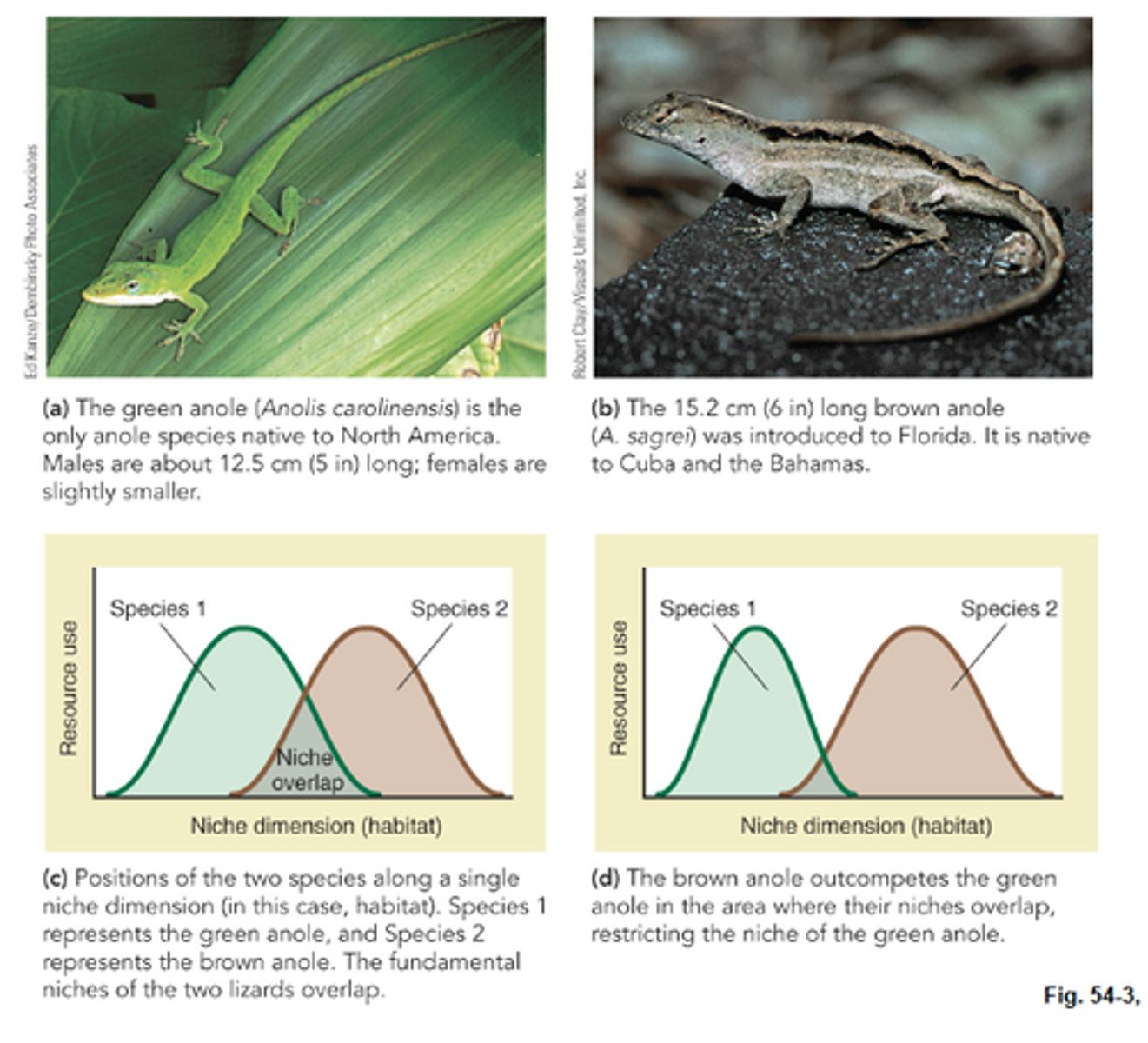
Asymmetric Competition vs Symmetric Competition
Asymmetric = I winner, One loser in the shared niche
Symmetric = both species end up with same fitness level in shared niche.
Niche differentiation
Natural selection favours individuals that do not compete (no niche overlap)
Character displacement = when traits evolve during niche differentiation (darwins finches evolving different beaks)
Adaptive Radiation vs Character Displacement
Radiation leads to displacement: As a radiation proceeds, new species often come into contact (sympatry), leading to competition, which induces character displacement.
Displacement enables radiation: By reducing competition through character displacement, species can coexist, allowing for further ecological diversification.
Realized niche vs fundamental niche
Fundamental niche: The range of resources a species could theoretically use, if they were not constrained in any way
Realized niche: The range of resources a species actually uses, because they are constrained by other factors like competition
consumption
1 species fitness increases at the expense of another (eating it)
- predation (carnivores and seed predators)
- Herbivory (plants only)
- Parasitism (nonfatal)
When is prey defended? (2 types of defence)
Constitutive: defence is always present
Inducible: defence is produced after exposure to consumers (SAVES ENERGY)
How is Prey Defended? (4 types)
Mechanical (thirns/spikes/shells)
Chemical (toxins/smells/letex)
Behavioral
(schooling in birds/fish, sounds, escape types, etc.)
Appearance (camo, warning colors. mimicry)
Mimicry types (2)
Mullerian: 2+ harmful inedible species resemble one another
Batesian: harmless or edible species resembles an inedible one
Mutualisms (3 types)
(+/+)
1. Transport (pollen & seed transport)
2. Nutritional (mycorrhizal fungi, e. coli, root nodules)
3. Protection (cleaner fish, etc)
Reciprocal Parasitism
Mutualisms with cheaters
Mutualism Categories
1. Obligate
2. Facultative: either species persists
Commensalism
(+/0)
- difficult to quantify
coevolution
- When interacting species influence each others adaptations
- Strong interactions can lead to an arms race, where a series of adaptations and counter-adaptations evolve
- ex) pred-prey, plant-pollinator
Trophic Levels
Secondary Consumers - consume other organisms
Primary Consumers - herbivores, consumer primary producers
Primary Producers - harvest energy from sun to produce organic molecs
Food webs
A complex diagram representing the many energy pathways in an ecosystem. Arrows from consumed to consumer.
Trophic Cascade
A series of changes in the abundance of species in a food web, usually from the loss of a top predator
Keystone species
a species with a disproportionate impact on a community, relative to their abundance
ecosystem engineers
Beavers or Tortoises that create ecosystems for other organisms (big trophic cascade if overhunted)
Succession
the process of community assembly, the gradual, directional change in composition and structure of terrestrial communities
1º - disturbance removes both soil and organisms (lava flow, fire)
2º - Disturbance removes organisms, but soil intact (storms). Pioneering species are first to reappear, climax community is long lived species (dominate mature ecosystem).
Succession and species interactions (3 types)
1. Facilitation: early arriving species make environment more favourable for later species
2. Inhibition: early arriving species make environment less favourable for later species.
3. Tolerance. Species do not impact each other
**shade/light availability example on lab exam!
Succession Trends
- diversity increases
- Physical structure become more complex
- Final species composition due to abiotic conditions (climate, soil, etc) biotic interactions and limits (dispersal, competition, etc) and chance events (arrival order)
Biological control (biocontrol)
Use of one species to reduce an invasive one using consumer-prey interactions.
Population ecology
groups of individuals of the same species and the factors affecting their pop. size and dist'
**pop. meaning sharing of same resources, envint'al factirs, etc.
2 types of pop. ecology
1. spatial attributes (size/range/dispersion)
2. Temporal attributes (demography/life history/pop.dynamics)
Spatial Attributes: Population size (4)
- Abundance (# indiv.)
- density (indiv./area or vol)
- coverage (% area occupied by pop.)
Can be described as absolute (actual, UNCOMMON) or relative (a comparison)
Ways to estimate population size
Sessile organisms (immobile): use quadrats or transects
vs
Mobile Organisms: use pop. indices or mark-recapture