positioning midterm
 Call Kai
 Learn
 Practice Test
 Spaced Repetition
 Match
 Flashcards
 Knowt Play
1/195

There's no tags or description
Looks like no tags are added yet.
Name | Mastery | Learn | Test | Matching | Spaced | Call with Kai | Chat |
|---|
No analytics yet
Send a link to your students to track their progress
196 Terms
two main methods for contrast administration (routes)
-gastrointestinal (oral, enteral)
-intravascular (injection, parenteral)
what are two other methods of contrast administration that are less used?
-intraarticular (injection into a joint space)
-intrathecal (injection around spinal cord, for myelography)
this type of contrast adds density, increases attenuation of the beam. examples are barium, iodinated water soluble contrast
positive agents
this type of contrast decreases density. less attenuation of the beam. examples are air, fizzies
negative agent
two types of iodinated contrast used for injection (not the brand names)
-iodinated non-ionic contrast
-iodinated ionic contrast
this type of iodinate contrast dissociates into two ions. benzene ring bond breaks. this was lower cost and used more often in the past. But it had higher chance of reaction due to osmosis, and greater risk of toxicity to cells)
iodinated ionic contrast
atomic number of iodine
53
this iodinated contrast is the one used today. it is hydrophilic (water-soluble) and is easy for IV injection and is safer. caution must still be used though.
iodinated non-ionic contrast
in CT tissues need a difference of about ____ HU to be visibly different
10 HU. (contrast can change it about 40-75)
in CT dose usually about ___, ____, ____ cc depending on machine etc
60,100,150 (not sure what she meant by this but it was in slides)
number of particles in a solution per unit liquid as compared with blood
osmolality
this type of liquid has about the same number of particles in the solution as per unit as blood
Isotonic
this liquid has more particles in the solution per unit than blood
hypertonic/hyperosmolar
contrast can have up to ___ times the number of particles in solution per unit blood
7
these type of agents have about 7 times the number of particles as blood
high osmolality agents
these type of agents have about 2 times as many particles as blood
low osmolality agents
low osmolality agents are used with patients who have _____ impairment.
kidney impairment (high BUN/creatinine) maybe one kidney
this is the thickness or the friction of a substance as it flows.
viscosity
contrast is a ____agent. warming it is very important for IV contrast it makes it easier to push and less likely to cause a complication at injection site.
viscous
atomic number of barium
56
barium made for x-ray and CT is not the same. X-ray barium would cause streaks in CT. CT is about ___-___ % barium. x-ray is about ____-____% x-ray is more dense.
1-3% and 96-98% for x-ray
reasons barium should not be given? (contraindications)
-dont give to r/o appendicitis
-if chance of perforation (recent colonoscopy, bariatric surgery)
-pt has diverticulitis, diverticulosis.
-recent abdominal surgery especially to bowel
this is when barium leaks into the peritoneal cavity it is associated with significant mortality rate
barium peritonitis
barium reactions are unlikely, but it is possible since it contains sulfa. chances are ___-_______ patient more likely to react to additive used for flavor.
1-500,000
iodinated water soluble contrast can be diluted and use orally. but it can stimulate ____ and cause diarrhea and cramping. this also travels faster through GI tract than barium
peristalsis
high and low osmolality contrast are still always _____ compared to the blood
hypertonic
high osmolar agents are _____ meaning they dissociate into two ions.
ionic
what happens when hypertonic solution (high or low contrast) is injected
body strives for homeostasis. water in the tissues moves to the blood vessels via osmosis. this is to create balance. (the shift is what they think causes reactions)
three predisposing factors for contrast reaction (in order of most likely to least)
1 prior reaction to contrast
2 asthma
3 severe allergies to other substances
two categories of contrast reactions
chemotoxic
idiosyncratic
this category of contrast reaction has to do with speed and dose of injection and the chemical makeup of the contrast. hemodynamic injuries, and nephropathy are examples.
chemotoxic
category of contrast reaction. this is unpredictable and is not related to dose. qualified as “allergy” but unlike an allergy antibodies are not released. so it is an allergic like reaction.
idiosyncratic
this is a type of vasogenic shock. due to severe allergic reaction caused by release of histamine in the body in response to foreign substances and a severe drop in blood pressure.
anaphylactic shock
this drug is a bronchodilator. used when patient is SOB, wheezing, have chest tightness, asthma.
Albuterol (pro-air, preventil, ventolin)
this drug is an anticonvulsant given when patient is having seizures.
Diazepam (Valium)
this drug is a vasoconstrictor and can be given when patient has hypotension.
Dopamine
this drug is an antihistamine. it can be given for hives, rash, itching
diphenhydramine (benadryl)
this is a vasoconstrictor. given when pt has bronchospasm, facial edema, severe urticaria, laryngospasm, peripheral vascular collapse.
Epinephrine (epi-pen)
this is a diuretic. given when patient has hypertension emergency, pulmonary edema, heart failure
Lasix (furosemide)
this is a vasodilator. used for hypertension, angina, arterial spasm
nitroglycerin
this is an antiinflammatory. it is preventative used for shock, and anaphylaxis
methylprednisone, solumedrol
some analgesics
morphine, demerol, tylenol
some antianxiety meds
ativan, valium, xanax
some anticoagulants
heparin, coumadin (warfarin)
antihypertensive medication
lopressor
some antiinflammatory medications
motrin, ibuprofen
antiulcer medication
zantac
this can treat cardiac arrhythmias. aids defibrillation
lidocaine (xylocaine)
this is an antiemetic
compazine
this is a laxative
dulcolax
this type of reaction involves limitied urticaria, sneezing, rash, transient nausea and emesis. headache vertigo. minor tachy or bradycardia. if they continue sneezing a lot it may be worse.
mild reaction to contrast
this reaction has tachycardia bradycardia and pt may have a weak pulse that may be rapid. mild hypotension. and wheezing. major cutaneous reaction and hives that do not respond to initial treatment.
moderate reaction to contrast
this reaction may involve convulsions, seizures, profound hypotension or total loss of blood pressure. pulmonary edema, epiglottal edema, cardiopulmonary arrest. pulmonary arrest
severe contrast reaction
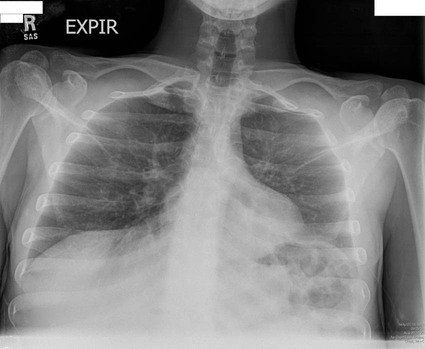
when doing a mobile chest x-ray if it comes out looking like this what went wrong
clavicles are above the apices. the patient may have been lordotic or the tube may have been angled more cephalic

when doing a chest x-ray and the patient is kyphotic (c-shaped) what should you not do with your angle?
don’t angle caudally. it will just make the distortion worse.
if you angle caudally too much when doing a portable chest x-ray what might happen?
distortion. clavicles look like handlebars and are farther down.
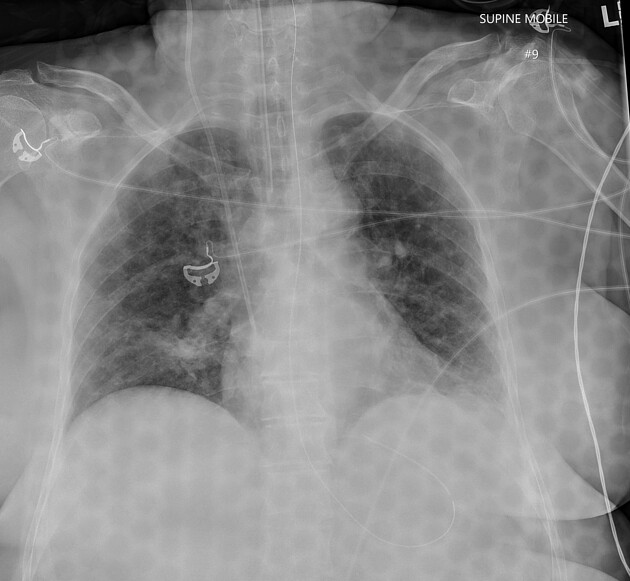
what causes this artifact
heating blanket. make sure to remove things that can cause artifact in mobile (within reason)
where is mobile radiography commonly performed
neonatal unit, patients room, emergency department, ICU, surgery, recovery rooms.
what is a major technical factor you need to consider with mobile radiography?
your time. Mobile has kVp and mAs settings but mAs automatically sets the mA and time to preset values. So if you use a grid and need more mAs for example you need to think about how time is also going to increase, and this could lead to patient motion.
it depends on the manufacturer but mAs in mobile ranges from ___ to ____
.04 to 320 mAs
depends on manufacturer but kVp in mobile units ranges from ___ to ____
40 to 130 kVp
technical considerations for mobile radiography
grid
anode heel effect
SID
(mAs too)
what are some issues you may run into when using a grid during mobile
for a grid to work it needs to have the central ray centered, it must be level, and it must be at the right focal distance (radius). when placed under a patient on a mattress the grid may be “off level.” also must make sure you are the correct distance.
if the central ray is ___ to ____ inches off the midline of a grid it can cause cutoff
1-1.5 inches
in this grid error the lateral margins of the image have less density.
off focus grid error
grids with _____ grid ratio have a wider focal range, but they also are less efficient at cleaning up scatter
less
what two grid ratios are commonly used in mobile radiography
6:1 and 8:1 (focal range is 36 to 44 inches)
this is software that estimates scatter radiation and provides scatter correction without use of a standard grid.
virtual grid
when is the anode heel effect more noticeable
-short SID
-large field size
-small anode angle
short SID and larger field sizes are common in mobile radiography. try to position tube to take advantage of anode heel.
where should the cathode be in chest x-ray mobile
at the diaphragm
where should cathode be in decubitus chest mobile image
at the downside of the chest
in mobile abdomen where should cathode be
at diaphragm.
in decubitus abdomen mobile imaging where should cathode be
it should be toward downside of abdomen
in mobile pelvis imaging where should cathode be
upper pelvis
where should cathode be for mobile lateral and ap femur
at proximal femur
in mobile lateral c-spine where should cathode be
over the lower vertebrae. (40 in SID only)
in mobile radiography the SID should be ____ inches for most mobile exams. if you use a longer SID requires more mAs which would lead to a longer exposure time.
40 inches.
what are some things that should be available on the mobile radiography unit
calipers, shield, technique chart
covers, tape, sponges, markers, grid
what is the recommended minimal distance for a radiographer in mobile
6 feet and try to stand 90 degrees to the primary beam and object being radiographed
most effective means of protection for radiographer in mobile imaging
distance
safety tips for mobile radiography
shields for radiographer and patient, or those who are nearby and can not leave. distance. inform those around that an exposure is going to be taking place.
SSD can not be less than ____ inches
12 inches
this is isolation used to protect the patient from receiving microorganisms.
reverse isolation
some PPE you may wear in isolation when doing mobile radiography
gloves, mask, eyewear, shoe covers, gown. (strict isolation you need mask, gown, and gloves if patient has drainage)
what type of cover should be on the IR in isolation
a clean impermeable one. pillowcases do not work. they can have the body fluid soak through.
when positioning for mobile radiography (especially when pt is in a traction device etc) what is important? (when it comes to moving etc)
moving the IR and the tube around the part as opposed to moving the patient.
when doing a portable chest what position do you want to have the patient in if possible
as upright as possible. the greatest angle they can tolerate. supine can be done if patient is critically ill or injured
top of IR in mobile chest x-rays should be about ___ inches above the relaxed shoulders
2 inches. (if supine shoulder may be higher)
what can you do with patients arms to prevent scapulae in lung field for mobile chest
internally rotate their arms
central ray for mobile chest
enters 3 inches below the jugular notch. (t7)
for an ap chest x-ray with patient in lateral decubitus they should be elevated ___ to __ inches via a fim support
2-3 inches
how long should patient be in decubitus position to asses for fluid or air
five minutes (for chest you want to see affected side upper lung for air and lower for fluid)
centering for ap decubitus abdomen (according to book)
book says 2 inches above crest and that pubic symphysis and bladder do not need to be seen since this is for air fluid levels
for ap abdomen projection in lateral decubitus what side do you want the patient on
left side. so as not to confuse gastric bubble as free air
which is preferred for mobile femur projection lateromedial or mediolateral
mediolateral since more of the proximal femur is visualized.
for lateral c-spine x table mobile top of IR should be ___ in above EAM. so you are centered to ____
1 inch. so you are at C4
steps to the speak up initiative (surgical avoiding wrong site, wrong patient)
-pre procedure verification
-surgical site marking
-time out right before starting procedure
this takes place in the operating room right before the procedure. include document review like looking at medical records or notes, diagnostic images, need for antibiotics, and other essential med needs and allergies
all activities stop anyone who believes there is wrong info must speak up.
time out
who calls time out usually
circulating nurse
20-30 percent of this occurs from errors occurring even before patient is admitted. can be from inaccurate chart notes, mislabeled x-ray image, mix up of patients with similar names. etc
wrong site, wrong patient procedure