Biotech exam 2
 Call Kai
 Learn
 Practice Test
 Spaced Repetition
 Match
 Flashcards
 Knowt Play
1/62

Earn XP
Description and Tags
lets do this shittt
63 Terms
Chromatin architecture serves as a control for which form of gene expression
transcriptional
How does chromatin architecture serve as the primary physical gatekeeper for gene editng machinery
High chromatin condensation decreases the specificity of engineered nucleases
Repair outcomes (Nhej vs HR) depend on the local nucleosome density and 3D genomic organization
What does 1 NUCLEOSOME consist of
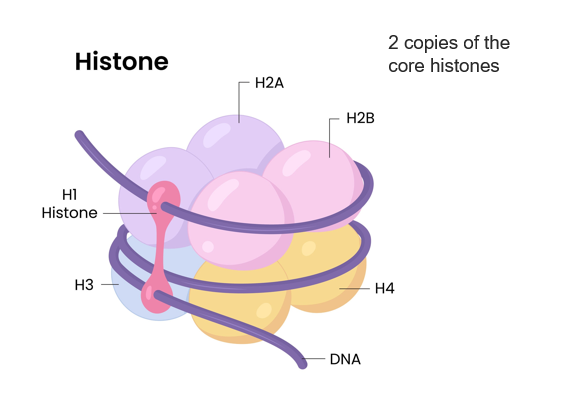
1 nucleosome consists of a histone octamer with 146 Bp DNA tightly wrapped around it
What is the order of DNA packing
Nucleosome → chromatin → chromosomes
chromatin is many nucleosomes, while a chromosome is many chromatin
List the histones that make up the histone core and their functions
H1 - pulls the nucleosome together keeping it highly compact
H2A
H2B
H3
H4
H2A through H4 form chemical bonds with DNA to form compact nucleosomes
How many nucleotide pairs of DNA is associated with one nucleosome
146 Bp are wrapped around the core histones, while linker DNA strands bring the total Bp number to around 200
What charge interactions stabilize DNA and histone binding
negatively charged DNA creates tight bonds with the positive Lys and Arg groups on the surface of histone proteins. If DNA is tightly bound to the + charged histone residues, any genes present cannot be expressed
What is a histone
Histones are highly conserved, small, basic proteins
What is HISTONE acetylation
histone acetylation is a reversible modification of lysine residues in the N terminal of the core histones
this modification reduces binding to DNA and destabilized the chromatin structure, leaving DNA open for gene expression
Any mutated genes bound tightly to histones are NOT accessible for expression
How do histone proteins affect transcription
For transcription and/or replication to occur, chromatin must unwind to expose the template DNA needed for these processes to begin. Post translational modifications of histone tails determine chromatin condensation and therefore DNA accessibility
What is euchromatin
a not highly condensed region of chromatin, it is transcriptionally active
What is heterochromatin
a highly condensed region of chromatin that is transcriptionally silent
How does the + charge of lys interact with the - charge of DNA
Under normal cellular conditions, the + charge of lys interacts favorably with the - charge of DNA. The ACETYLATION of lysine will NEUTRALIZE the + charge of lys, and loosen the +/- binding, opening DNA for transcription/ RNA poly and TF binding
If a histone is acetylation, is transcription active or repressed
Active, because the + charge is neutralized and DNA can unwind from the histone core
If a histone is deacetylated, is transcription active or repressed
Repressed, as the + charge of lys interacts favorably with the - charge of DNA
What are the possible post translational modifications of the histone tails
Acetylation
Methylation
Phosphorylation
Ubiquitination
What enzyme transfers acetyl groups to Lysine to induce DNA transcription
histone acetyltransferases (HATS)
What enzyme removes acetyl groups from histones to repress DNA transcription
Histone Deacetylases (HDs)

What are the three proposed mechanisms of transcriptional repression mediated by cytosine methylation
Direct interference with transcription activator factor binding. TF factors cannot bind to highly methylated regions of DNA
Transcriptional repressors which bind to highly methylated regions, preventing TF and Poly 2 from binding
Inactive chromatin structure, where TF cannot access DNA
What is the significance of Heterochromatin in gene editing
Densely packed heterochromatin inhibits Cas9, ZFN, and TALEN binding and cleaving
What is the significance of Euchromatin in gene editing
Open chromatic regions are characterized by histone acetylation and DNA HYPOmethlation, these regions allow cas9, ZFN, and TALEN to easily bind to and cleave DNA
How does rotational and translational positioning affect Nuclease accessibility
DNA facing outward on the nucleosome surface may remain partially accessible to guide RNA search mechanisms, while DNA facing inwards toward the histone core is inaccessible
How does the local chromatin environment regulate how an introduced DSB is repaired
Heterochromatin favors NHEJ (which causes off site mutations), as the compact structure limits restriction enzyme access, delaying repairs and promoting error prone joining
Euchromatin favors HDR, as these regions are accessible to polymerase which promote precise template directed repair
How does nucleosome density regulate how introduced DSB are repaired
nucleosome positioning dictates the the exact boundaries of deletions, favoring INDELS
What is epigenome editing
The alteration of gene expression without making primary changed to the DNA. Instead of cutting or mutating the genetic code, epigenome editors add or remove chemical tags on DNA or histone proteins to turn genes on/off
What are the key differences between engineered nuclease (crispr, talens, zfn) vs an epigenome editor
An engineered nuclease introduced DSB or base changes which permanently alter their target DNA sequence through deletions, insertions, or rearrangements with a high risk of off target deletions or insertions. Epigenome editing on the otherhand modifies chromatin structure via methylation/acetylation, leaving the DNA sequence unchanged and a potentially reversable affect across cell divisions
What are the two core components of an epigenome editor
The targeting molecule (DNA binding protein) which retains its ability to bind to a specific target sequence guided by gRNA, but lacks endonuclease activity
Ex: dCas9, ZFPs, TALEs
Effector Module (an epigenetic modifier) which adds or removes acetyl/methyl groups from local chromatin
Ex: histone acetyltranferase to upregulate gene transcription OR a histone methyltransferase to silence transcription
Explain how Nucleases sensitivity to salt is useful to DNA analysis
To dissociate DNA from its histone core, nuclease will first digest any linker DNA in the sample, releasing just the nucleosome core particle. Then, high salt concentrations will break the octameric histone core into its subunits, releasing DNA into the solution.
High salt concentrations encourage DNA dissociation
Low salt concentrations encourage DNA binding
What is the significance of Micrococcal Nuclease (MNase)
MNase can induce DSB within nucleosome linker regions, but only single stranded nicks within the nucleosome itself. Because of this, Mnase can be used ot determine whether aDNA fragment of interest is within a nucleosome
Describe Ubiquitination
Ubiquitination involves one or more covalent additions of ubiquitin (protein) to the lysine residues of target proteins. This post translational modification is reversible, and is involved in the regulation of membrane trafficking and protein degradation
Describe the BRCA1-BARD1 tumor suppressor (protein) and its relation to DNA repair
The BRCA1-BARD1 tumor suppressor is an E3 ubiquitin ligase necessary for the repair of DSB by HR. Repression of these genes and their translated proteins prevents HR DNA repair and favors NHEJ/Cancerous mutations
What is Homologous recombination
HR is a biological process where nucleotide sequences are exchanged between two homologous molecules of DNA. It is known for its role in repairing broken DNA and shuffling genetic material

What are the three key steps of HR
Strand Exchange - occurs when a helper protein (Rad51) is used by an “invading” single strand to “attack” its matching DS DNA molecule (usually a sister chromatid)
D loop Formation - strand migration results in D loop formation, where an invading strand pairs with its complementary match on the sister chromatid. The cell then uses the sisterchromatid as a template to synthesize and rebuild the missing genetic sequence
Resolution - DNA strands are untangled and sealed, leaving a perfectly repaired DNA molecule
What is the significance of HR and genome editing
Error Free DNA repair - HR relies on an undamaged template to fix harmful DSB without mutation or loss of information
Driving Genetic Diversity - During meiosis HR cuts and swaps segments between maternal and paternal chromosomes, resulting in crossing over making sure that no two gametes are identical, providing genetic variation
Proper chromosome segregation
Guarding against Cancer - HR acts as a tumor-suppressing mechanism
Gene Editing - HR can be used for gene targeting by introducing custom DNA fragments flanked by sequences that match a specific target, this is used to trick a cells HR machinery into swapping out a target gene for a new one

Define Genome editing
a type of genetic engineering in which DNA is inserted, replaced, or removed using artificially engineered nucleases that create specific DSB and harness the cells mechanisms to repair the induced break by HR or NHEJ
What are the key differences between HR and NHEJ
HR is an error free mechanism that required an undamaged DNA template to fix a DSB. This is only active during S and G2, and is a slow complex process.
NHEJ is error prone and results in INDELS. No template is required, and it is a rapid response available throughout the entire cell cycle.
Describe the BRCA1 and BRCA2 pathway
Double stranded break occurs
BRCA 1 activates signals to pause the cell cycle
BRCA2 Loads strand exchange helper proteins (RAD51) to exposed ss DNA (step 1 of HR)
HR repair takes place as a flawless template directed fix
A mutation in BRCA1 or BRCA2 inhibits signaling pathways necessary for HR to take place
What occurs when a person inherits a mutation in BRCA1 and/or BRCA2
The HR pathway fails due to a lack of BRCA proteins/signaling
NHEJ is favored since HR cannot take place, leading to a build up of mutations and deletions of vital genes
These accumulated mutations result in genetic instability, accelerating the rate at which a cell can mutate, quickly transforming healthy tissue into aggressive cancers.
What is the result of chromosome duplication
Unbalanced gene dosage causing developmental abnormalities
What is the result of chromosome deletions
Possible total loss of gene functions
What are chromosomal fragile sites
GC rich regions of chromosomes are often poorly connected to the rest of the chromosome, putting the region at risk of a break and an extreeme loss of genetic material. A loss of this genetic material during development may result in decreased mental capacity

What are Zinc Finger Nucleases
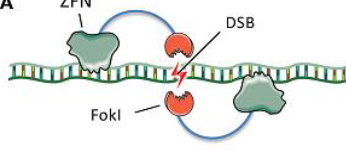
ZFNs were the first programmable nuclease that can facilitate targeting editing of the genome through DSB at specific sites
What was the first human study involving ZFN
The first human ZFN study focused on mutating the CCR5 receptor located on T cells, inhibiting HIV from binding to and infecting T cells
What are the two domains of ZFN
The DNA binding domain (Zinc Finger Protein) - The left and right handed domains recognize DNA sequences on both sides of the helix, both domains must bind to the molecule for cleaving to occur
The DNA cleaving domain (Fok1) - Fok1 is a nonspecific nuclease, responsible for forming a dimer that cuts 7 bp of DNA at a time. This domain is nonspecific without the DNA binding domain
Describe the ZFN pathway and possible outcomes
The amount of donor sequence incorporated will decline with distance from the original break
NHEJ mutations at the cleavage site are more localized

What is the significance of having both the DNA binding domain and the DNA cleaving domain
When the DNA binding and DNA cleaving domains are combined, they make a highly specific PAIR of genomic scissors
What are the two outcomes of gene manipulations
Targeted Mutagenesis
Targeted gene replacements - replacement of an existing sequence with one designed in the lab

What organism is used to as a model for ZFN and why
Yeast is the most common model organism for ZFN, as its cellular machinery favors HR (mammalian cells favor NHEJ). The use of yeast allows for rapid phenotypic screening, and its DSB repair machinery is similar to mammalian systems, making findings directly applicable
Describe ZFN mediated genome editing
ZFN pair is delivered into the cell through transfection or electroporation
ZFN pair recognizes and dimerize around the target DNA site
If no repair template was added to the system, 1-20% of cells are repaired using NHEJ resulting in deletions
OR
if a repair template was added to the system, 1-20% of cells will be repaired using HR, resulting in gene integration
Define Transfection
Transfection is the process of introducing EXOFENOUS nucleic acids into eukaryotic cells to study gene expression. Cells may be stably transfected or transiently transfected
What is the core principle of transfection
to break through the cell membrane to successfully deliver exogenous material into the cell
Describe transient transfection
DNA is introduced into the cell, but is NOT integrated and instead remains as an episome (DNA in cytoplasm). Transient transfection shows only temporary expression, as the introduced DNA is lost as the cell divides.
Describe stable transfection
DNA is permanently integrated into the host cells chromosome, allowing for long term permanent gene expression that is passed down to daughter cells. This may be used for drug discovery or the generation or permanent cell lines
List the three types of transfection
Calcium phosphate transfection
Electroporation
Liposome mediated

What is calcium phosphate transfection
Transfection via the precipitation of DNA and Calcium Phosphate. This method may be used for stable or transient infection
What is electroporation
Exposure of cell membranes to high intensity electric pules, causing temporary destabilization of the cell membrane which allows for the entry of exogenous molecules. This however may cause cell death
What is liposome mediated transfection
The use of liposome forming lipids to introduce RNA, DNA, or CRISPR/cas9 components to a cell. This method is usually cell type specific
Define transDUCTION
Transduction is virus mediated transfer of exogenous material. Commonly used viruses are AAV and lentivirus
What three things must be considered when selecting transfection reagents and protocols
Desired cell type
Rare cell types such as neurons, which are more difficult to transfect
cytotoxicity parameters, with low cytotoxicity with high transfection being favored
What is the significance of ZFN
Double-stranded breaks are used to create site-specific mutagenesis that stimulates the cell’s natural DNA repair processes, such as HR and NHEJ. These processes are used to precisely target DNA sites, resulting in cell lines with targeted deletions, integrations, and modifications
What are the benefits of ZFN
Rapid disruption of, or integration into, genomic loci
mutations are permanent
work in a variety of somatic cell types
can create knock out or knock in cell lines in as little as two months
What are the drawbacks of ZFN
Edits occur in only 1-20% of the cell population (CRISPR is 90%)
High cost of ZF DNA binding domain construction
Off target mutations occur in 1/10 cells